
The Skin of the Painting: Interview With Angel Otero
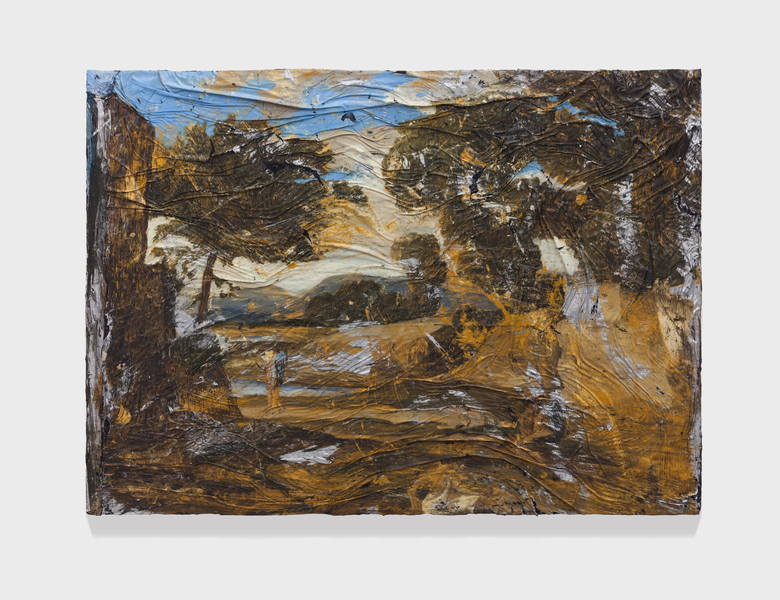
Angel Otero conceives painting as a material capable of recording its own becoming.
Born in Santurce, Puerto Rico, in 1981, and now working between Puerto Rico and New
York, he has developed a practice in which memory, art history, and material
transformation are deeply intertwined.
Since 2010, oil skins have been central to his practice: oil paint is applied to glass or
Plexiglas, allowed to partially dry, separated from the support, and transferred onto
canvas. The act of peeling becomes a constructive gesture. Each fragment retains
something of its previous state, while the surface records erasures, layers, and new
configurations.
This temporality also runs through Otero’s recent work. Domestic objects, photographs,
and furniture associated with family memory enter oceanic landscapes or images
suspended between figuration and abstraction. The sea assumes both a physical and
psychological presence: origin, distance, migration, return.
In Agua Salada, produced during a residency at Hauser & Wirth Somerset, water
becomes a condition through which memory, place, and belonging are explored. In The
Ocean Forgot Your Garden, at Newport Art Museum, this inquiry expands through the
relationship between Puerto Rico and Newport, two geographies connected by the
Atlantic and by histories of movement and passage.
In Otero’s work, painting preserves what the process transforms. The surface becomes
a material chronicle: a place where what has been removed continues to leave a trace.
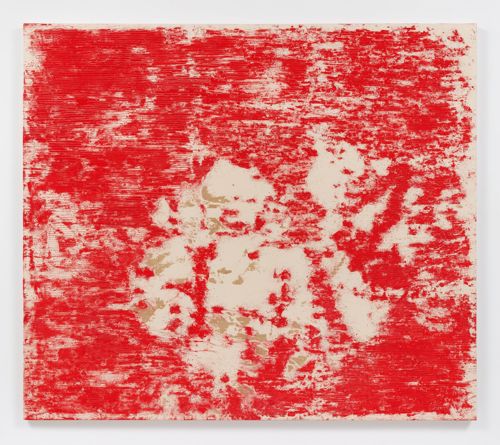
OTERO ANGEL Lago 2015 Copyright SARAH MUEHLBAUER
Margherita Artoni (MA): Your paintings often seem to emerge through a process in which the image is discovered rather than simply executed. Layers are accumulated, removed, transferred, cut, and recomposed, while traces of earlier stages remain visible.
Could you describe the movement from the first impulse for a work to the moment when
you recognise that it is complete? Do you begin with an image, a memory, a material
possibility, or some combination of the three? At what point does the process begin to
take on a direction of its own?
Angel Otero (AO): The beginning of a painting, I would say, tends to start from a combination of all three: a memory, an idea of something I saw in a photo, or maybe a reference from a painting from some period of painting history.
It can start from an exploration of a material. There have been moments when I decide I want to paint this motif of water, or waves, or ocean, and I start quite traditionally, just painting this movement that looks like these curving gestures that simulate a wave over the plexi. After that's finished, I let it dry, and then I might think that it will be very interesting to replicate an image of a couch on top of these waves.
I keep in mind that these decisions are me sort of painting backwards, because eventually the waves are going to be the first image, and the background is going to be the couch. It evolves into a combination of intuitive decisions that range from memory to material and art history reference.
At some point, after these layers of the three, or maybe an accumulation of the same reference multiple times over the surface, I decide to scrape. It is in that moment of scraping that things start to reveal themselves in a very unpredictable way, and the work starts asking for a different response.
Unexpected moments, completely uncontrolled turnouts, can make the work take on a very drastic curve from what I was expecting, and I just follow it. I think it's a back-and-forth conversation between me and the work, me and the material, me and my ideas, and the nature of those materials that I'm exposing them to through these unconventional methods.
At some point, I decide to stop. It's a feeling difficult to explain, but the work really kind of asks to let it be. A day later, a week later, I might come back to it. Maybe I don't. Maybe it leaves the studio at that stage. Or, if I keep having it close to me, depending on my state and my sort of position on that present day towards that work, I'll change it. If not, it just stays like that.
Having a work feel complete is a very difficult thing to explain when these things happen. I think it's something intuitive, something emotional. At least in my work, it really is, and I like to be in that kind of relationship with the work.
MA: The oil skin has become one of the defining elements of your practice. Once separated from the glass, the painted surface acquires a physical autonomy: it can be folded, torn, wrinkled, layered, cut, and transferred. It carries the memory of an earlier state while becoming the material for another.
What does the oil skin make possible that conventional painting cannot? Does its physical presence create a tactile dimension in which the painting is experienced through the body as well as through the eye? And when does this material language become poetic for you rather than simply formal?
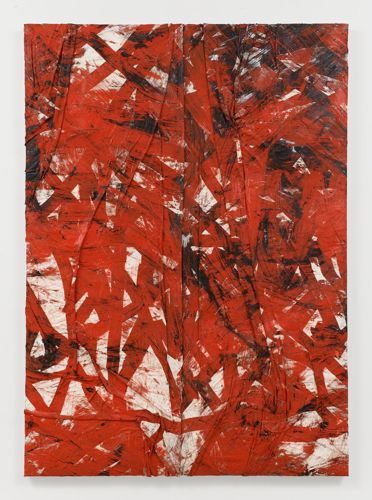
OTERO ANGEL Untitled 2013 Copyright SARAH MUEHLBAUER
AO: In an early stage, I always felt that I was searching for the relationship between me and the materiality of painting, not painting only as a material or as something between me and a narrative, or me and an expression. I was aiming to expand the possibilities of how you can express not just a narrative but also emotion. It was an ambiguous relationship between the material and the self, or the material and the human using it, viewing it, or perceiving it.
In my late years of grad school, I just felt that painting in a traditional way on the canvas, using my brush, the paint, and the mediums, wasn't really a challenge to me. It wasn't really that exciting. I felt that I was more thrilled to get into the unknown than just follow the known.
There were a lot of traditional painters that I was very drawn to, even some not far from my generation. I felt they were so good at finding a unique form of using oil paint in traditional ways, but they still felt so unique. To me, they transmitted a very moving scenario when the relationship between how they painted something and what they were painting clashed on a canvas.
Going back to my studio, I was struggling with that. I decided that I wanted to use oil paint in a little bit of an unpredictable way, but still sort of working with the traditional methods. I started using the dry oil paint that I had in my palette. I felt that it was interesting to think about oil paint on canvas when it was just a collage of dry oil paint instead of the usual methods for applying oil paint to the surface of a canvas. That quickly drew a relationship towards painting. It wasn't only about the normal quality of paint, but also about enhancing my relationship with three-dimensionality through painting, the physical element of painting.
It's that kind of collage of dry oil paint that eventually took me to the process of the skin. I did feel that the process of the skin, at first hand, was a very original way of producing an artwork and visiting the methods of painting from a different angle. Over time, not right at the moment, it made sense to me that the work was becoming more of a physical, ritualistic relationship. With something that was definitely about reading it physically, as well as by observation, I felt it carried a metaphoric resonance with the way I felt about memory: something that felt so real and, in some way, controlled. Eventually, as I grew and as time passed, I felt memory evolves and reshapes itself depending on where we stand, how we feel, what we have gone through, and where we are in present time in relationship to the past.
I like to believe that my process is connected to that same perception of memory. I choose layers, I know what I painted, and then I introduce it into this sophisticated, physical process that eventually takes on some sort of shape of its own. I like to perceive every work from that perspective.
MA: Your process allows for a degree of uncertainty. Paint can tear, wrinkle, resist
separation, or behave differently from what you anticipated, while the final composition
depends on a series of precise decisions about what to preserve, reveal, or conceal.
What role does error play in your practice? When an unexpected result occurs, how do
you recognise its potential? Are you interested in the accident itself, or in what it makes
possible? How do you negotiate the boundary between relinquishing control and exercising a more intuitive form of control?
AO: Error and chance play a huge role in the work. The first thing that drew me to it was the challenge: this dance back and forth between me and the material, the material and the narrative, or the matter of the material and the subject. My decisions from the beginning, even the idea of what I wanted to achieve by painting over glass, scraping the paint with a spatula, and collaging that into the canvas, quickly led to frustration.
The rejection of the material toward the idea, especially oil paint, was that it was so fragile when trying to scrape it out, pick it up, and collage it into the canvas. It was tearing apart, creating bubbles, accumulation, and messiness on my fingers. It was, you name it, a number of challenges. Over time, I slowly was able to achieve a little bit more control over what I was aiming for, but the space for error, accident, and uncertainty was always there. I have learned to live with it in the sense that it directs, at times, where the work is heading.
There are moments when the predictability of the work becomes quite accurate, and the work comes out almost as I intended. At times, it is accepted. At times, it is maybe too easy to read, so I keep it around and add layers later, or revisit it later on. For example, the fold work came about from an accident when I was trying to collage the oil paint skin. It was just a layer of oil paint on its own, without fabric or any kind of support or some of these other materials that I use these days. When I was sliding it after scraping it from the cardboard into the adhesive on the canvas, I had moved the cardboard a little too roughly. The skin would sort of slide and wrinkle and glue itself over the surface, making a humongous mess of a wrinkle material. The image that I had painted and scraped and revealed was disappearing completely, smushing everything together, just all the things that I did not want.
It started a real debate about acceptance, very related to life and to the things that we cannot control. At times, we need to just accept, move over, work upon it, or reject it.
After that accident and that frustrating night, eventually I had to take all the paintings that were meant for other canvases, scrape them, and fill the negative space that I couldn't with the first skin. With the new paintings, the painting completely changed. I remember finishing it on the floor and then putting it on the wall, amazed and surprised to see something that I was not aiming to create. It did not cross my mind at all, other than at the right moment, with the right intuition, bravery, and hopefulness towards the work.
MA: Your work engages with the Spanish Baroque, the still-life tradition, and the legacy of
Abstract Expressionism, while subjecting these histories to radically contemporary
processes. Images and pictorial structures are taken apart and reconstructed through oil
skins, silicone, fragments, and collage.
Which artists or periods have been most formative for you? When you return to an art-
historical language, what are you seeking: an image, a structure, a way of seeing, a
particular relationship to material? How does that inherited language change once it
passes through your process?
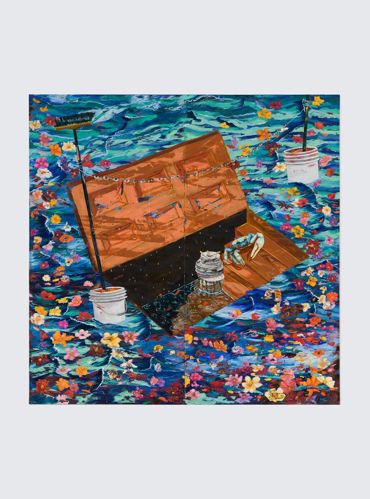
ANGEL OTERO, The Day the Sea Forgave My Father, 2026 Photo: Ken Adlard
AO: I have always been a big fan of art history, and especially of the Renaissance. My
relationship to that wasn' only about embracing painting history as something that I needed to learn as background for my practice. It wasn't necessarily a way for me to find where I fit into these conversations. They sort of brought up a lot of questions, and it was very interesting to me to study the ongoing conversation of subjects within painting and within time: different artists revisiting other artists' subjects in relationship to their present time.
I was also aiming for a personal engagement with growing up, reading or seeing these things from elderly people or people who knew about art and depicted it as real art. I was also aiming for the technical strategy to execute a painting that was easy to recognize as a very good composition or a very well-painted figure that is recreated almost like a photo because of how perfect it is.
The religious subject and the mythological subjects in a lot of the master painters. The strange obsession, when it came to Spanish Baroque, with a lot of the design on furniture, architecture, on painting, just everything, carrying this sort of elegance and aesthetic of beauty and almost perfection. I always felt that I did not have the right knowledge or talent to execute, and I always felt it was cool to bring that very personal relationship of mine towards these subjects of art and painting history into my unconventional work.
It was a way of using it as a tool for formal qualities, but also it was a way of me taking on my own conversations with past subjects and reconstructing them, almost obsessively, maybe even destroying them. I felt that when Picasso was painting his own version of Velasquez's Las Meninas, there was a confrontation. He admired Velasquez. We all know that, right? He was very vocal about his admiration for Velasquez, but I'm sure there was a certain sense of envy. There was a certain sense of two toreros kind of fighting over who is more relevant and who's more important: "How do I kill the father?" Almost like a Freudian kind of perspective.
I think I'm close to that similar scenario when it comes to my decision on taking on Nicolas Poussin or the Picasso paintings, de Kooning. It really is about that: taking it and bringing it to my own language and transforming it almost into my own by destroying it. I say that, obviously, in a very metaphoric way.
MA: You work between Puerto Rico and New York, your recent residency in Somerset introduced another environment into your practice. You have described place as “a living presence within the work,” shaped by light, architecture, weather, and history.
How does the physical environment of your studio affect the way you work? Does Puerto Rico generate a different relationship to memory, material, and image than New York or Somerset? What can a place contribute to a painting without becoming its subject?
AO: Changing the environment is always challenging. When we work in our studios and create our own magical space or place to be creative, we tend to quickly transform it into what is best for the work, right? We create routines and an atmosphere that is inspiring and accommodates our needs for our books, the people around us, and the things that we see every day outside the studio, depending on where we are. All the same, changing that is quite dramatic, not far from moving from one house or country to another, making new friends, finding a new job, and changing your life.
I have always liked, or have tried to embrace, these changes positively. They bring up my anxiety. They create tension. They can be frustrating. They can carry a huge feeling of loss, but they do bring something new.
Working out of Puerto Rico, I would say it first started as a huge difficulty to adjust myself, because I felt Puerto Rico carries so much of the subject I have always worked upon. With the addition that these subjects were worked upon from a distance, distance played a big role. Now I feel like the subject is right in my face. I'm inside of it, or it's watching me paint from behind. That took me a while to find where the inspiration was taking off and where it was clashing with myself, or the self of mine that came from New York.
The inspiration is not only the fact that I'm now going to paint more about the environment that I'm living in, my new studio, and my present reality. It has to do with being honest, accepting, and then going back to New York and working in that studio. It has a different feeling, a different vibe. You start seeing things that you have seen for many years. As an artist, access to the museums has always been quite a quality opportunity.
Somerset is not different from what I just explained. It is a residency, something I decided to do for a short time, where the paintings I brought were unfinished. I decided to resolve them as much as possible in this new environment.
I wouldn't say it was so much to inspire me in a way that I was trying to replicate the landscape, or make a portrait of the community or its sensibility, but I think, emotionally, just all of the above. Surrounding myself with these unique and beautiful mornings and afternoons, the people I came across, the conversations I was able to have, coming back to my studio, turning on the fireplace and working at night, and looking at the work, there was a certain peacefulness that I encountered for the first time. That peacefulness brought a very unique sense of confidence that was implied, indeed, in the work. That's how I feel about place and about the studio as a living place.
MA: The ocean has become an increasingly powerful presence in your recent work. In Agua Salada and The Ocean Forgot Your Garden, water connects Puerto Rico with other
geographies through origin, migration, departure, and return. Dreams and Salt, first presented in Puerto Rico and subsequently shown in Somerset, will now enter the public landscape of Regent’s Park as part of Frieze Sculpture.
What changes when a work moves between such different environments? Over the past
decade, your practice has expanded from oil skins into sculpture, textiles, found materials, figuration, and moving image. As your forthcoming Hauser & Wirth Publishers publication brings different moments of this practice together, what do you now recognise as its deepest continuity? And after this period of expansion, where do you sense the next transformation might occur?
AO: When a work moves between different environments, it starts to have a different relationship with the place. The work carries where it came from, but it also reacts to the new light, the architecture, the landscape, the weather, and the people who are experiencing it. With a work like Dreams and Salt, the ocean is not only an image. It is connected to Puerto Rico, to memory, to migration, to departure and return. But when the work moves to Somerset, or now to Regent’s Park, all of that starts to shift. It becomes part of another place, and I like that tension.
Maybe the deepest continuity in the work is that I am always trying to keep painting open. Even when the work becomes sculpture, or textile, or moving image, or uses found materials, it is still very connected to painting: to surface, to touch, to memory, to the body, and to the way an image can change through process.
I don’t know exactly where the next transformation will happen, and I think I prefer not to know too clearly. It might come from bringing the work more into public space, or into a closer relationship with architecture and landscape. But I think it will probably begin in the same way: with an image, a material, a memory, and then something unexpected that asks me to follow it.
Main Image: Angel Otero“Poussin's Mirror,” 2014 Oil paint collaged on canvas Copyright Angel Otero