
The Image After Meaning: Michaël Borremans and the Fragile Authority of Painting
Michaël Borremans paints at the moment when the image remains persuasive while its authority becomes uncertain.
In an era saturated with visual information, his paintings investigate the fragile relationship between appearance, knowledge, and belief. French Painting, his first solo
exhibition in France in two decades, unfolds from this tension: a meditation on what happens when images retain their power of attraction while their meanings become increasingly unstable.
The title invokes one of the most influential traditions in Western art, recalling the measured intelligence of Chardin, the theatrical elegance of Watteau, the modern fracture introduced by Manet. Borremans approaches this legacy as a living structure whose conventions can still generate meaning while revealing their own vulnerability. Portraiture, still life, and the balanced syntax of classical composition remain present, yet their former certainty has weakened. In conversation with curator Jeffrey Grove, the artist has stated a governing premise for this shift: he paints from culture, never from nature, since even a human figure on canvas is already a representation before it is anything else. What emerges is painting after the confidence of its inherited language has been disrupted.
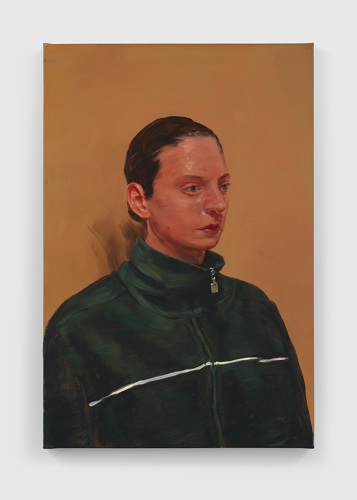
Michaël Borremans, Nina, 2026 Oil on linen © Michaël Borremans Courtesy the artist and David Zwirner Photo by Cedric Verhelst
Borremans' images are frequently described as enigmatic. Their force lies elsewhere. They are immediately legible and yet resistant to resolution. Every surface is rendered with extraordinary discipline, every tonal transition calibrated with precision, every composition governed by an almost classical control. The image appears complete, but interpretation remains unsettled. This instability is produced through Borremans' painterly mastery: velvety surfaces, a restrained chromatic range, and a controlled luminosity that create a visual authority gradually turning inward, questioning itself. Beauty becomes the point at which certainty begins to fracture.
Massimiliano Gioni, artistic director of the New Museum, has located the source of Borremans' pull in stillness itself, describing his most seductive effects as arising from an act of suspension, a kind of inaction. It is an accurate account of the surface, but it stops short of naming what that suspension costs the viewer: not just delayed spectacle, but delayed belief. A useful counterpoint is Gerhard Richter. Where Richter challenged the authority of the photographic image through blur, fragmentation, and erasure, Borremans reaches a related uncertainty through extreme clarity. Doubt does not enter through absence or distortion. It emerges from the very perfection of the painted surface. His images are easy to see; they are harder to believe.
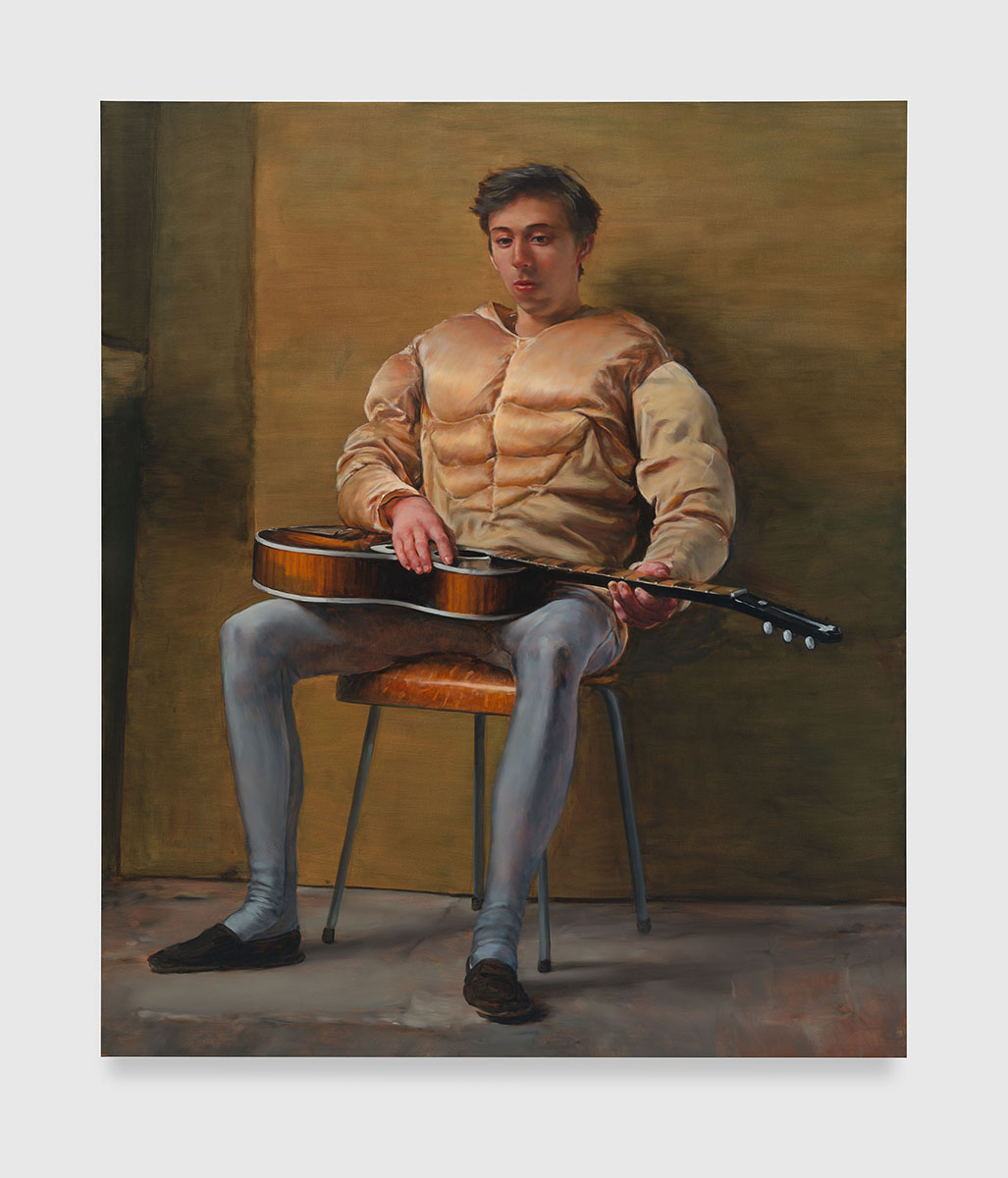
The exhibition's title work, French Painting (2026, oil on canvas, 240 × 200 cm), embodies this condition with unsettling precision. A young man occupies the canvas wearing a padded suit built to simulate swollen, exaggerated muscles — an armor of false flesh rather than an actual body. In his hands he holds a guitar stripped of its strings, an instrument stilled at the root, incapable of sound by construction rather than by choice. Asked directly about the work, Borremans has said he was not thinking of any specific commentary on masculinity when he painted it, only of a human being, since he draws no distinction between genders when he paints. The figure does not resolve into a coherent statement about power, vulnerability, or performance; it holds all three unresolved, wrapped in a fiction of strength that does nothing.
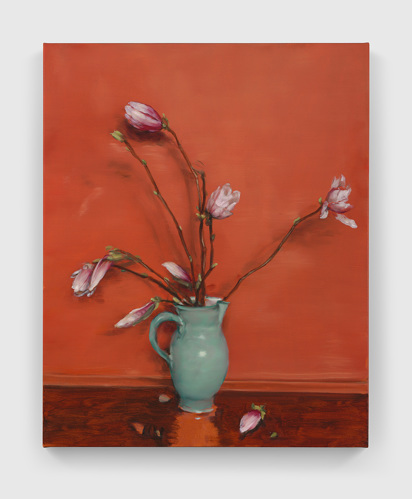
Michaël Borremans,Magnolias flowers in a green vase, 2026 Oil on linen © Michaël Borremans Courtesy the artist and David Zwirner Photo by Cedric Verhelst
A similar tension unfolds in Magnolia Flowers II (2026, oil on linen, 74.5 × 60 cm). A green ceramic pitcher holds freshly cut magnolia branches, their pale blossoms emerging against a dark and undefined background. The composition possesses the restraint of European still-life painting, while the delicate handling of paint allows light to move softly across the petals and glazed surface of the vessel. The flowers exist because they have been removed from the living plant that sustained them; their beauty depends on separation, preservation, transformation into an object of contemplation. Borremans turns the still life into an examination of the human impulse to arrange and possess the natural world through representation.
Placed together, French Painting and Magnolia Flowers II dissolve the traditional boundary between portrait and still life. The human figure, armored and silenced, acquires the stillness of an object; the flowers take on an unexpected vulnerability. Both become subjects of attention and uncertainty, occupying the same unstable field of representation. The comparison with Vilhelm Hammershøi sharpens this quality of silence: where Hammershøi's interiors create spaces of introspection, where absence suggests a hidden interior world, Borremans' silence operates differently, suspending interpretation itself and leaving the visible powerful while meaning stays unresolved.
This condition gives French Painting a broader contemporary resonance. Our visual culture is defined by an extraordinary abundance of images, circulating across contexts with increasing speed and instability. Borremans responds by returning to the concentrated temporality of painting, restoring attention to the fragile process through which images acquire significance. The crisis he stages begins when an image remains convincing while no longer generating shared belief — Gioni's suspension, pushed one step further, into doubt.
If painting once sought to make the world intelligible, Borremans explores what follows that ambition. His works examine the space between recognition and understanding, between what the eye accepts and what the mind can affirm. Within that suspended interval, he has developed one of the most compelling pictorial languages in contemporary art.
Main Image: Michaël Borremans, French Painting, 2026 Oil on canvas © Michaël Borremans Courtesy the artist and David Zwirner Photo by Cedric Verhelst