
THE CONDITIONS OF APPEARANCE — Art in Systems of Continuous Selection
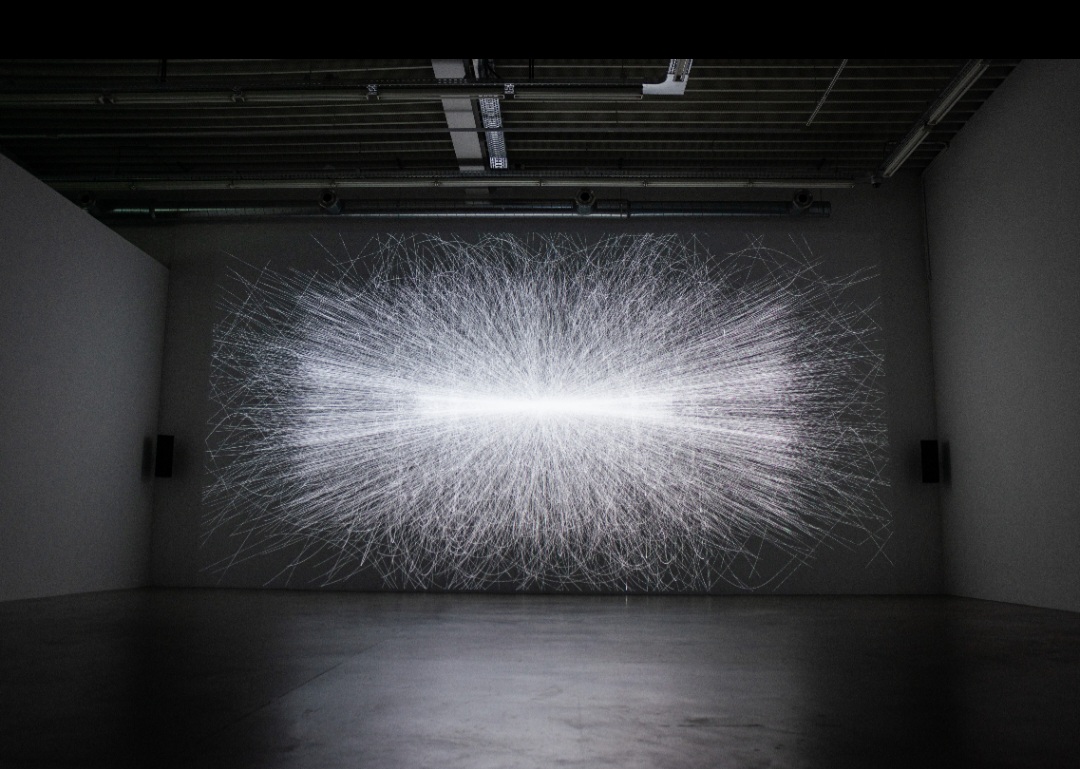
Contemporary artistic experience is defined less by the production of form than by the regulation of appearance. Art no longer unfolds within stable frameworks of recognition, but within environments where visibility is continuously produced, filtered, and redistributed.
To speak of art today is to speak of conditions: infrastructural, technical, and cognitive
arrangements that determine what becomes perceptible, and under which parameters
something is registered as art.
Within this shift, authorship loses its traditional centrality. The artist is embedded in systems of circulation in which persistence outweighs declaration, and recognition is generated through repetition across fragmented fields of attention.
Digital platforms are not neutral channels of dissemination. They function as selection systems that organize visibility through layered logics of prioritization, ranking, and engagement. What appears is never simply shown; it emerges through continuous differential filtering that determines its legibility.
These conditions are not uniform across contexts, but unevenly distributed across institutional and non-institutional spaces.
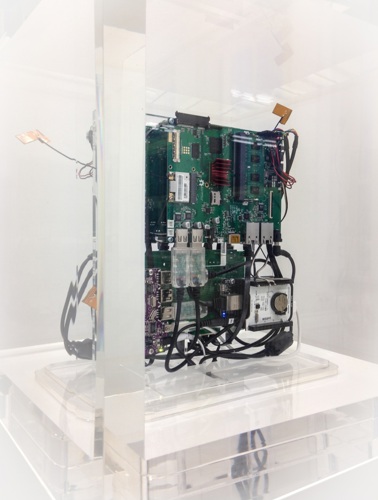
Trevor Paglen, Jacob Appelbaum, Autonomy Cube, 2014–2018, installation view. Photo: Rosa Menkman, via Wikimedia Commons (CC BY-SA 2.0).
At the level of interface culture, visibility is further shaped by design protocols that structure perception in advance of interpretation. Scrolling, ranking, recommendation systems, and algorithmic feeds do not simply distribute content; they pre-format the conditions under which attention can be directed. In this sense, the interface is not a neutral threshold between user and content, but an active site of epistemic organization.
The work of Ryoji Ikeda can be understood less as representation than as a structuring of perception under quantified conditions, where sensory experience is inseparable from computational constraint and measurement.
At the same time, the analysis of Byung-Chul Han describes a subject increasingly shaped by exposure, performance, and continuous self-optimization. Beyond this psychological dimension, attention must also be understood as a spatial distribution: a field structured by interfaces that fragment, redirect, and recombine perception in real time.
Attention itself, under these conditions, is no longer stable or continuous. It operates as a discontinuous resource,redistributed across competing demands of visibility. Temporal experience is no longer organized around duration, but around intensity, interruption, and algorithmically induced rhythm. What persists is not sustained focus, but oscillation between capture and release within attention economies.
A further layer of this transformation concerns the increasingly predictive nature of cultural visibility. Algorithmic systems do not simply respond to artistic production; they actively anticipate it, shaping the conditions under which certain forms become more likely to appear than others. In this sense, visibility is no longer a retrospective recognition of what has been produced, but a pre-structuring of what can plausibly emerge within the field of cultural production. The distinction between creation and distribution becomes less stable, as both are folded into the same operational continuum.
Within this predictive environment, artistic practice is immanently entangled with the
infrastructures that render it perceptible. Platforms such as Instagram, TikTok, and similar image-based networks do not merely host artworks or documentation; they reorganize the grammar of visibility through metrics of engagement, temporal compression, and recursive recommendation loops. What becomes visible is less a matter of curatorial decision than of statistical amplification, where repetition and variation are calibrated through non-human logics of optimization.
This does not eliminate artistic intention, but redistributes it across multiple layers of mediation. Authorship becomes a distributed function shared between human and non-human agents, between creative gestures and infrastructural constraints. The work of art is therefore inseparable from the conditions of its circulation.
Curatorial practice is fully absorbed into this regime. The exhibition no longer operates as narrative mediation but as a filtering apparatus within an expanded informational ecology. Selection becomes infrastructural rather than interpretative: it determines not only what is visible, but what can be constituted as visible at all.
Critical discourse follows the same structural displacement. Writing no longer functions as an external commentary on artistic production; it becomes part of the same circulation system, contributing—whether deliberately or not—to the modulation of attention.
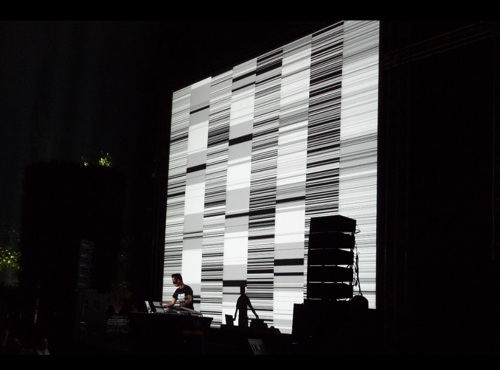
Ryoji Ikeda, Spectra, 2010. Photo: bonus1up (Flickr), via Wikimedia Commons, CC BY 2.0.
The notion of a unified public has dissolved. What remains is a shifting topology of attention composed of transient alignments that emerge and disappear according to algorithmic logics. Addressability is no longer given in advance: there is no stable receiver, only variable configurations of perceptual availability.
In this context, artistic production is no longer defined by belonging—movements, schools, collective declarations—but by its capacity to persist within systems of continuous selection without stabilizing into fixed identity.
This does not imply the disappearance of art, nor its absorption into technology. It signals a structural reconfiguration of its conditions: from expression to selection, from declaration to circulation, from continuity to managed visibility.
Rather than operating within a unified regime of meaning, contemporary art now unfolds across layered systems of partial coherence. Meaning is no longer stabilized in advance, but temporarily assembled within shifting configurations of visibility, circulation, and attention. What emerges is not a loss of intelligibility, but its redistribution across infrastructures that continuously reorganize the conditions under which interpretation becomes possible. In this sense, artistic practice becomes a mode of navigation within unstable systems, where form is not fixed but continuously reconstituted through its exposure to changing regimes of perception.
Art today does not speak in manifestos. It persists as the ongoing production of appearance.
Main Image: Ryoji Ikeda, data-verse, installation view, Almine Rech Gallery, Brussels, 2024. Photo: 9yz, via Wikimedia Commons, CC BY-SA 4.0.