
Sophia Loeb: Light Before the Image
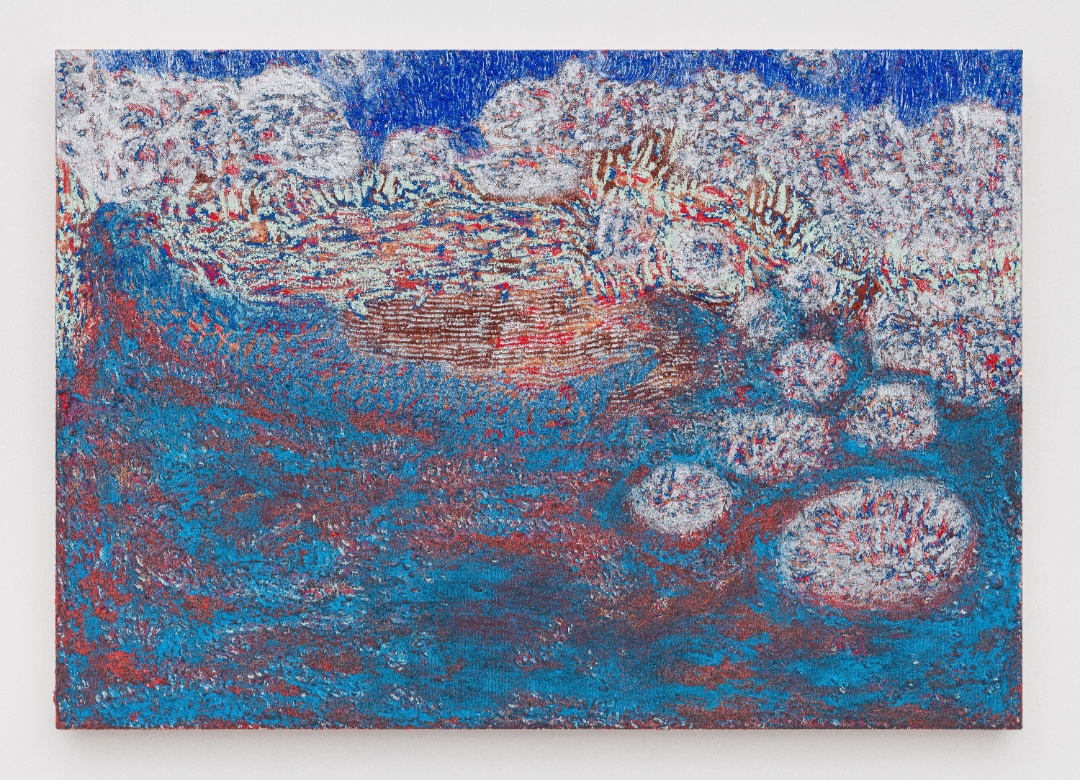
Sophia Loeb creates paintings in which landscape, abstraction and sensory experience converge. Her images move between recognition and invention, constructing environments where colour, atmosphere and matter follow an internal logic. Rather than depicting a landscape, Loeb turns it into a condition of perception—something encountered as much as seen.
Nature occupies a fundamental position within her practice. Her work emerges from a deep engagement with the natural world and the interdependence between living forms. This relationship to the world is inseparable from the physicality of her practice. Loeb approaches the canvas from multiple positions, rotating and tilting it so that gravity, movement and resistance become active elements. Liquid and powdered pigments, oil and oil sticks are applied, scraped away and reworked through successive layers. Her early experience as a sculptor remains evident in her treatment of the canvas as a physical field with weight, density and resistance.
Her process is intuitive rather than predetermined. One gesture, colour or material response generates the next. Texture can provoke sensation; movement can produce colour; one layer can call for the presence or removal of another. Seeing, touching, moving and feeling become part of the same process, with the body participating in the discovery of what the image might become.
This logic reaches particular intensity in Loeb’s recent exploration of light. In O Manifesto da Luz antes do Amanhecer (The Manifesto of Light Before Dawn), her second solo exhibition at Pippy Houldsworth Gallery in London, presented from 5 June to 4 July 2026, light becomes a primary condition of visibility and revelation. Across new paintings and impasto surfaces, Loeb moves between abstraction, landscape and visual perception, evoking dawn, mist and shifting atmospheric conditions. Developed in Brazil while reflecting on London and its mutable light, the exhibition extends her longstanding fascination with the cosmos. Light becomes a threshold through which the world enters visibility.
Throughout Loeb’s practice, layers accumulate, conceal and re-emerge, holding different temporal states within a single surface. Abstraction offers a way of approaching the visible world through sensation, memory and matter, bringing seemingly separate experiences into a shared field.
Margherita Artoni (MA): Your paintings emerge from two very different atmospheric experiences. Brazil enters your work through humidity, vegetation, intense colour and a sense of organic interconnection, while London brings fog, muted light and constantly shifting weather. These places do not appear as separate subjects; they dissolve into an internal geography.
How has moving between Brazil and London changed your understanding of what a landscape can be? When you begin a work, are you responding to a particular place, to the memory of a place, or to an atmospheric condition that exists between the external world and your own perception? Can a landscape become more truthful when it ceases to describe a specific place?
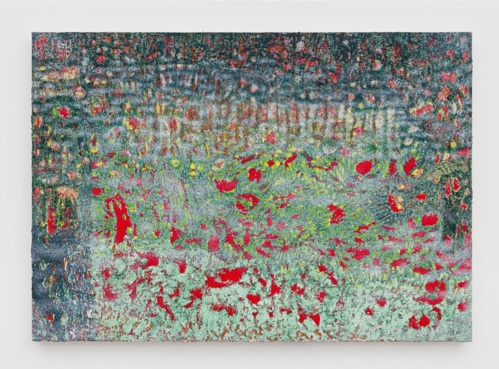
Sophia Loeb, Vinde nevoeira, revoará sobre a morada, 2026. Courtesy the artist and Pippy Houldsworth Gallery, London © Sophia Loeb 2026 Photo: Ana Pigosso
Sophia Loeb (SL): I think living between Brazil and London has made me realise that a landscape doesn’t necessarily have to belong to a specific place. It can be a combination of memories, colours, light and sensations. In a way, the place where I am not can have an even stronger presence in my paintings than the place where I am.
When I’m in London, I often think about Brazil and my memories of it. The fog and
changing weather in London, for example, appeared in the works for my last solo show at
Pippy Houldsworth Gallery, even though all of them were painted in Brazil, mostly during
summer and autumn.
Of course, my routine also changes between the two cities and that has an impact on
how I work. The time I wake up, how I get to the studio, what I do before and after
painting. I think that in London, I absorb a lot of culture and perhaps pay more attention
to the formal side of the work. In Brazil, I feel more connected to beauty. So, both places
feed my work in different ways, but often without me consciously thinking about it.
MA: In O Manifesto da Luz antes do Amanhecer (The Manifesto of Light Before Dawn), light functions less as a subject than as an event within the surface. Colour emerges through layers of pigment, while opacity and luminosity continually alter one another. The works occupy a threshold between what has appeared and what is still coming into view.
Your choice of colour is closely connected to the physical behaviour of pigments—their density, transparency, temperature and response to light.
How do you recognise that a particular pigment belongs to a work before you fully understand why? Can colour carry an emotional or bodily knowledge that precedes conscious thought? When a material resists your intention, can that resistance become a form of intelligence within the work?
SL: Colour is probably one of the first things I respond to when I'm painting, but it's not
always a conscious decision. Sometimes I have a visual certainty that a particular colour
needs to be there, even if I know it will eventually be covered by another layer, creating
new textures and depth. I don't always know why it needs to be there. The certainty
comes when the idea starts to materialise, until then, it's still open.
Sometimes a pigment or texture does something I wasn't expecting, and I have to respond
to it rather than try to correct it. At a certain point, I need to let go of my original intention and allow the painting to take another direction. Painting is an exercise in resolving problems in some way.
MA: Gesture is central to your practice. Your marks register rhythm, pressure, speed and
hesitation, recording an encounter between the body and the surface. They occupy a space between intention and instinct, where thought becomes physical. Your sculptural background is particularly relevant here. You move around the canvas, rotate it and respond to the resistance or fluidity of the material. Colour, movement, texture and bodily sensation can trigger one another before becoming conscious decisions.
Can a gesture contain knowledge or emotion that cannot be articulated through words? What happens internally when looking, touching, moving and feeling become almost indistinguishable? Can the physical quality of a mark reveal something about the work—or about your own state of mind—that you did not consciously know before making it?
SL: My paintings are quite autobiographical. They come from sensations, experiences and
things that happen in my life. I think painting can also be a way of reinterpreting these
experiences and finding new ways of looking at life and the things around me.
I don't really see painting as something that happens only through the hand or the brush.
My background in sculpture has definitely influenced the way I work. I see painting as an
experience, where the surface has its own volume, depth and physical presence. When I
paint with my hands, for example, I feel much more connected to the surface. I can be
more direct and create textures that become part of the painting's structure.
I don't usually know exactly what I'm going to do when I start a painting. I respond to what's happening on the canvas, and each gesture creates a new situation that I have to deal with. Sometimes I make a mark very quickly, almost without thinking, and other times I need to spend a long time looking at the work before I know what to do next.
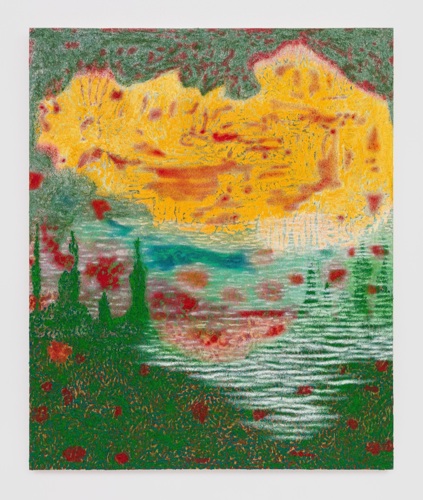
Sophia Loeb Vinde nevoeira, revoará sobre a morada, 2026 Courtesy the artist and Pippy Houldsworth Gallery, London © Sophia Loeb 2026 Photo: Ana Pigosso
MA: Accumulation in your work is accompanied by erasure. Earlier gestures remain partially present beneath subsequent layers, allowing several temporal states to coexist on the same surface. What has disappeared continues to exert a presence.
Do you think of these buried layers as a form of memory? What interests you about allowing something to remain present without being fully visible? Can adding, covering, scraping and revealing suggest a conception of time in which the past continues to act within the present?
SL: I think memory is very present in my work, but not necessarily as something you can see in the layers themselves. The final layer can only exist because of everything that came before it. In that sense, the layers carry the history of how the painting was created, even when they are no longer visible.
I see my paintings as places where the physical rules of our world don't necessarily apply. The past and the present can exist at the same time. Even gestures and layers that have been covered continue to influence the texture, the colour and the way the painting develops. They become part of the same present, even if we can't see them anymore.
For me, that’s one of the secrets of painting: things don't have to remain visible to continue to exist.
MA: Your practice brings together the history of painting, the natural environment and your
fascination with the cosmos. How does an influence become transformed into something that no longer belongs to its original source, becoming part of your own visual language?
Can abstraction provide a way of thinking beyond a purely human perspective, allowing different forms of life, matter and energy to coexist within the same image?
SL: I’m very influenced by nature and the history of painting, especially Impressionism and
Abstract Expressionism. But I don't think about these references as things I need to reproduce in my work. They become part of what I absorb and eventually find their way into the painting in ways that aren&'t always easy to pinpoint.
It could be a particular landscape or an image that catches my attention, but also a song, a film I've seen, or even a person I've met. I'm very observant, and I think all these things stay with me in some way. What comes into the painting isn't necessarily the thing itself, but the sensation or idea that it left behind.
I think abstraction allows all these different influences to exist together without needing to explain where they came from or how they are connected.
MA: Your images evoke landscapes, organic forms, atmospheric phenomena and cosmic spaces while resisting identification with any of them. Recognition remains suspended within abstraction, allowing the viewer to sense something without necessarily being able to name it. This raises a larger question about painting beyond representation.
What can abstraction still make visible today? In a culture saturated with rapidly produced and digitally mediated images, what can the material, physical and durational experience of painting offer that an image cannot? When a work moves beyond the thing it appears to depict, what remains after the image?
SL: Abstraction can give us the possibility of experiencing something without having to identify or name it. My paintings are autobiographical for me, but they can become something completely different for each viewer, depending on their own experiences and the way they see the world.
I think of the painting as something alive and I like the idea that the canvas is only a glimpse of a larger world, that the forms continue beyond its edges, so there is no real beginning, middle or end.
Like looking at the sea and the horizon, you can imagine what exists beyond what you can see. It's not just an experience of the image, but of the texture, scale, light and physical presence of the work. It asks for time and allows different things to emerge for each person.
Main Image: Sophia Loeb Levitamos sobre o abismo, 2026. Courtesy the artist and Pippy Houldsworth Gallery, London © Sophia Loeb 2026 Photo: Ana Pigosso