
Skulptur Projekte Münster 2027 Takes Form: Further Projects Announced
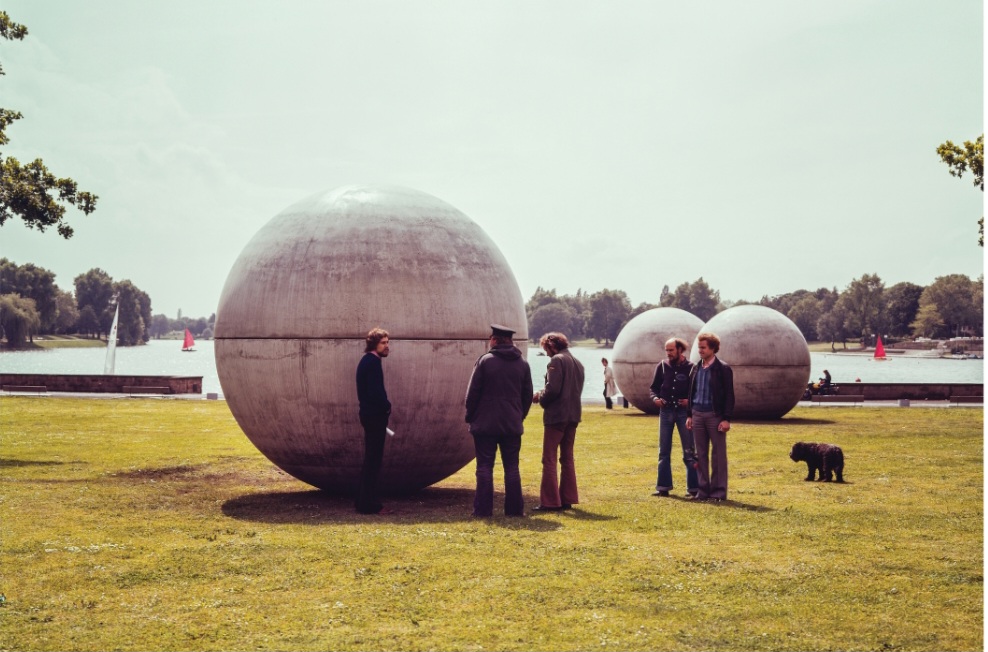
The sixth edition of Skulptur Projekte Münster will take place from 13 June to 3 October 2027, once again inviting visitors to experience art in the public space.
Returning to the city every ten years, the coming edition marks the 50th anniversary of the first exhibition hosted by Klaus Bußmann and Kasper König in 1977. Led by the curatorial collective What, How & for Whom / WHW (Ivet Ćurlin, Nataša Ilić, and Sabina Sabolović) as Artistic Directors, the majority of Skulptur Projekte will continue to unfold across Münster’s city centre, while also extending into neighbourhoods that have been less present in previous editions.
Following the announcement of the first five artist projects (Róza El-Hassan, Hew Locke, Oscar Murillo, Selma Selman, and Iza Tarasewicz) in June 2026, Skulptur Projekte has now revealed a further thirteen of around thirty site-specific commissions. A common interest amongst the selected artists and artists’ collectives is in a deepening engagement with both the local and what WHW describe as the ‘interconnected elsewheres of our fluid, cross-cultural present.’
WHW explain: ‘Informed by the history of Münster as “City of Westphalian Peace”, the artists of Skulptur Projekte 2027 are developing their proposals in awareness of the violence of the present, considering the political decisions, historical global relations, and economic systems that have shaped it. Against the ruptures and losses of recent years, the exhibition asks not only what art can show, but what it can hold. In times when cancellations, censorship, and withdrawal have constrained cultural work, Skulptur Projekte seeks to make room for voices to be heard, for losses to be mourned, for consolation, and for alternatives to be proposed. An artwork in the public space need not compete for visibility in an already overly saturated world; it can offer time to witness, to feel, and to stay with what cannot readily be resolved. At a moment when political and economic propositions struggle to make a positive future imaginable, the faint hope of Skulptur Projekte 2027 is that such encounters with art in public space might allow for perspectives to be felt and acknowledged that are often misrepresented or obscured, without forcing consensus where none exists.’
Skulptur Projekte is hosted by the Landschaftsverband Westfalen-Lippe (LWL) and the City of Münster. The exhibition is organized by the LWL-Museum für Kunst und Kultur.
In the spirit of continuity with change, the Artistic Directors, curatorial collective What, How & for Whom / WHW, together with curators Vincent Schier and Eva Wilson, build on the tradition of Skulptur Projekte as an artists’ project. While each artistic proposal is deeply engrained in the specific context of Münster, the artists approach the city through individual experiences, histories, and realities that resonate both locally and beyond. The projects, developed in response to the city and in conversation with the curatorial team, fundamentally shape the trajectory of the exhibition.
Several new works explore how language, knowledge, and imagination take form through collective processes. Exploring forgotten or suppressed languages and their cultures, epistemologies informed by plant life, the potential of regenerative worlds for new realities, and public debates as the cornerstone of democratic agency, they touch on questions of access to and the possibility of intervention in knowledge systems, statecraft, and the very fabric of society.
For Mercedes Azpilicueta, this begins with the creation of an imagined landscape that invites shared experiences and encourages play. Her project involves collaborators from the fields of botany, poetry, performance, and architectural design, and is being developed in conversation with Münster’s neighbourhood of Berg Fidel, specifically through the community centre LorenzSüd. The neighbourhood’s vegetable life also becomes an agent in exploring and expanding the possibilities of imagining new worlds through fiction and more-than-human interactions.
Also in Berg Fidel, in the south of Münster, Nolan Oswald Dennis is mapping the neighbourhood onto the cosmos and vice versa, constructing an observatory as a hyper-local calendric device. Using diagrams, maps, models, film, sound, and installation, Dennis’s practice explores a Black consciousness of space and asks what material and metaphysical conditions are required in the service of decolonization on a planetary scale. Their project for Münster dis- and re-organises access to and use of public knowledge infrastructures.
Questions of how language shapes public discourse also inform the work of Alice Creischer and Andreas Siekmann. In their work they often focus, through poetic translation, on questions of power, politics, and economy, referring to specific historical moments while recontextualizing them within newly developed narratives. In Münster, Creischer and Siekmann choose seven parliamentary debates held at the German Bundestag between 2019 and 2025. Andreas Siekmann returns to Münster after having participated in the fourth edition of Skulptur Projekte in 2007.
Münster is shaped not only by its urban space, but also profoundly by its surrounding landscapes. The relationship between the rural and the city along with the use of land for agriculture, food production, environmental protection, or leisure have a long history and still define the region both infrastructurally and economically. Several projects approach the rural relationally, connecting conditions in Münster and the Münsterland to other places, landscapes, and planetary conditions.
Myvillages is a trans-local artist collective set up in 2003. Co-founders Wapke Feenstra and Kathrin Böhm are developing a new work that pays attention to the rural as a place of multi-vocal knowledge, co-produced culture, and diverse economies. Rooted in transdisciplinary and inter-generational (un)learning and collaboration, Myvillages challenges the cultural hegemony of the urban. For Skulptur Projekte, Myvillages are digging deep both in Münster and the surrounding Münsterland, to allow for a new visibility of the interdependent histories and geographies that connect the urban and the rural in the region.
Kosen Ohtsubo began studying ikebana, a traditional Japanese art form that uses plants as its material, in the 1960s. Since then, he has explored his own forms of expression beyond the beauty and conventions traditionally associated with ikebana, sometimes transforming entire spaces through large-scale installations. Ohtsubo often works with materials drawn from everyday life, such as vegetables, worn clothing, and discarded objects. In Münster, he turns to local apple trees that are cut down when they no longer bear fruit. Together with a local team, he will use these trees to create a large outdoor installation in the centre of the city.
Kapwani Kiwanga explores structures of power and how history shapes our present. Looking at non-linear conceptions of time and futures far beyond our horizon, Kiwanga is developing a project for Münster that uses a form of timekeeping to bring the prospect of deep time into the framework of human experience. Kiwanga is particularly interested in the ambiguous force of water: from its erosive and nourishing properties, its use in water clocks, to its employment as a weapon of war in the 1660 flooding of Münster by the Prince Bishop, breaking the city’s resistance against a historic siege.
Continuing her long-lasting artistic engagement with the rural, artist Iza Tarasewicz will realise her work at Gut Kinderhaus, a former farm in the North of Münster. Today, Gut Kinderhaus is a residential and working community where people with different disabilities live and work. Tarasewicz is developing an installation structured around seasonal cycles and agricultural processes. At its centre is an exchange of knowledge and practices that underpins the coexistence of humans, animals, and nature, as well as collective forms of labour and care.
The history of sculpture in the public sphere is deeply entangled with questions of remembrance and dominant narratives through which some histories are preserved while others are marginalized or erased.
Near a busy crossroads at the threshold to the historic centre, Iman Issa plays with the codes of public memorialisation. Working around the idea of ruins and their afterlives, she creates frictions between object and text, material and interpretation, and questions who has agency about what is displayed in the public sphere. Intentionally irritating the consistency between different access points of interpretation, Issa fosters a new space of ghostly resonance.
Reflecting on forms and possibilities of mourning and commemoration, Natascha Sadr Haghighian’s project continues her practice of following biographies and individual life stories that expose the times and societies they are embedded in. She is interested in the infrastructures and conditions of collaboration, play, and disobedient forms of sensing and recording. Her work reflects the experiences and infrastructures of migrant communities in Germany, as well as the violence of racism, dispossession, displacement, and exclusion.
Ashfika Rahman turns to invisibilised labour, using poetry, drawing, and forgotten languages as methods of witnessing and giving voice. Influenced by her childhood experience of traveling through Bangladesh with her mother, a social worker, Rahman collects testimonies from countless, often marginalised voices on issues of human rights, land rights, women’s rights, and social justice, weaving these into intricate installations.
At the former Hörster Friedhof, a nineteenth-century cemetery, Selma Selman presents an installation that invokes the perspectives and personal histories of women. Drawing on her own family history, Selman makes visible the cycles of globalised labour by using materials that would elsewhere be discarded as scrap. At this historical site of remembrance and mourning, the artist introduces a poetic narrative shaped by the perspectives of female ancestors.
Róza El-Hassan is developing her contribution for Skulptur Projekte in relation to two locations: the Botanical Garden behind the Baroque Schloss and the district of Berg Fidel. Located in the south of Münster, the residential district was developed in the late 1960s and 1970s as one of the city’s first large-scale modern housing areas with mixed housing and architectural types. Berg Fidel is characterised by demographic diversity, including a high proportion of residents with international backgrounds. Through personal and collective histories of migration, El-Hassan addresses themes such as displacement and exile, as well as vulnerability, fragility, and mutual support, connecting intimate experiences with wider social and political questions.
Münster’s identity is closely connected to the legacy of the Peace of Westphalia. In 1648, the Westphalian Peace, which was negotiated over many years in Osnabrück and Münster, brought a diplomatic end to the Thirty Years’ War that had devastated much of Europe. One of the city's official mottos is ‘peace through dialogue’. At the same time, the presence of military infrastructure in the urban space, as well as Münster’s involvement in Europe’s long history of violent combat, remain tangible to this day. Addressing a world shaped by wars and smouldering conflicts, Skulptur Projekte 2027 reflects on the continued reality of living in controlled bodies and spaces, the conditions of war and peace, and the current escalation of militarisation, alongside interrelated experiences of displacement and belonging.
Working across diverse media, Vlatka Horvat explores the dense entanglements of personal and collective lived experience. For Skulptur Projekte, she is researching a peace monument erected in Münster in 1905 but subsequently melted down for the war industry in 1942. Her work, devised in response, takes the form of sky observatories — sculptural forms that stage a sensory encounter with landscape while asking how looking at the sky might be different in times of peace and times of war.
Conceiving listening infrastructures and nomadic music ensembles, and working across video, installation, and stage work, Anton Kats’ practice expands listening beyond the auditory, as a way of imagining and reshaping the world. Proposing Sonic Antifascism as a field of practice, Kats thinks through the ongoing war in Ukraine towards interconnected histories, while reckoning with contemporary forms of fascism. His sculpture in Kinderhaus, a neighbourhood to the north of Münster, brings political and territorial systems of ordering into relation with systems of sound-tuning and instrument design, developing an interactive sculpture and collective instrument intended to interrupt and reorient.
Khalil Rabah’s artistic practice critically interrogates questions of identity, belonging, and rootedness through an engagement with the institutional structures that shape collective memory, cultural narratives, and relationships to place. Working across diverse media and performative interventions, Rabah confronts histories of erasure, displacement, and marginalisation. For his project in Münster, Rabah articulates the tensions between mobility and containment, cultivation and extraction, rootedness and displacement. Through conditions of uncertainty and suspension, the project reconceptualises belonging not as a fixed state, but as an ongoing negotiation between land, memory, and the possibilities of continuity and transformation.
In the south-east, the York-Quartier in Gremmendorf, a former military barracks, is undergoing one of the largest transformations in Münster’s recent history. Built by the National Socialists and used by British armed forces until 2012, the former York-Kaserne currently accommodates refugees and is in the process of being redeveloped into a new residential neighbourhood. The former Officer’s Casino will transform into a space for community, encounter, and education. Here, Oscar Murillo is realising an installation centred on communal cooking and collective sharing. The project reflects the entanglement of labour and economic exchange within processes of production.
In this singular social and architectural context of the former military barracks, Ali Cherri is showing new large-scale sculptural works in the garden of the Officers’ Casino, a former Nazi building and later a social club for the British armed forces. Cherri’s dreamlike scenarios address the lives of soldiers, juxtaposing the physical consequences of military discipline with tiredness, exhaustion, or sleep as subtle expressions of vulnerability and resistance.
In the city centre, Hew Locke will realise an installation in the Haus der Niederlande at the Krameramtshaus. Built in 1589, the building served as the meeting place and administrative headquarters for local merchants. Locke combines found objects in his sculptures. His works feature both historical and fictional figures staged as representatives of power, while questioning the traditional visual language of monuments and memorials. By working at the historic site of the peace treaty negotiations between the Netherlands and Spain, which brought an end to the two nations’ Eighty Years’ War with the Peace of Westphalia in 1648, Locke connects the local context to broader histories of colonialism, migration, and the uneven distribution of political power.
Main Image: Claes Oldenburg, Giant Pool Balls (1977) Skulptur Projekte, Münster, photo: Rudolf Wakonigg