
Skulptur Projekte Münster 2027 announces First Locations and Artists
From 13 June to 3 October 2027, Skulptur Projekte once again invites visitors to experience art in the public space.
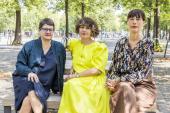
Returning to the city every ten years, the coming edition marks the 50th anniversary since Klaus Bußmann and Kasper König first hosted the exhibition in 1977. Led by the curatorial collective What, How & for Whom / WHW (Ivet Ćurlin, Nataša Ilić, and Sabina Sabolović) as Artistic Directors, Skulptur Projekte will expand beyond the city centre, with a particular focus on neighbourhoods in transformation, such as Kinderhaus, Berg Fidel, and the York-Quartier. One year before the opening, the first of around thirty locations and projects are announced.
Since their appointment in the summer of 2024, the artistic directors, the curatorial collective What, How & for Whom / WHW, have been working intensively in Münster, together with the team of Skulptur Projekte 2027. The relationships and local networks that have emerged during this time form the foundation for the artistic projects of the upcoming edition. The works conceived for 2027 are developing through exchanges with local communities, initiatives, and institutions. Many of the participating artists draw connections between the city of Münster and other places and lived realities.
How has communal life evolved across Münster’s different neighbourhoods in response to social and economic change over the past decade? With a particular focus on neighbourhoods in transformation such as Kinderhaus, Berg Fidel, and the York-Quartier, alongside Münster’s city centre, which has featured prominently in previous editions, Skulptur Projekte 2027 turns its attention to local perspectives while asking how we want to live today and in the future.
What, How & for Whom / WHW outline their curatorial approach as follows: ‘We are interested in exploring how open and accessible the city is to different people and perspectives. We want to shed light on the many ‘cities within the city’, as well as on questions of participation, inclusion, exclusion, and community. Our conversations with the artists have been inspired by the idea of shared narrations or objects: while each perspective is rooted in the specific, there are connections between many elsewheres and Münster.’
A cluster of works will be realised in the north of Münster, in Kinderhaus, which originated in the fourteenth century as a home for the sick outside of the city gates and grew substantially through residential housing in the 1970s. In its urban structure, the district still reflects a post-war model of planned urban development: large housing estates built in the 1970s stand alongside suburban, owner-occupied areas, rural farms, and woodlands.
Continuing her long-lasting artistic engagement with the rural, artist Iza Tarasewicz (*1981, Białystok, Poland) will realise her work at Gut Kinderhaus, a former farm. Today, Gut Kinderhaus is a residential and working community where people with different disabilities live and work. Tarasewicz intends to develop an installation structured around seasonal cycles and agricultural processes. At its centre is an exchange of knowledge and practices that underpins the coexistence of humans, animals, and nature, as well as collective forms of labour and care.
In the city centre, Hew Locke (*1959, Edinburgh, UK) will realise an installation in the Haus der Niederlande at the Krameramtshaus. Built in 1589, the building served as the meeting place and administrative headquarters for local merchants. Locke combines found objects in his sculptures. His works feature both historical and fictional figures staged as representatives of power, while questioning the traditional visual language of monuments and memorials. By working at the historic site of the peace treaty negotiations between the Netherlands and Spain, which brought an end to the two nations’ Eighty Years’ War with the Peace of Westphalia in 1648, Locke connects the local context to broader histories of colonialism, migration, and the uneven distribution of political power.
At the former Hörster Friedhof, a nineteenth-century cemetery, Selma Selman (*1991, Bihać, Bosnia) presents an installation that takes female perspectives and personal histories as its point of departure. Drawing on her own family history, Selman makes visible the cycles of globalised labour by using materials that would elsewhere be discarded as scrap. At this historical site of remembrance and mourning, the artist introduces a poetic narrative shaped by marginalised perspectives.
Róza El-Hassan (*1966, Budapest, Hungary) is developing her contribution for Skulptur Projekte in relation to two locations: the Botanical Garden behind the Baroque Schloss and the district of Berg Fidel. Located in the south of Münster, the residential district was developed in the late 1960s and 1970s as one of the city’s first large-scale modern housing areas with mixed housing and architectural types. Berg Fidel is characterised by demographic diversity, including a high proportion of residents with international backgrounds. Through personal and collective histories of migration, El-Hassan addresses themes such as displacement and exile, as well as vulnerability, fragility, and mutual support, connecting intimate experiences with wider social and political questions.
Further to the south-east, the York-Quartier, a former military barracks, has undergone one of the largest transformations in Münster’s recent history.
Built by the National Socialists and used by British armed forces until 2012, the former York-Kaserne currently accommodates refugees and is in the process of being redeveloped into a new residential neighbourhood. The former Officer’s Casino will transform into a space for community, encounter, and education. Here, Oscar Murillo (*1986, La Paila, Colombia) is developing an installation centred on communal cooking and collective sharing. The project is developed in collaboration with local crop producers and communities, reflecting the entanglement of labour and economic exchange within processes of production.
Around thirty artists are invited to participate in Skulptur Projekte 2027. These will be announced successively in the months leading up to the opening on 12 June 2027.
Main Image: Sabina Sabolović, Nataša Ilić, and Ivet Ćurlin; photo: Hanna Neander / LWL