
Shaqúelle Whyte: The Unresolved Drama of the Figure
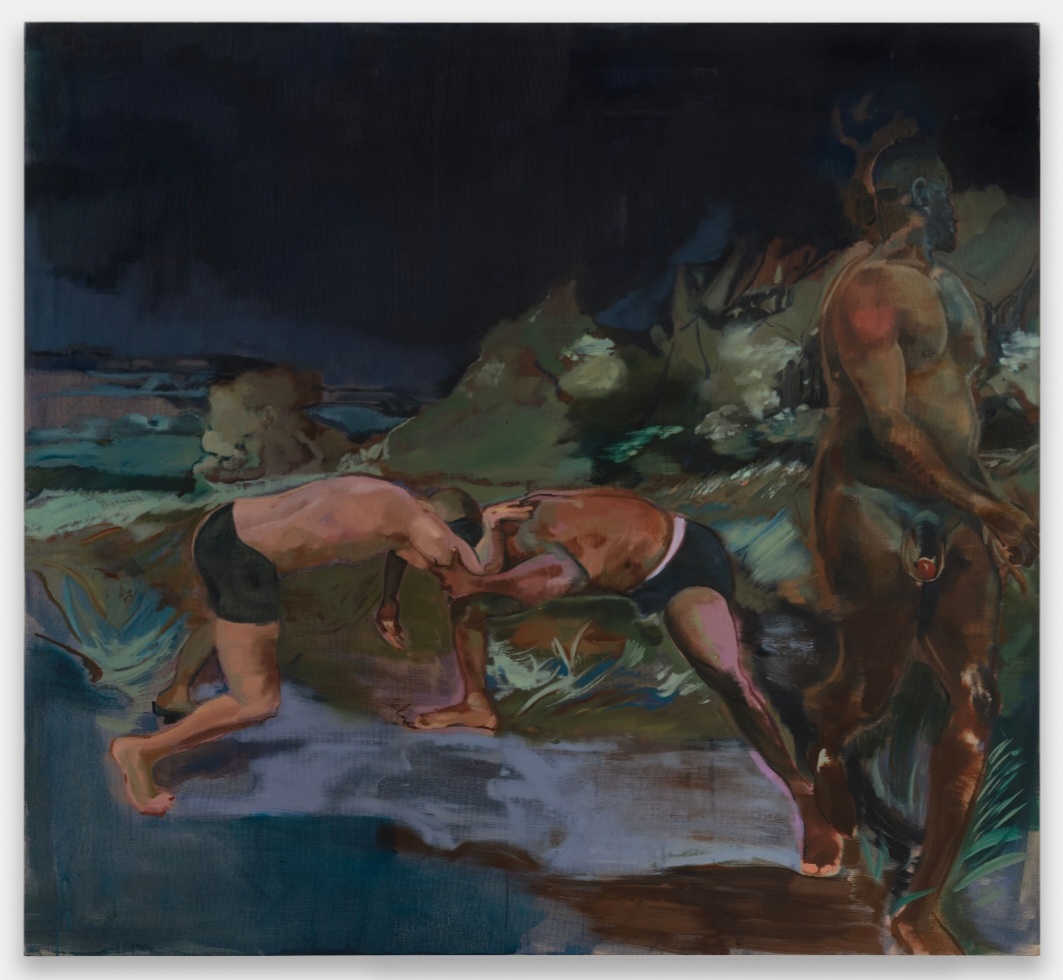
In his paintings, Shaqúelle Whyte constructs imagined spaces charged with ambiguity, exploring the human condition through expressive brushwork, loosely rendered figures, and expansive compositions. His scenes hover between recognition and invention, creating worlds whose logic remains deliberately elusive.
Narrative is central to Whyte’s practice, although it rarely unfolds linearly. Recurring motifs and details connect seemingly separate paintings, while the theatrical structure of his compositions gives each scene the quality of an episode within a larger, unresolved drama. Figures occupy distinct positions within these spaces, establishing relationships whose meanings remain open.
Gesture and mark form another essential dimension of this language. A turned body, a hand, a posture, or an averted gaze can redirect the meaning of an entire scene. His energetic brushwork introduces a parallel register in which every mark carries material presence as well as expressive charge. Meaning therefore emerges through the interaction between figure, gesture, and painterly action.
The figures also provide a route into the subconscious. Whyte does not represent himself directly; instead, everyday experience and inner life enter the paintings through invention, allowing personal thought and emotion to take form without becoming autobiography. This relationship between memory, identity, and imagined experience has become particularly pronounced in Nine nights; Strange fruit, presented at White Cube Hong Kong in 2026. Drawing on the Jamaican funerary tradition of Nine Nights and the historical resonance of Billie Holiday’s Strange Fruit, the exhibition addresses familial grief, diasporic inheritance, and fractured temporality through figures that split, converge, and repeat. Painting becomes a space in which memory can be reconfigured and experience held open rather than resolved.
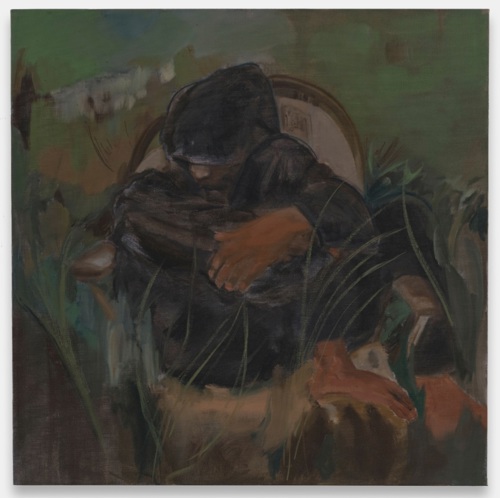
Shaqúelle Whyte, Inside Outside, 2025. Courtesy the artist and Pippy Houldsworth Gallery, London. Copyright Shaqúelle Whyte 2025. Photography by Eva Herzog.
Margherita Artoni (MA): You have described the canvas as a stage and your figures as actors. This theatrical dimension is evident in the way bodies occupy space, encounter one another, and appear to belong to a drama that extends beyond the limits of the image.
What does the idea of staging allow you to do within painting? How do you determine the positions, proximity, and relationships of your figures? At what point does the scene begin to acquire its own internal drama?
MA: A turned body, a hand, a posture, or an averted gaze can redirect the meaning of an entire scene. Your brushwork introduces another register of communication, in which the physical character of a mark can carry expressive as well as material weight.
Could gesture be understood as a form of visual syntax in your paintings? How do you think about the relationship between bodily signs and painterly signs? When can a gesture move beyond description and begin to generate meaning on its own?
SW: Gesture is something that I’m still trying to understand. Ultimately, I do believe that a lot of it is innate. I’m often trying to hold an understanding of pace within the work alongside the way in which I dictate a mark.
For me, the best thing about painting is that it’s fluid, especially oil paint. Rhythm is incredibly important, and I think this is where gesture can move beyond description. A mark doesn’t necessarily have to describe a body; it can begin to advocate for the body being one with the environment in which I’ve placed it. The bodily gesture and the painted gesture start to become part of the same thing.
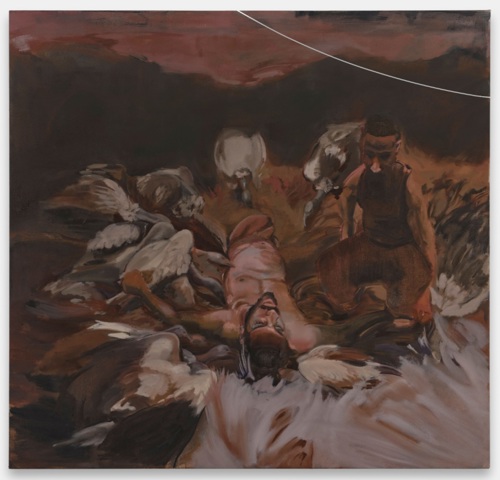
Shaqúelle Whyte, Prometheus bound; sky burial, 2025. Courtesy the artist and Pippy Houldsworth Gallery, London. Copyright Shaqúelle Whyte 2025. Photography by Eva Herzog.
MA: You have described the moment when “the canvas starts telling you what to do,” suggesting a process in which the painting itself can begin to determine its direction. This introduces a tension between intention and responsiveness, between what you bring to the canvas and what emerges through the act of painting.
How does this exchange unfold in practice? How much do you need to know before you begin, and how willing are you to follow a possibility that the painting introduces unexpectedly? What role do instinct and conscious decision-making ultimately play in determining when a work is complete?
SW: I wish I had a more interesting answer to this question because the question itself is amazing, but I suppose it’s something that’s really difficult to explain. During the process of making a painting, there are moments where intuition is leading the practice. However, as I’ve come to better understand the way in which I approach paint, I’m also better able to replicate certain ways that I want the paint to behave and understand how those decisions affect the whole.
For example, when I’m looking to delineate the body, particularly where there are multiple figures, transparency becomes integral to my understanding of how I can achieve form while still encompassing the environment. I’m trying to hold both at the same time.
There is conscious decision-making within that, but I also need to give space to serendipity. Ultimately, it is trying to maintain that balance—between what I know how to do and what the painting unexpectedly presents to me—that dictates the exchange.
MA: Your paintings often suggest stories without establishing a fixed chronology or definitive plot. Motifs and visual elements recur across works, carrying traces of previous contexts while acquiring new associations within each composition.
What interests you in constructing narratives that remain fragmentary? How do recurring elements function within this process: as fragments of a larger story, or as independent carriers of meaning that change with each pictorial context? What possibilities emerge when the viewer is given no definitive resolution?
SW: The idea that a painting can be fixed within its own philosophy, for me, leads to the work becoming stuck. The fragmented nature of my narratives reflects the varying places in which my paintings lie, particularly between my interests in literature and history painting.
Fragmentation allows me to build on initial ideas and draw from the chronology of my own work. Just because a painting has been made doesn’t mean that the idea within it can’t be reappropriated, reevaluated and used within another painting. An image or motif can return and mean something slightly different because its context has changed.
I’m trying to approach story from all different sides, much like a gyroscope. I don’t necessarily want the viewer to arrive at a definitive resolution, because I’m not sure I’ve arrived at one either. The painting can remain in motion.
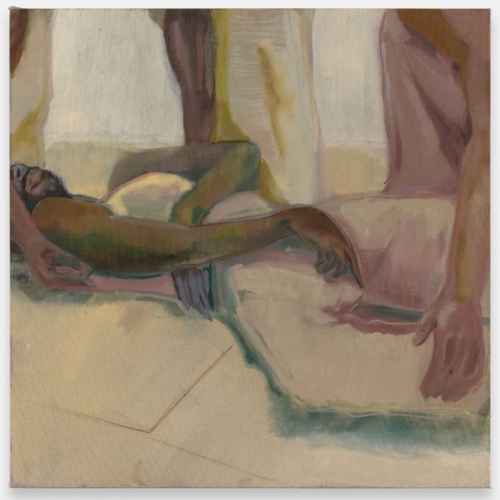
Shaqúelle Whyte, Next Breath, 2025. Courtesy the artist and Pippy Houldsworth Gallery, London. Copyright Shaqúelle Whyte 2025. Photography by Eva Herzog.
MA: Your figures frequently appear absorbed in states that remain inaccessible to the viewer. Faces may be obscured or turned away, creating a distance between the depicted subject and the person looking at the painting.
What does this withholding make possible within figuration? Can limiting access to a figure’s interiority produce a more intimate encounter with it? When you paint a psychological state, are you seeking to define it, or to preserve its opacity?
SW: For me, withholding reflects my interest in the bodily notions of painting rather than the directness that comes with a figure facing the viewer. When I do paint a psychological state, preserving its opacity allows me to continue understanding the question proposed within the painting, or even the idea that I’m trying to explore as I’m making it.
I don’t know whether I’m limiting the figure’s interiority so much as the figures themselves are uninterested in the viewer. The reality in which they exist is happening right then, right now. They’re concerned with that particular moment in time and don’t have the luxury to consider anything else.
I think that distance can actually create a different kind of intimacy. We are allowed to witness the figure without necessarily being acknowledged by them or being given complete access to what they are thinking.
MA: Your practice enters a longer history of Black figuration while also opening the figure towards intimacy, fantasy, psychology, and ambiguity. You have spoken about artists including Kehinde Wiley, Jennifer Packer, Kudzanai-Violet Hwami, Hurvin Anderson, Kerry James Marshall, and Lynette Yiadom-Boakye as important points of reference in expanding your understanding of what Blackness can encompass within painting.
Which artists have most significantly shaped the way you think about the Black experience through painting? What have their approaches made possible for your own practice, formally or conceptually? How do you negotiate the space between making work from within a specific cultural experience and allowing the Black figure to exist beyond any predetermined narrative of Blackness
SW: Primarily, it has been Jennifer Packer and Michael Armitage. The fluidity that their painting presents, as well as the steadfastness of their practices, is something that I look to emulate within my own.
When it comes to making work that explores the Black experience, it’s also to say that I’m exploring my own life. I am Black. That’s something I wouldn’t change, and I would be in every lifetime. The questions that I ask within my paintings, and the fluidity that comes with painting possible answers to those questions, come from my experience as a Black man.
I don’t want to take on any preconceived notion of duty towards what a Black narrative should be. Rather, I’m trying to make work that is truthful, and I think that is how I’m able to get closer to presenting the specificity of Black cultural experience.
It isn’t something that I’m trying to orchestrate. It already exists in every interaction that I have with the world, and therefore inevitably exists within the paintings.