
Sedrick Chisom: The Architecture of Myth
Sedrick Chisom’s practice explores painting as a space where history, mythology, speculative imagination and visual memory converge.
Drawing from religious iconography, mythology, archival sources, popular culture and speculative fiction, Chisom creates complex pictorial environments where different temporalities coexist. His paintings investigate the formation of power, authority, belonging and violence through the narratives and images that organise social imagination.
Moving between painting and writing, Chisomapproaches artistic practice as a form of myth-making: a process through which inherited images and narratives are transformed into new symbolic landscapes. His work explores the relationship between memory and invention, revealing painting’s capacity to generate alternative modes of perception and new ways of engaging with reality.
In an era defined by the constant production and circulation of visual information, Chisom’s paintings return attention to the construction of meaning itself. They ask how narratives are created, inherited and transformed, and how painting can remain a space for speculative thought, critical reflection and the invention of new visual worlds.
This conversation explores Chisom’s approach to world-building, the relationship between painting and writing, the role of mythology and historical fragments, the material dimension of the painted surface, and the continuing potential of painting as a medium for expanding our understanding of images.
Margherita Artoni (MA): Your practice moves across painting, writing, mythology and historical research. Through these interconnected forms, you construct speculative worlds and alternative frameworks of interpretation. How do you understand world-building as an artistic practice, and what possibilities does it open within painting?
Sedrick Chisom (SC): World-building is crafting a fictional history, language, geography, politics for an invented world, is usually associated with low culture like comic books, serialized fiction, video games, the MCU action films etc. I like it for that reason actually. There’s something vital about the fact that the methodology of world-building feels intuitively incompatible at the level of taste with proper painting, critical painting, and institutional art. But the incompatibility is social not formal/structural. Philip Guston, Thomas Pynchon, Joseph Beuys, Goya, Marcel Broodthaers, Sun Ra, Walid Raad, and Dante are all world-builders. The scandal of a world-building practice is that it discloses the world as socially crafted and reproduced from belief. In other words what’s scandalous isn’t that world-building is serialized daydreaming so much as that it exposes the artifice in the things that exist in the sacred position within the social order, such as political documents, legal rituals, borders, historical narratives and maps. It interrupts the feedback loop between pre-reflective belief and reification of power. The MFA-speak critique of painting is that painting is historically too complicit in reifying the social construction of power to comment on the world in a way that isn’t problematic—and I actually agree with that. The pitfall of that critique is that it’s often sustained from a fantasy that an art form can exist in an outside position to the problem. Whereas rather than fantasize about Archimedean points I prefer to engage with painting from the vantage point of how painting is inescapably involved in the problem.
MA: Your practice has often been described as a form of myth-making, developing narratives and symbolic structures through both painting and writing. How do these two forms of expression inform one another within your practice? What different forms of knowledge emerge through their relationship?
CS: What is in common with the ways I use both mediums is that I’m absolutely allergic to telling the reader or viewer what to think. I guess also the same obsessive pathos drives both. However, the language I employ in my writing practice is often absurd, bureaucratic, declarative, religious, paranoiac-hysterical, in acrimonious separation from the situation it describes on the canvas, or a close reading of the surface. Humor feels more implicit in my paintings and often becomes more explicit in my writing. I write short stories occasionally. People often tell me that I write like a painter in that I’m not concerned with telling the reader what a character thinks. I don’t find access to interiority compelling, I like interiority to be frustrated or structurally withheld in some way as it is in painting. I would much rather say “the water tasted like TV static,” or describe how something appears, or describe the surface of an object than to present interiority. I think to me dialogue can be almost like poetic expression and doesn’t have to really drive the story. It’s more important to me to investigate in writing that someone is particularly animated by a form of speech more so than to describe what the content of that speech is. Notably when the fact of speech undermines the content of that speech. For example someone declaring “I don’t care!”—what is trying to be communicated in that speech is undermined by the fact that it is spoken. Something else is disclosed through the way the speaker is animated by their speech. In my writing what drives the story are incompatibilities and contradictions within a situation. In the psychoanalytic sense, desire is driven towards the object of satisfaction when it is obstructed from getting it. I haven’t really talked so much about painting because I almost always talk about it all the time and all day long, but my paintings are often more melancholic and filled with dread than my writing is. They’re visually intense, simultaneously oversaturated and muddy, materially charged, vaguely macabre in some ways, and I bring description and abstraction to the point where the two modes of painting collapse into one another. The repetition of key terms in the titles and the repetition of imagery, motifs, characters, and geography is what produces the sense that the paintings aren’t discrete interventions but that the sum total of them are grasped as a single unfolding moment.
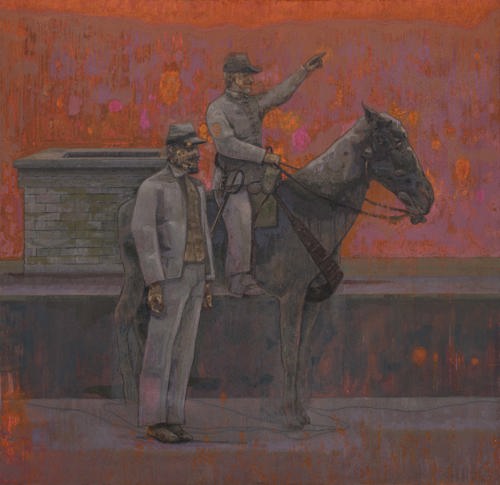
MA: Your works bring together historical imagery, theatricality, dark humour and elements of the grotesque. In The Villain of History for One Night Alone (2024), your exhibition at Pilar Corrias, London, you explored the figure of the villain and the narratives through which societies construct ideas of morality, power and conflict. How do these strategies allow you to examine the relationship between history, violence and representation? How can painting reveal the symbolic structures that shape collective imagination?
CS: With regard to violence, the most sensible way for me to think through direct representation is that historical violence exceeds representation, and that excessive representation of historical violence is paradoxically an insufficient vehicle for its content. That’s the basic problem of representation of historical trauma. So the problem isn’t simply how to represent historical violence, but how to represent the structures that make violence intelligible, legitimate, or even invisible to the people carrying it out. In that sense I’m not doing a straightforward representation of a chain of historical events but rather I’m trying through painting to a degree to present the symbolic logic inherited from history that remains active in the present. Also from the position of the figures I paint, it’s important to realize that they don’t experience themselves as villains. What we would call the apocalypse they would call a right-wing revolution. They’re villains from our position not necessarily from theirs. But the figures inhabit the problem of a symbolic structure that isn’t transparent to them, even as they actively reproduce it. I guess to simplify, the figures cannot register that they’re inside of ideology any better than we can. Painting gives me a way of estranging those categories and making them collide—historical genres, racial types, religious imagery, political mythology, caricature, fantasy—without pretending that I occupy some neutral position outside of them. Those are also some of the structures through which a collective imagination is produced. By forcing them into contradiction, the categories through which violence becomes intelligible can themselves become estranged enough to be seen.
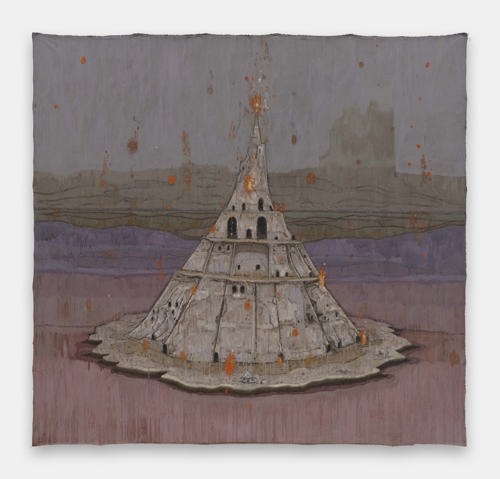
144,000 Believers were Lost to Lower Cloisters when the Occidental Tower Overflowed with Liquid Fire, On the Eighteenth of April, Regrettably Annulling the Year ofOur Lord, 2025. © Sedrick Chisom. Courtesy the artist and Pilar Corrias, London
MA: In The Revenants of Our Founding Furies, your exhibition at Matthew Brown in New York, different historical periods coexist within a single pictorial space, creating an expanded and unstable sense of time. How does this understanding of temporality influence the construction of an image, from composition and narrative structure to the development of the painted surface?
SC: I’m so invested in this idea that the past is always active in the present. And it’s not even some woo woo thing either, I think it’s really practical. The decisions of yesterday are active in the constraints of today. You can test this. If you badly procrastinate on a really important task early in the day you can observe how that delay carries into the present. Time you stole from yourself earlier echoes into the present and compounds, mutates, and may even organize your decisions. What’s that got to do with painting? The formal and material decisions you made already set the constraints and produce agency for the next decisions. Those subsequent decisions retroactively change the context of the prior decisions. Anyone who’s ever made a mistake, then seen their mistake become the best decision in the painting because of what they do after the error, knows this from experience. At the level of image-making those material decisions can affect my own execution or description and vice versa. Material incidence i.e. drips, splatters, sanding down the paint too much, laying on the paint too thick, etc. can become the narrative event in the painting. Sometimes the figures will be spread across different time periods but connected through an underlying historical edifice in the same way that the modern city of London exists on top of the roads that were built during the period where Rome established Londinium as a settlement. So in one image I might have figures from the American Revolution, figures from Greek myth, architecture from slave plantations, cows from the open range era, and military technology from the Civil War, acting on one another in the same pictorial plane. They could also be reacting against a prior stage of the painting that was thought through the idiom of Color Field abstraction. That prior Color Field ground will typically be active as the organizing principle that determines light and where shadows may develop.
MA: Your paintings contain multiple visual languages at once, inviting viewers to navigate complex symbolic systems. At the same time, their surfaces carry traces of accumulation, transformation and revision. What role do opacity, ambiguity and material process play in shaping the experience of your images?
SC: I used the word “estrangement” earlier and I think that’s a key word here. Often the symbolic systems of the paintings feel like the depicted worlds have been subjected to a weathering system. Combinations of color and texture can be suggestive of bacterial mold, or oxidation, or chemical burn marks. Certain textures and surface conditions are often estranged from their normative contexts. For example a face might be painted like the surface condition of rock sediment, or the sky will feel like acids aroused from metabolic processes. Perhaps architectural and mechanical elements fulfil the pictorial function a human figure does based on how it is treated or inhabits space. I deliberately use the “wrong” decision in the context of my particular painting idiom, to punctuate a moment in a painting. That’s probably the closest thing at the level of painting I have to a strategy. So for example an edge could be too dark or too solid. A hand can be underarticulated, while another is overarticulated. The most pictorially distant object can be invested with so many layers of paint that it feels like the beginning of relief, while the most proximate object to the viewer can feel weightless and diaphanous. I basically like to fuck with the viewer and the viewer’s expectation of how passages in a painting “should” be executed.
MA: At a moment when images are produced and circulated with unprecedented speed, painting continues to insist on duration, attention and material presence. What can painting still offer that cannot be reduced to the circulation of images? And what possibilities do you think remain unexplored within the medium?
SC: Painting is not an image, or signage, or an illustration. It is often the interruption of those things. Painting’s stubborn capacity to divert the attention of the viewer from the given undermines its potential uses for instrumentality. I would say that painting is enriched by the exploding production and circulation of images. Viewing painting as degraded because of its situation in a networked image cult turns painting into a lost object: an imagined former satisfaction that never existed as such, but is retroactively constructed through its loss. Loss itself then becomes a source of satisfaction, like people now getting back into iPods or trad life. Nostalgia becomes a project of recovering an origin that was never actually possessed. Rather, a paradigm shift in painting is once again unfolding, as it did when photography was invented. I prefer to think that the novel circumstances painting encounters friction with mainly deepen what its history and tradition mean. Our insight into what it means to paint can only be enriched from inside of the paradigm shift. What those unexplored possibilities will turn out to be is as transparent to me as insight is to my soldiers. It’s just something we have to figure out through painting.
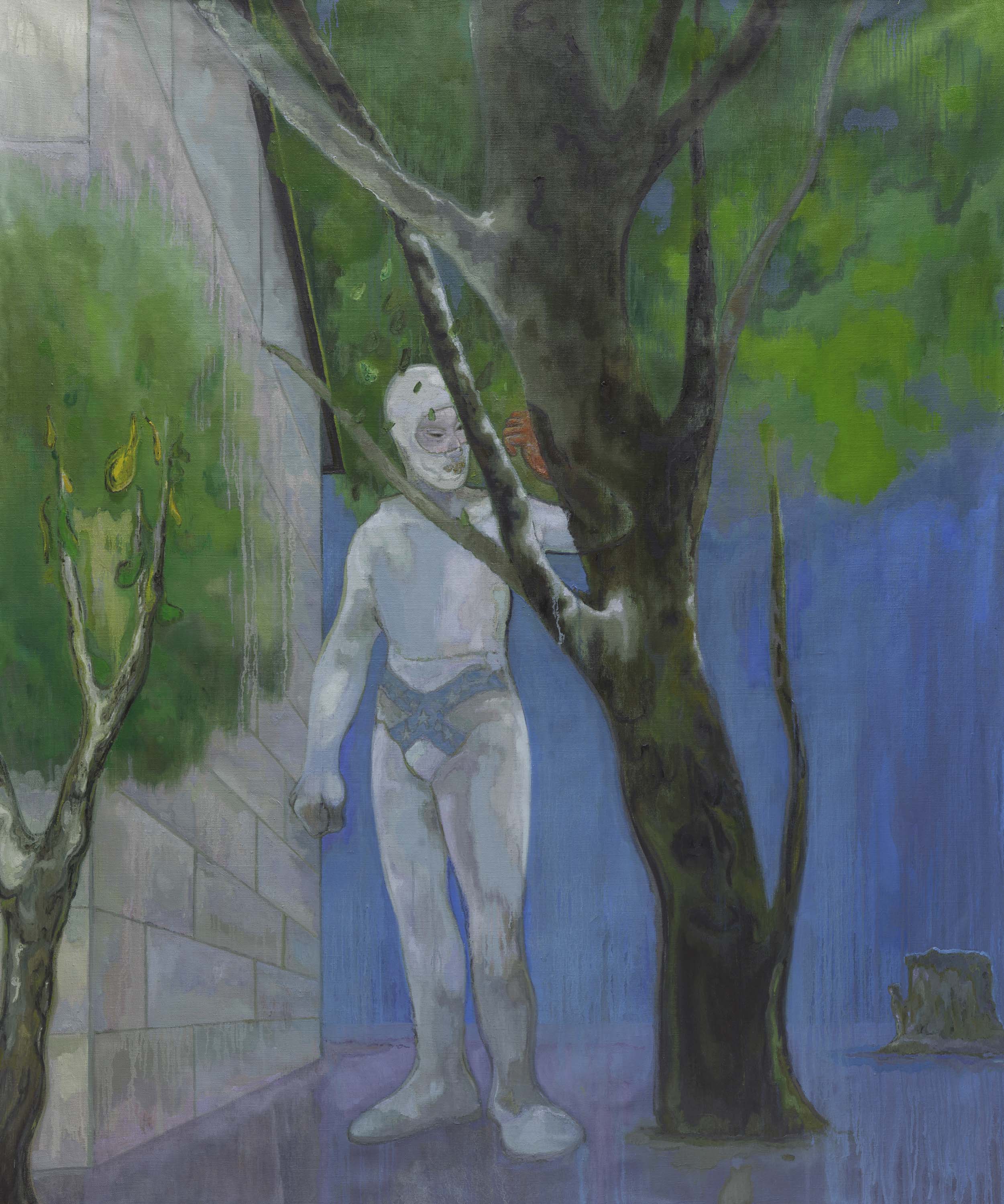
Main Image: The Hateful Heart of White Diver, A Harbinger of The Apocalypse, Whose Anguished Nativity and Bad Teeth Could not Disguised Blighted Hands, 2022. © Sedrick Chisom. Courtesy the artist and Pilar Corrias, London