
Scott Kahn: The Quiet Dislocation of the Familiar
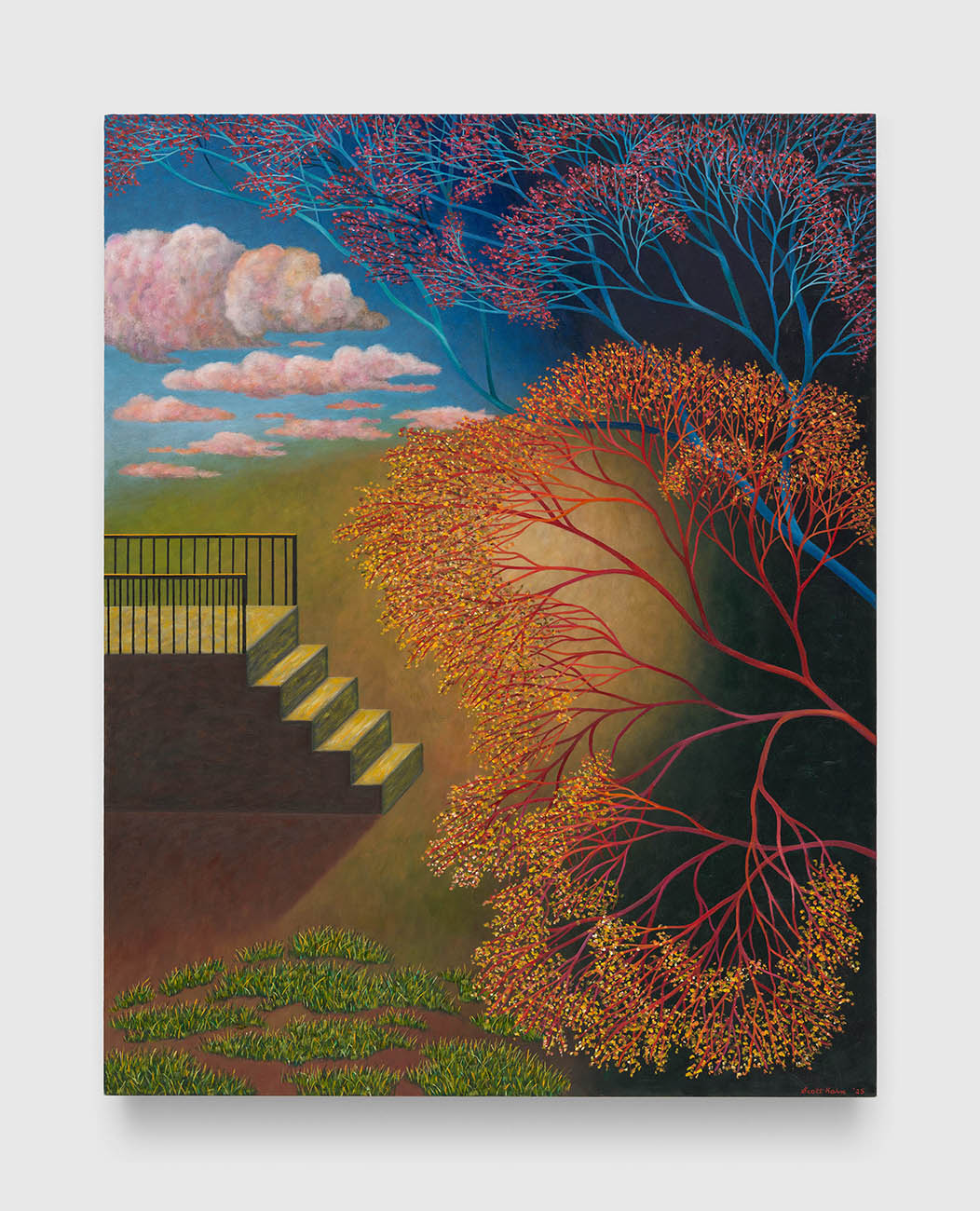
In his Silent Night exhibition at David Zwirner, Scott Kahn turns the familiar landscape into
a site of perceptual dislocation, where memory, estrangement, and belonging converge.
Houses, gardens, trees, and moonlit paths retain the clarity of everyday experience while
acquiring an elusive psychological charge. Their stillness conceals a subtle rupture: the
world remains recognisable, while its promise of belonging begins to falter. Kahn reveals
how places deeply known can become emotionally inaccessible.
His paintings inhabit the shifting ground between memory and perception. Carefully
composed scenes possess the peculiar lucidity of dreams, where every detail appears
tangible and the logic connecting them remains elusive. Landscape becomes a
psychological terrain, shaped by the friction between visible reality and inward experience.
In The Basement Window (2025), a Magrittean house frames an unexpected vision:
beyond the window, a tree bursts into bloom. The flowering tree unsettles the boundary
between interior and exterior, shelter and exposure, recollection and imagination. The
window, traditionally a promise of access, becomes a threshold between realities whose
relationship remains unresolved. The image holds the lucid strangeness of a dream,
allowing the extraordinary to enter domestic space with complete composure.
The house carries the intimacy of personal memory, its architecture preserving a past that
has grown difficult to inhabit. Kahn transforms the domestic interior into a site of perceptual disalignment, where recollection acquires the instability of an image encountered for the first time. As in René Magritte, the uncanny emerges through a quiet disturbance in the ordinary.
A different emotional register defines Berkshire Nightscape II (2005). A snow-covered
landscape rests beneath the moon, its measured composition and near-symmetry evoking
peace and formal equilibrium. Suspended in time, the scene approaches an almost
absolute order. Its harmony creates a curious distance: the landscape offers visual refuge
while seeming sealed within its own serenity.
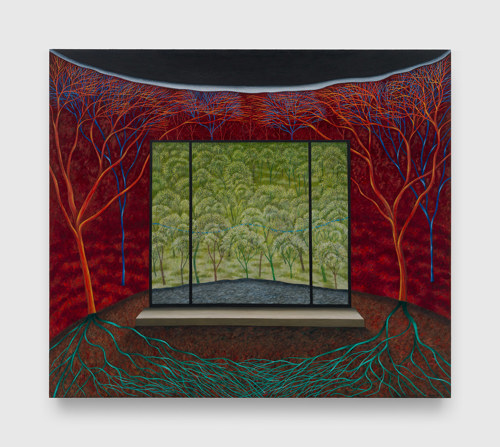
Scott Kahn, The Basement, 2025 © Scott Kahn Courtesy the artist and David Zwirner
This emotional reserve recalls Edward Hopper, whose spaces often hold a tension
between visibility and participation. In Kahn’s moonlit scene, solitude is embedded in the
composition. The eye finds balance; the self encounters distance. Tranquillity becomes an
ambiguous experience, inviting contemplation while withholding intimacy.
In Silent Night, Moon (2026), the nocturnal garden acquires a more animated atmosphere.
A path leads between two bushes at the edges of the canvas, toward a moon that seems
to dance beneath red clouds. The path establishes a direction, though its destination
remains uncertain. Against the garden’s stillness, the moon introduces a flicker of
instability, lending the scene an almost theatrical quality. Movement is suggested; arrival
remains suspended.
Kahn achieves conceptual depth through a strikingly flat pictorial language, a quality that
feels increasingly rare in contemporary painting. The clarity of his forms, the restraint of his compositions, and the absence of overt painterly drama lend the images an almost
disarming immediacy. His approach to flatness may bring Alex Katz to mind, particularly in
the way pictorial reduction sharpens the image’s presence. Kahn’s landscapes, however,
open onto a distinct psychological register. Where Katz’s pared-down surfaces often
intensify the encounter with the figure, Kahn’s distillation of the natural and domestic world
gives rise to a more elusive sense of place. Their formal simplicity holds a profound uncertainty: the eye grasps the scene at once, while the mind continues to wander through it.
Dissociation offers a useful metaphor for this condition: a distance opening between the
self and its surroundings. In Kahn’s work, this separation registers through perception
itself. Familiar forms persist as the sense of connection anchoring us to place begins to
loosen. His landscapes expose the fragile bond between recognition and emotional
presence.
Silent Night leaves the viewer in a state of suspended belonging. Its settings remain
optically accessible, while their emotional coordinates drift beyond easy reach. Kahn
reveals how little the world must change for our relation to it to become uncertain. We
continue to recognise the world—recognition alone may no longer be enough to make us
feel at home within it.
Main Image: Scott Kahn, The Leaves Have Fallen, 2024/2025 © Scott Kahn Courtesy the artist and David Zwirner