
Sang Woo Kim’s Façades: The Politics of Looking
A face carries the tension between personal identity and public perception. It invites
recognition while remaining vulnerable to projection, classification and desire.
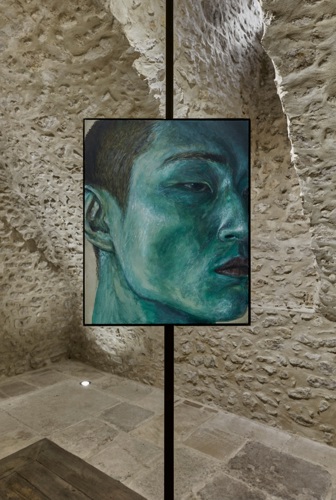
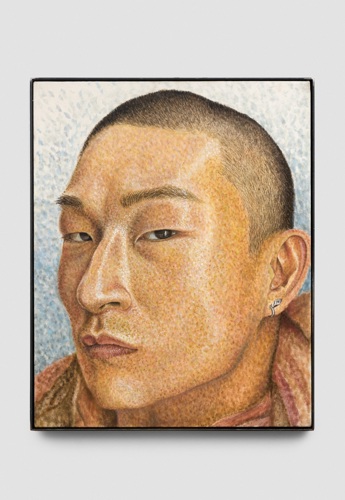
In Façades, Sang Woo Kim explores this unstable territory through five self-portraits, presented by Sébastien Bertrand at La Nicotière in Bourron-Marlotte. Marking his first solo exhibition in France, the presentation brings a longstanding inquiry into visibility to a new stage: for the first time in this series, Kim paints his full face.
The five canvases offer distinct painterly interpretations of the same likeness. Kim’s earlier
self-portraits often isolated facial fragments, allowing partial visibility to shape the
encounter with the viewer. Here, the complete face becomes the exhibition’s recurring
subject, while variations in painterly language prevent it from settling into a definitive
image. The series turns repetition into a method of inquiry: each portrait revisits the self,
exposing the limits of any single representation.
Kim’s investment in this question is rooted in his early experience of displacement and
difference. Born in Seoul and raised in Britain from childhood, he became conscious of his
visibility as one of the few Asian students at his school. At sixteen, he already painted a monumental self-portrait, an act he later described as “almost propaganda.” Its scale
asserted a presence within a social environment where his appearance already carried
significance. Painting became a means of entering representation on his own terms.
His subsequent work as a fashion model complicated that relationship with visibility. Within
commercial image-making, the face circulates as a recognisable surface, shaped by
aesthetic conventions and the expectations of others. Kim has reflected on the
racialisation and fetishisation that can accompany such visibility. His return to self-
portraiture reclaims authorship over an image that has also existed within systems of
external scrutiny.
The five portraits resist a simple narrative of recovered control. Their serial structure
presents identity as provisional, continually shaped by context, memory and the act of
looking. The full face offers greater visual access, yet the multiplication of likenesses
unsettles the assumption that visibility guarantees understanding. Kim’s self-image
remains open to revision.
The oval arrangement gives this inquiry a further dimension. Its sequence recalls the
systematic presentation of modelling digitals, where the face is documented for inspection
and comparison. At La Nicotière, repetition acquires a contemplative, almost devotional
quality. The portraits redirect the logic of external assessment towards sustained attention,
allowing the artist’s image to become a site of reflection.
The title Façades deepens this ambiguity. A façade is commonly associated with an
exterior that conceals an interior truth. Kim’s work complicates that division. A face is
shaped by lived experience and social interpretation; its surface is where these forces
meet. Identity emerges through this encounter, continually negotiated between self-
perception and the gaze of others.
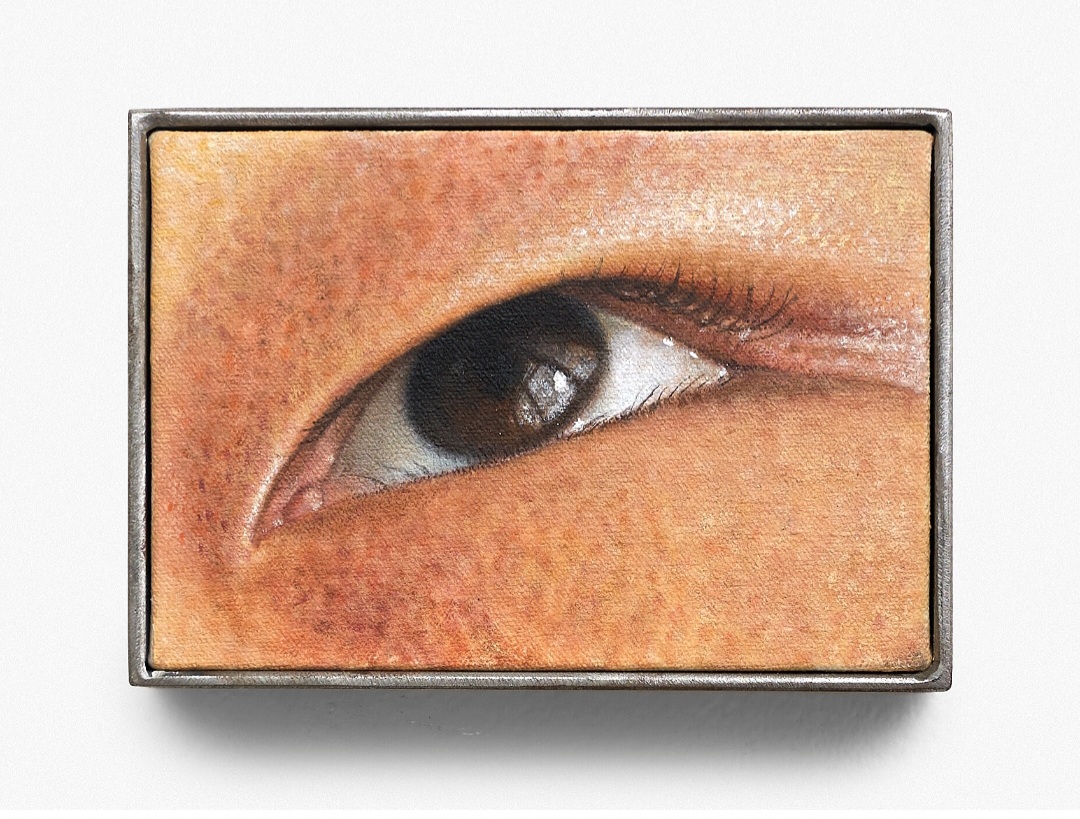
Differences in scale also shape the viewer’s encounter with the exhibition. Chiudi 031 and
Chiudi 032 (2026, oil on canvas, each 50 × 40 cm) belong to the central installation of five
self-portraits, sharing a format that establishes a sustained visual relationship among the
works. By contrast, La piega 009 (2026, oil on canvas, 10.2 × 14 cm) is presented
separately from this main grouping. Its smaller scale and distinct placement create a moreintimate, isolated encounter, rather than participating directly in the sequence of five faces. The contrast introduces different conditions of attention, from the more expansive canvas and the collective rhythm of the principal installation to the intimacy of the small format. This separation is significant: while the five self-portraits develop the exhibition’s sustained investigation of the face through repetition and variation, La piega 009 occupies a distinct spatial and perceptual position within the exhibition. Across the exhibition, presentation becomes part of the meaning carried by the recurring face.
Kim’s work has been discussed in relation to Jenny Saville and Lucian Freud, whose
practices foreground the painted body and the instability of likeness. Such affinities offer a
context for his engagement with figuration, while Façades directs attention towards a more
specific concern: the social life of the face, and the ways images acquire meaning through
the circumstances of their production and reception.
Eugene Yiu Nam Cheung describes the paintings as a “theatre of self interrogation,” suggesting that viewers may find themselves reflected in Kim’s world. This observation extends the exhibition beyond autobiography. The viewer enters the encounter carrying habits of recognition and assumptions about identity. Looking becomes an active part of the work’s subject.
Phin Jennings’s writing on Kim’s adolescent self-portrait traces a connection between that
early assertion of presence and the artist’s continuing examination of visibility. Façades
returns to this history with a more expansive image of the self, while preserving the
uncertainty that has always accompanied representation. The five portraits offer no final
account of who Kim is; their differences keep the question alive.
At La Nicotière, self-portraiture becomes an inquiry into the conditions of seeing. Kim
places his face before the viewer as a changing, contested image, shaped by both agency
and interpretation. The exhibition’s force lies in the distance it preserves between visibility
and knowledge—a space where identity remains in the making.
Main Image: Sang Woo Kim, The Fold 009 Courtesy the artist and Sebastien Bertrand, photo Studio Graysc