
Rose Wylie: Beyond the Hierarchy of Images
Rose Wylie’s exhibition Napoleon and Wild Flowers is on view at David Zwirner, on the
fifth and sixth floors of H Queen’s, 80 Queen’s Road Central, Central, Hong Kong, from
November 24, 2026, to March 6, 2027.
At first glance, Napoleon and wild flowers seem to inhabit entirely different worlds. The former evokes the grand narratives of history, conquest and power; the latter belongs to the modest, often overlooked details of the natural environment. In Wylie’s exhibition, however, these distant territories enter into a compelling dialogue. Their encounter unsettles familiar hierarchies of scale and significance, bringing an emperor, a cinematic character, swimmers and flowers into a common pictorial universe. What connects them is the artist’s ability to extract unexpected possibilities from apparently unrelated sources.
This approach is already evident in Sitting on Bench, Red Shadow (2007), a painting recalling a scene from Pedro Almodóvar’s Volver (2006), featuring Raimunda, played by Penélope Cruz. Wylie does not reconstruct the cinematic episode or pursue a conventional likeness. She selects and accentuates distinctive features, transforming the figure into something immediately recognisable and entirely her own. The character retains an echo of the film while acquiring an independent presence. The result is closer to an impression held in memory than to a traditional portrait. Delicacy ultimately prevails over any attempt at monumental construction: the figure’s vulnerability and lightness lend her an almost suspended quality, as though she were emerging from the uncertain territory between recollection and appearance.
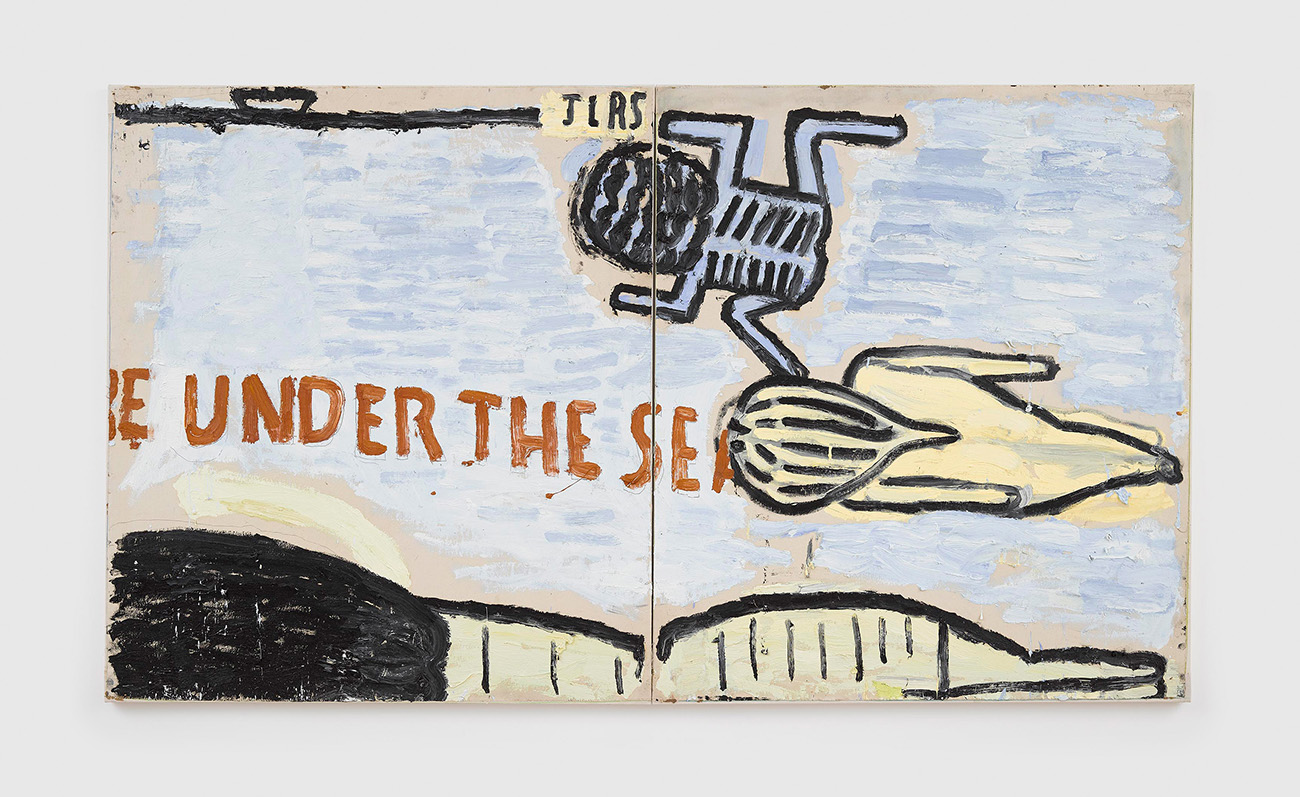
A different form of suspension defines Under the Sea (2020). Its title plays on the Beatles’ song “Octopus’s Garden”, while the initials of Ringo Starr and John Lennon, inscribed at the top of the painting, introduce another layer of popular-cultural reference. Below them, swimmers appear suspended mid-current. The work draws on Wylie’s lifelong love of swimming and the sea, which she associates with a metaphysical dimension, a realm released from gravity and the usual limits of beginning and end. Water becomes an alternative spatial order in which bodies lose their terrestrial weight and familiar perspectives dissolve. Music, personal experience and bodily memory converge in a composition whose meaning remains open.
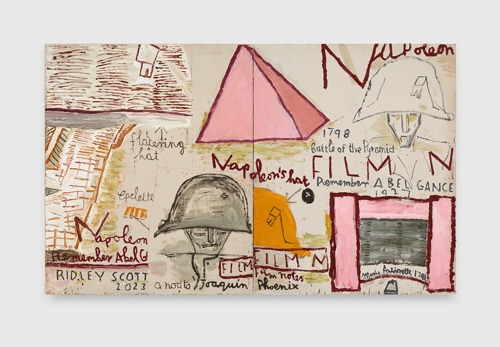
Rose Wylie, Napoleon (Film Notes), 2026 © Rose Wylie Courtesy the artist and David Zwirner
The pictorial register of Napoleon (Film Notes) (2026) is markedly different, charged with an almost arrogant force. Revisiting her impressions of Ridley Scott’s 2023 film Napoleon, Wylie approaches the emperor and the imagery of military history through fragments of recollection. References to the Battle of the Pyramids and to 1798 coexist with the discontinuous character of film notes. The diptych does not seek to provide a historical account. Its assertive composition, emphatic forms and expansive energy make painting itself the principal event. Napoleon’s authority is absorbed into a pictorial construction whose force derives from gesture, scale and compositional intensity.
The distance between the delicacy of Sitting on Bench, Red Shadow and the assertiveness of Napoleon (Film Notes) reveals a central quality of Wylie’s practice. Restraint and excess, vulnerability and visual aggression, intimacy and monumentality constitute complementary registers within an artistic language that resists fixed stylistic definitions. Her consistency resides in the independence with which she approaches each subject, continually recalibrating the relationship between image, gesture, scale and meaning. The unity of her work emerges through this freedom of movement.
Colour provides a further, subtler source of cohesion. Wylie’s often delicate, muted tonal palette establishes a shared atmosphere across works whose subjects and emotional registers may appear almost dichotomous. This chromatic sensitivity creates visual kinship between cinematic figures, historical protagonists, swimmers and wildflowers, allowing each painting to preserve its individual character within a recognisable artistic universe. The continuity is understated, yet essential: it binds together disparate compositions without diminishing their differences.
This interplay between individuality and coherence reaches a particularly concentrated expression in the new wildflower series. Across six canvases and accompanying works on paper, Wylie turns her attention to plants that might otherwise pass unnoticed. Each flower occupies the centre of a canvas approximately six feet high, enlarged to a scale that confers prominence on what is ordinarily considered modest or incidental. The backgrounds are built up through thick layers of paint, creating satiny smooth surfaces against which the distinctive qualities of each plant become more pronounced. The flowers are graphically rendered, retaining specific characteristics and variations that connect them to the observed natural world. Painted from memory as well as from life, they inhabit the space between attentive observation and imaginative transformation.
The series draws on sixteenth-century German botanical drawings and the miniatures of the fifteenth-century illuminated manuscript Très Riches Heures du Duc de Berry. These references provide a historical context for Wylie’s interest in the formal qualities of plants. Her approach, however, extends beyond botanical description. She isolates the expressive potential of each flower, allowing its particular shape and presence to acquire an autonomous pictorial identity. The concept of synecdoche offers a useful interpretative key: the individual flower becomes a fragment through which the larger natural world can be apprehended. Its particularity opens onto a wider reality, turning an apparently minor detail into a point of access to the universal.
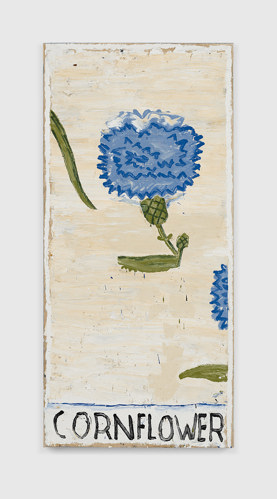
Rose Wylie, Cornflower, 2026 © Rose Wylie Courtesy the artist and David Zwirner
In Daisy, Cornflower and Dark Red Stalk (all 2026), this transformation assumes distinct forms. Their enlarged presence draws attention to the singular character of each plant, while the relationship between figure and background establishes a different internal balance in every composition. The apparent simplicity of the motifs conceals a more complex pictorial process: each flower remains recognisable while acquiring a heightened, almost unfamiliar presence. Fritillary (part study) (2026) introduces a more provisional dimension. Its designation as a study suggests an image still engaged in the process of looking, selection and transformation.
Wylie’s interest in botanical forms also has a longer history, evident in Blackberry Leaf (1997). Focusing on the leaf rather than the flower or fruit, the painting transfers to canvas a composition first developed on ruled paper. Its spiny, almond-shaped form reveals an enduring fascination with the beauty of everyday natural elements, including those whose unrefined qualities might ordinarily escape attention. The new series therefore extends an investigation that has accompanied the artist for decades.
Certain affinities with other artists help situate Wylie’s approach within a broader history of modern and contemporary painting. The irreverent transformation of familiar forms recalls Philip Guston, whose work Wylie has admired. Paula Rego offers a point of comparison in the psychological charge that recognisable figures and situations can acquire, while the enlargement of ordinary subjects may evoke Alex Katz. Wylie’s attention to the essential structures of plants also invites consideration alongside Ellsworth Kelly’s botanical studies. These connections remain interpretative rather than genealogical. They illuminate aspects of her practice while leaving intact its distinctive independence.
Ultimately, Napoleon and Wild Flowers establishes a porous boundary between representation and imagination, history and memory, the monumental and the everyday. Cinema, popular music, personal experience, historical imagery and the natural world provide Wylie with a varied repertoire of references. Through selection, displacement and pictorial reinvention, these sources enter a language governed by the internal demands of painting. The exhibition consequently resists any stable hierarchy of subjects or established division between high and low, grand and ordinary.
Napoleon and the wildflowers embody two different scales of attention, brought together through the same artistic freedom. The flower expands until it commands the space traditionally associated with monumental subjects; the emperor, meanwhile, becomes part of a field of images open to reinterpretation. Their encounter changes the way significance is assigned to what we see. In Wylie’s paintings, the act of looking becomes an invitation to reconsider the value, scale and possibilities of every subject.
Main Image: Rose Wylie, Under the Sea, 2020 © Rose Wylie Courtesy the artist and David Zwirner