
Quentin James McCaffrey: The Architecture of Memory
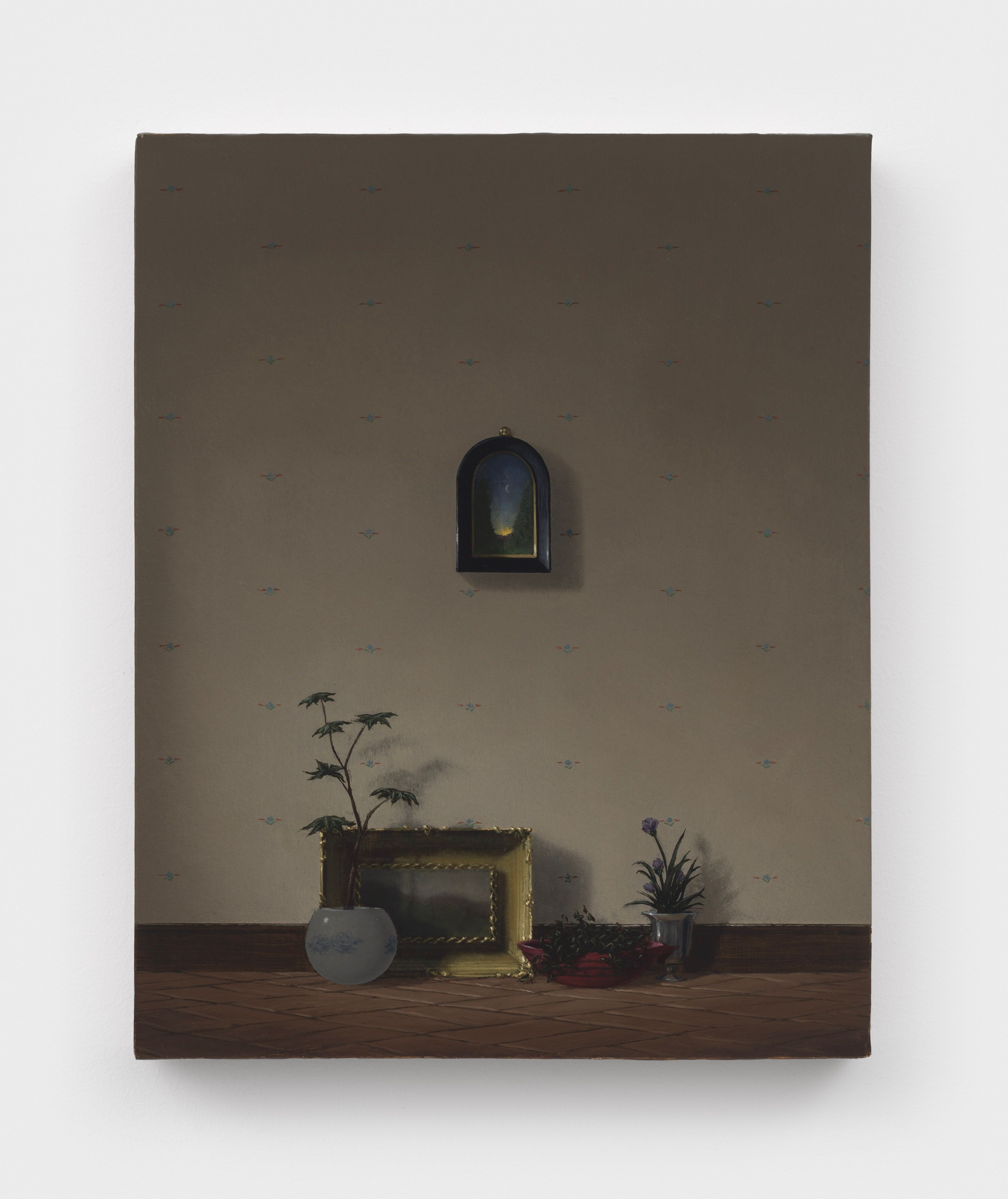
In an age saturated by images, Quentin James McCaffrey’s paintings propose a slower and a more contemplative mode of attention. Through carefully constructed interiors, architectural fragments and charged arrangements of objects, his practice investigates the relationship between perception, memory and imagination.
McCaffrey’s paintings occupy an ambiguous territory between recognition and invention. His interiors appear familiar while resisting a precise location, evoking spaces that seem remembered rather than observed. Like a Proustian fragment of memory, they are activated less by the reconstruction of a specific place than by atmosphere, sensation and the subtle return of impressions that have remained beneath consciousness.
His recent exhibition at Nicelle Beauchene Gallery further revealed the artist’s exploration of interior spaces as psychological landscapes, where architecture becomes a structure of recollection and projection. His forthcoming solo exhibition at Alison Jacques in London continues this investigation through imagined rooms, reflections and environments suspended between the real and the dreamlike.
Within these carefully composed settings, objects acquire a particular presence. Furniture, mirrors, flowers, framed images and architectural details do not simply occupy the painted surface; they establish relationships between absence and presence, intimacy and distance. An object can function as a synecdoche: a fragment that evokes a larger reality, carrying traces of memory, desire and human experience beyond its physical existence.
Colour plays a central role in McCaffrey’s practice. His restrained and carefully balanced palettes create atmospheres in which light, architecture and surface converge. Colour does not merely describe an environment; it determines its emotional register, shaping the psychological experience of the image.
Across his paintings, recurring motifs, reflections and images within images form a distinctive visual language. These elements operate as thresholds between the visible world and an interior dimension, where details become signs and fragments suggest narratives that extend beyond what is immediately presented.
In the context of contemporary image culture, McCaffrey’s work affirms painting as a space of duration, ambiguity and presence. His paintings invite a sustained encounter in which meaning emerges gradually, through attention, memory and the experience of looking.
Margherita Artoni (MA): Your paintings often depict carefully constructed interior spaces that feel familiar yet impossible to locate. These environments evoke psychological territories where architecture, memory and imagination intersect. They suggest places recalled through sensation rather than directly observed. How do you understand the relationship between physical space and inner space in your practice? How does an environment become transformed into a carrier of memory, desire and emotional experience?
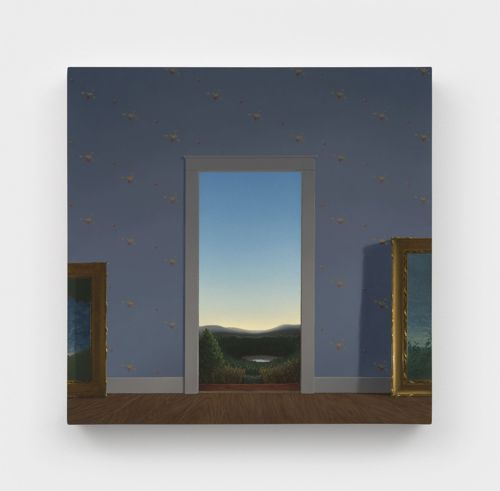
Quentin James McCaffrey View, 2026 Oil on canvas over wood panel 12 3/4 x 13 x 11/2 inches qmccaffrey162
Quentin James McCaffrey (QJM): I work from my imagination therefore the paintings come from my psyche. Composing intuitively, I try to clear my mind while working. This allows the interiors in my paintings to translate to a psychological interior. The exterior, or its effects, are obscured or distorted in most of the paintings. This creates and defines a tension between the interior and exterior.
The space that is built in the paintings acts as a stage or scene. Artists whose work often inhabits an enigmatic space, such as Magritte, Gertrude Abercrombie, Vermeer, or Giotto, clearly define the “stage” of the painting. These settings are simple invented planes on which the elements of the paintings are composed. I see a similarity in my work and think there is something in this way of working that charges the space depicted and allows it a level of intrigue.
MA: Objects occupy a significant role within your compositions. Mirrors, rugs, flowers, furniture and architectural details contribute to the atmosphere of each painting, creating subtle relationships between intimacy and distance, presence and absence. Do you think of objects as forms of synecdoche — fragments capable of containing or suggesting a larger reality beyond themselves? How can an everyday object become a vehicle for memory, desire or psychological meaning within the painted image?
QJM: When constructing a painting I don’t think about the semiotics of the elements within it. I’m considering formal elements such as composition and value. I think that because I don’t use specific references such as working from life or images it allows the objects to be symbolic. The context of the elements in the painting and their relationships to each other also plays a role.
MA: Your paintings reveal a remarkable chromatic coherence. Colour creates atmospheres in which architectural forms, objects and empty spaces acquire a particular emotional intensity. It guides the viewer’s perception of the painted world and establishes its psychological register. How do you approach colour within your practice? Does it emerge intuitively through the act of painting, or does it function as a structural element through which you construct relationships of mood, tension and meaning?
QJM: Often as I compose an image I will have an intuitive sense of what dominant colors suit that piece. Other times I see the image in my mind and it has a sense of color inherently. As I work, I consider the colors I have used so far when making decisions about further elements. If I have painted a wall taking up the majority of the picture plane, color decisions for objects sitting in front of it will be made in relation to what I have already painted.
This will continue for each element of the painting and I will adjust as I begin to see the painting as a whole. A discussion about color in painting is also tied to palette and the physical realities of paint and technique.
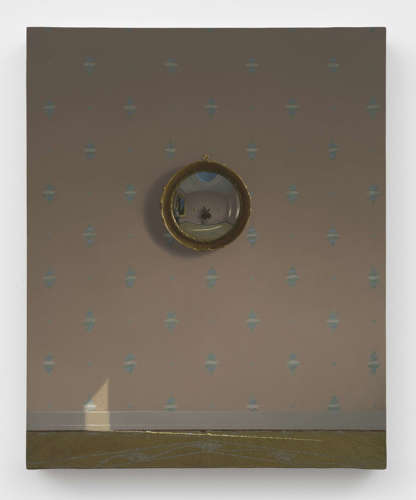
Quentin James McCaffrey Mirror with Sunbeam, 2023 Oil on canvas over wood panel 13 1/2 h x 11 w x 1 1/2 d inch qmccaffrey 069
MA: Over time, your work has developed a distinctive visual vocabulary of interiors, architectural structures, reflections and recurring motifs. This language feels both carefully formed and continuously discovered. How did you forge the iconography that defines your practice today? When you think about these recurring elements, do you consider them as signs whose meaning evolves through repetition and context?
How does the relationship between signifier, image and memory develop during the process of painting? How do you compose in the studio? Do you work on one painting at a time or across several works simultaneously? Do you create preparatory studies? Does distance or interruption allow a work to reveal itself more fully?
QJM: I grew up around a lot of antiques and art in domestic spaces. The relationships between these objects and spaces have had a strong effect on me. Since studying in Italy and looking at painters I admire, I have become attached to some enduring themes, formats and techniques. This has synthesized into the elements that reoccur in my work.
The vocabulary of my work is a pastiche of western art and interiors. It represents many times and places as filtered through my imagination and process. I see the present, or any point in time, as an accumulation of the past up until that point.
In the studio I am working on many paintings at once. Usually all the paintings for a body of work will be made simultaneously and will move together towards their finished state. This way of working allows me to consider the composition or cohesion of a body of work as a whole.
I begin paintings with a small thumbnail sketch and move quickly to a schematic translation of it onto the painting surface. I try to make as many decisions as possible on the painting as something is gained by the process and decisions I make while working. As I work, paint needs to dry and I do not always know the next action to take. This time allows me to work on different paintings while I consider what to do.
MA: Your paintings emerge from a highly personal vision of space, memory and perception. They reveal a particular way of seeing, yet once an image enters the world it becomes open to the experiences and associations of others. Do you feel a responsibility toward the vision that your paintings communicate? What role can the artist’s vision occupy today as a way of revealing forms of experience that might otherwise remain unseen?
QJM: My role is to shepherd the work into existence and to create the conditions to allow the work to be seen in a suitable context. I think it is dangerous to prescribe an experience or interpretation. I’ll only say that the scale of my work and the intimacy it requires allows for a type of encounter that I hope for viewers.
MA: At a moment when images are produced and circulated with unprecedented speed, painting continues to insist on duration, attention and material presence. What can painting still offer that cannot be reduced to the circulation of images? What possibilities do you believe remain unexplored within the medium?
QJM: To make a painting is to build an idea or image in a physical reality, inseparable from material, through process. This is an alchemy that allows something greater or different to emerge from its parts. Despite the profusion of images, this has not changed. Through contrast, the unique attributes of painting may be further valued. What makes artwork new and interesting is an artist’s honest and singular engagement with content, materials and process. As long as people are compelled to do this, which they are, previously unseen work will be revealed.
Main Image: Quentin James McCaffrey Sunset, 2023 Oil on canvas over wood panel 10h x 8 w x 1 1/2 d inches qmccaffrey 043