
Pam Evelyn: The Material Life of Painting
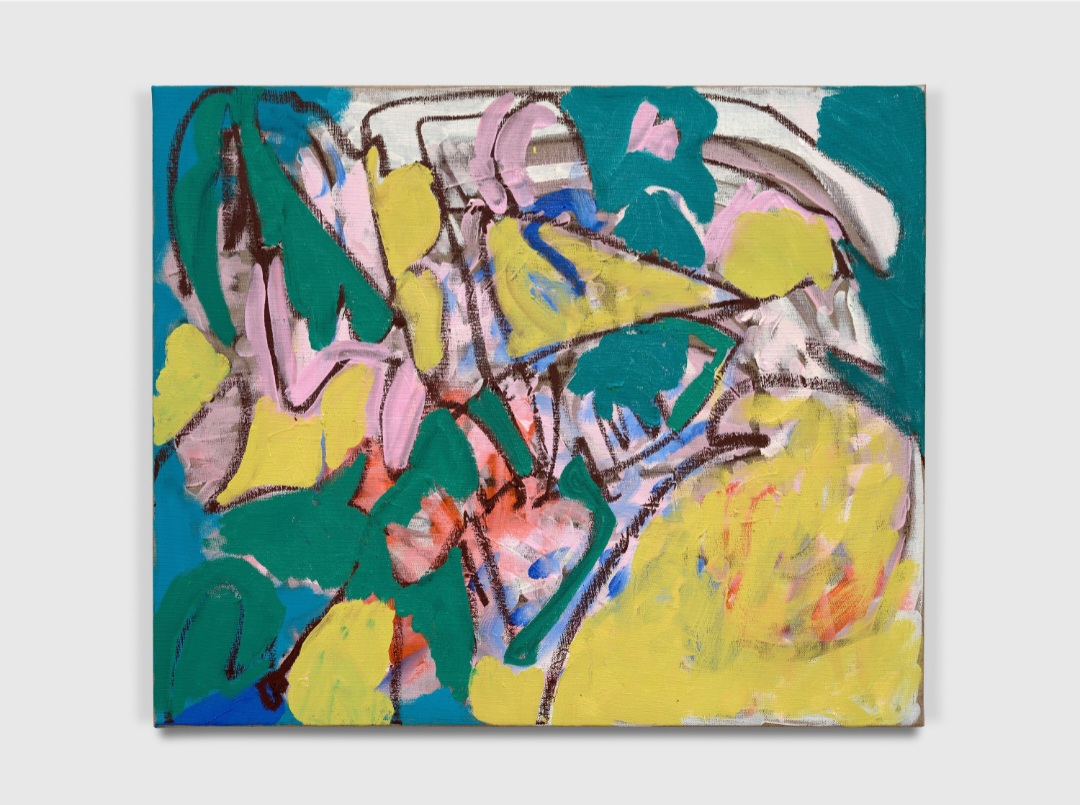
In an age saturated by images, Pam Evelyn’s paintings propose a different experience of
looking: physical, prolonged and deeply attentive to the life of the surface. Her expansive
canvases emerge through dense accumulations of oil, where colour, gesture, erasure and
matter remain visibly entangled. Occupying an unstable territory between abstraction,
figuration and landscape, forms appear, dissolve and return.
Evelyn works intuitively, allowing each canvas to redirect her decisions as it develops.
Paint is scraped away, reapplied, buried and recovered; drips, stains and blemishes
preserve traces of previous actions. The surface becomes a palimpsest in which
destruction and renewal, chance and control continually intersect.
The body is integral to the scale of the work, the movement of the brush and the pressure
of the gesture. Bodily and landscape structures intermittently emerge within the
abstraction, while nature operates as rhythm, structure and sensory experience. More
recently, Evelyn has turned her attention towards the urban environment, finding in
London's glass architecture, shifting reflections and urban rhythms a different kind of
nature, one that exists within the city walls. Her paintings become spaces where visual
experience and physical memory converge.
Colour carries its own agency. Saturation, transparency, density, luminosity and contrast
establish the atmosphere of each work, while accumulated marks create a distinct sense
of duration. Earlier decisions remain embedded within later ones, turning the finished
canvas into a record of changing perception.
These concerns also resonate in The Wild Asphalt, Evelyn's forthcoming exhibition at
Pace Gallery in Seoul, where the visual energy of the urban environment meets the
material and gestural language that has long defined her practice.
The title Salvaged Future resonates with Evelyn’s approach: what is removed survives as
residue, scar, memory or potential. References to Lee Krasner, Monet and Géricault enter
the paintings without becoming quotations, bringing different histories of landscape,
figuration, gesture and abstraction into conversation.
At the centre of Evelyn’s practice is an evolving relationship between intuition, matter and
duration. Each decision creates the conditions for the next, allowing painting to become a
form of knowledge grounded in attention, physical experience and sustained response.
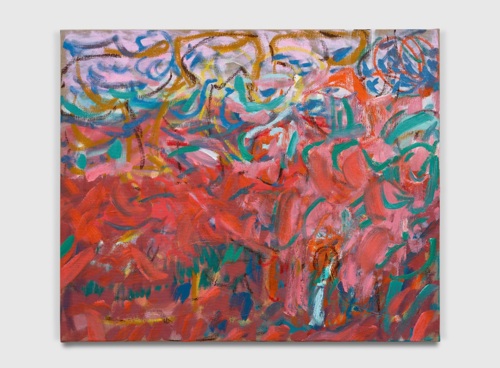
Pam Evelyn, Riviera Blues, 2026 Oil on Linen © Pam Evelyn/Pace Gallery
Margherita Artoni (MA): You have described your approach as deeply intuitive, allowing the painting to redirect your decisions as it develops. This requires a particular form of attentiveness: listening to what is happening on the canvas while remaining open to uncertainty.
What is your relationship with solitude in the studio?
Pam Evelyn (PA): Everything I did today had to be bad at a certain point. But then I realised there was value in all the bits I would normally reject.
My focus is really the thing I'm trying to work on.
But when you really break down what being in control actually means, it's a sort of game.
All you can do is keep setting up a zone where that can happen, leaving the door open to
possibilities.
MA: How does intuition guide you when the direction of a work remains uncertain?
PA: I remain sceptical about my intuition. Painting is winning right now, and I remain uncertain until I have a bold, brilliant day.
Your practice is intensely physical. Paint is applied, scraped, erased, dragged and
reworked over long periods, while the scale of your canvases makes bodily movement
integral to their making.
MA: How do you understand the relationship between painting and performance? Do you sometimes step back simply to contemplate what has emerged? Does a physical action become decisive enough to redirect the course of a painting?
PE: I'm just in that complex zone, you know, when you just paint to paint.
The things I want to play with are all shape-related.
I find figuration a bit limiting.
If I could solve just one thing in painting, it would be the simple relationship between
abstraction and figuration.
MA: Your paintings retain a sensitivity to figurative and landscape structures while remaining deliberately unstable. Nature and the body can appear as underlying subjects, emerging through forms that hover between recognition and abstraction.
How do these elements interact within your work? Are you translating specific
visual experiences, or responding to rhythms, structures, sensations and memories
associated with them?
PE: Whenever I turn and look at nature, I find it so dynamic, full of energy. My paintings are both landscape and abstract.
I just turned my back on the usual coastal landscape I would draw from. London life
became more appealing to me, especially all the glass and reflections. There is an
alchemy in the city. I became excited by this, drawn to a nature that exists within the city
walls.
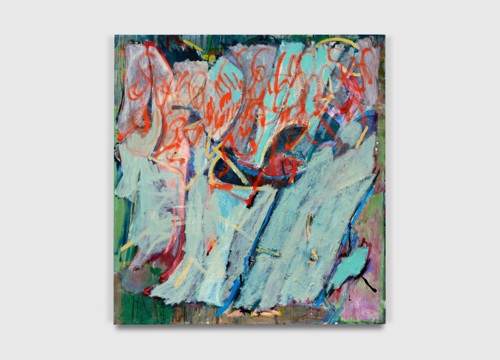
Pam Evelyn, Urban Grit, 2026 Oil on Linen © Pam Evelyn/Pace Gallery
MA: What draws you towards an image that resists a fixed reading?
PE: I love it when a gesture runs out of space.
MA: Colour and mark constitute a distinctive vocabulary throughout your paintings. Saturation, transparency, density, luminosity and contrast establish complex relationships, while recurring forms of mark-making contribute to the identity of each canvas.
How did your chromatic and gestural language develop? Do particular choices originate in observation, memory, intuition or the demands of the painting itself? At what point does a colour or mark become necessary to the work?
PE: The playful and emotional gesture of the hand is demonstrative of what one is thinking.
There is always potential in painting to revisit things.
MA: Your paintings develop over extended periods, accumulating drips, abrasions, erasures and blemishes. These traces preserve evidence of earlier stages and of the circumstances in which the work was made.
Do you consciously return to memories or sensations from earlier periods of your life while painting? Can the process provide access to experiences that have become difficult to recall directly? Can a mark continue to carry an emotional charge after its original impulse has become inaccessible?
PE: Drawing into accidents, there's an awkwardness about my own involvement in the work.
Invention is how I go in, with the unresolved grotesque falling into resolution.
MA: The title Salvaged Future suggests a process in which what has been removed remains present as residue, memory or possibility, while earlier decisions continue to inhabit the surface.
In a culture where images are produced and discarded with extraordinary speed, what can a large-scale painting offer through duration and sustained attention?
PE: The playful and emotional gesture of the hand is demonstrative of what one is thinking.
Main Image: Pam Evelyn, Umbrella Pines, 2026 Oil on Linen © Pam Evelyn/Pace Gallery