
Nathanaëlle Herbelin: The Intimacy of the Unfinished
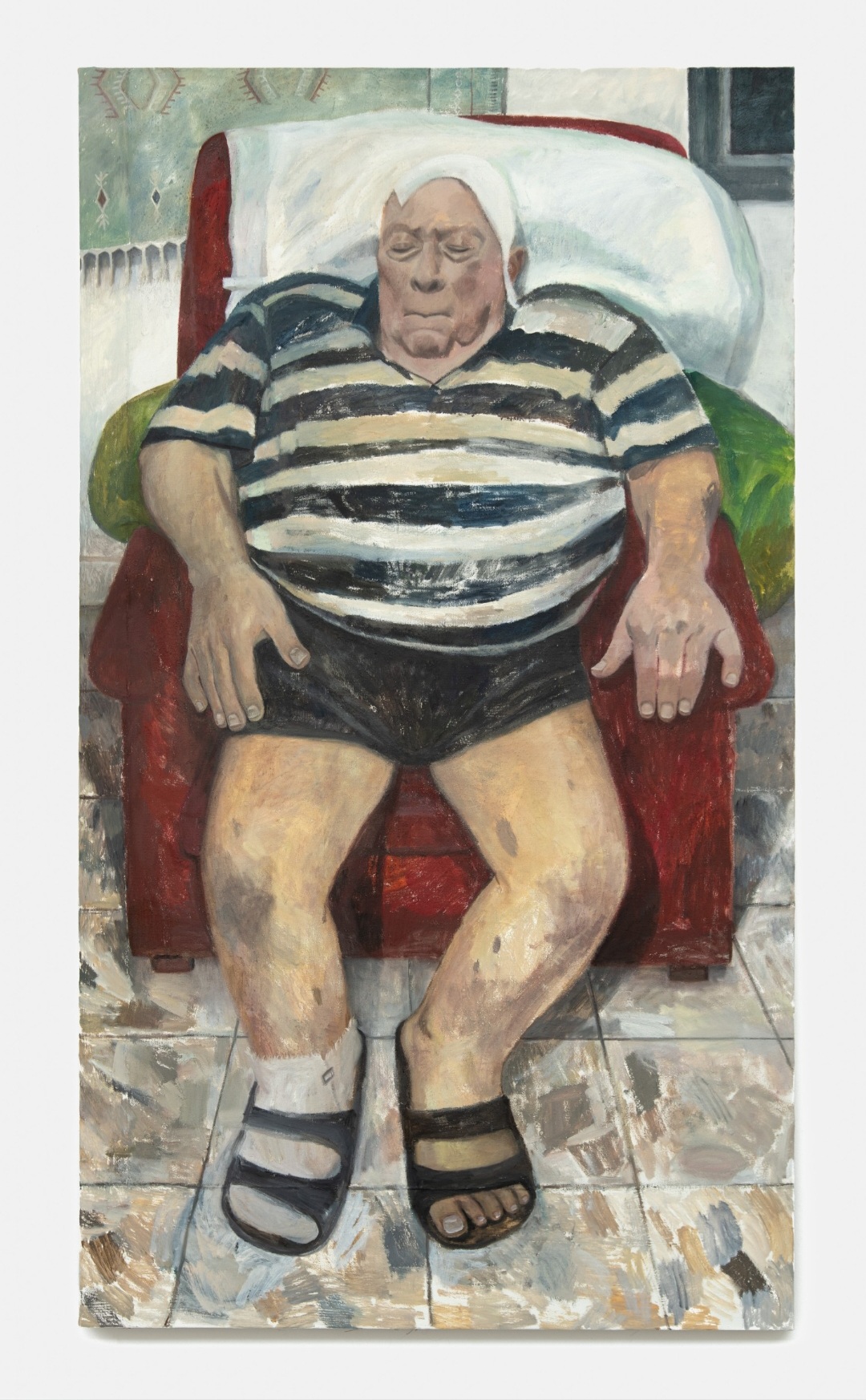
Nathanaëlle Herbelin’s paintings begin with the intimacy of everyday life: domestic interiors, bodies, relationships and moments that might otherwise remain unnoticed.
Born in 1989 to a French father and an Israeli mother and based in Paris, Herbelin has
developed a figurative language in which lived experience, memory and imagination are
closely intertwined.
Herbelin is inspired by late 19th century painting, which can be traced in her attention to the quotidian, sensitive gestures , flattened spaces and subtle chromatic dynamics. Her paintings nevertheless speak unmistakably from the present. Contemporaneity arises from her compositions alongside questions of gender, motherhood, the body and female pleasure. Historical references and present-day experience coexist within the same visual language.
Rooms function as mental landscapes: they absorb the presence of those who inhabit them, while objects, light and architectural details contribute to the atmosphere of each
scene.
They can also feel like pockets of suspended time: recognisable spaces temporarily detached from the chronology of everyday life, where a private moment seems able to continue indefinitely. Her muted chromatic language reinforces this sensation. Colour registers atmosphere, allowing emotion to remain perceptible without becoming explicit.
The relationships between figures are equally fluid. Tenderness, distance, care, desire
and estrangement can coexist within the same scene, while meaning shifts according to
the encounter between bodies, gestures and surroundings. Her figures and
environments often hover between definition and disappearance, giving the image a
sense of continuous becoming.
At the centre of Herbelin’s practice lies an understanding of intimacy as a way of entering into relation with the world. Individual experience becomes a point of contact with something shared, while the open structure of the image allows experiences to remain resistant to definitive interpretation.
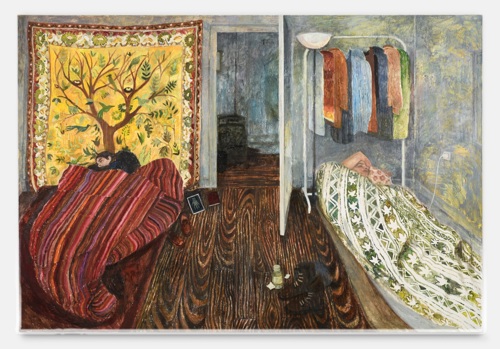
Nathanaëlle Herbelin, Undivided attention, 2023 oil on canvas. Photo Thomas Merle Courtesy: the Artist and Xavier Hufkens, Brussels
Margherita Artoni (MA): Your paintings often begin with people and situations that are close to you, while others emerge from encounters with strangers, landscapes and everyday scenes. Personal experience and observation seem to occupy the same field.
What does intimacy mean to you as a starting point for painting? How does proximity to
a subject affect your way of looking? Can painting create a sense of closeness with
someone or something you have only briefly encountered? How do observation and
imagination interact during this process?
Nathanaëlle Herbelin (NH): I paint the same way I have a conversation: this exchange is never about the weather, and it never has clear boundaries. I try to shape the studio as a safe space, where people can feel comfortable enough to share and open up to me.
Ideally, the studio should be able to contain any kind of information or emotion and be free from judgment or exploitation. Even though I believe everything can be a subject for painting, I would never accept being cynical or offensive.
I feel that my role is to shed light on my guests and their life stories, and to remain loyal to the way they reveal themselves to me.
So, for me, this is intimacy: it is a place where you can come, unpack the contents of your luggage, and feel relieved. I try to make the paintings as inclusive as possible, since I believe that all of us suffer from the same things, though under different names or in different forms. By painting portraits without a mise en scène or external ideas, and staying close to the reality of the person in front of me, I can make the painting more convincing.
MA: Domestic interiors are central to your work. Bedrooms, bathrooms and living spaces
seem to absorb the presence of the people who inhabit them, while objects, light and
architectural details contribute to their psychological atmosphere.
These rooms often feel like pockets of suspended time. They remain recognisable while
appearing detached from the chronology of everyday life, as though a particular moment could continue indefinitely. Your muted chromatic language reinforces this sensation, with colour registering atmosphere and leaving emotions partially unspoken.
What creates this sense of suspension for you? Can colour communicate through restraint, allowing an emotion to remain open rather than naming it? Can an interior convey a psychological state before the figures within it become fully legible? Do you think rooms retain traces of the experiences that take place within them?
NH: I am not sure whether rooms are pockets of suspended time, as many different
periods of time unfold within them. Although rooms, for me, are like portraits of people, there is no single clear owner; many people could have lived there. They are influenced by the architectural past, as well as by the character or mental state of the person inhabiting them in the present. For example, the room of an addict might be filled with the tension of craving, while the room of a depressed woman might convey a sense of claustrophobic distress. I paint many rooms like personal temples, filled with objects intended for purification, symbolizing both despair and hope.
I also paint many dinners and dinner tables. This must be related to the fact that I left my homeland and missed so many important family reunions. It is not only a matter of longing, but also a technical challenge: so many hands, eyes, and gestures. Even when it is just the table, without any human beings around it, I try to convey the spectres of those who inhabited the space and the dynamics that were present before.
Regarding my colour palette, I must admit that I have barely thought about it so far, and that my choices have mostly been intuitive. However,I have recently started experimenting with a new technique: I begin the painting on a monochromatic background, such as pink, deep green, or more traditionally, burnt sienna, and observe how the entire painting that develops over it is influenced by this constraint.
MA: You have maintained a close relationship with the collections of the Musée d’Orsay
since childhood, and your paintings have often been discussed in relation to Pierre Bonnard, Édouard Vuillard and Félix Vallotton. At the same time, phones, cables, laptops and contemporary forms of intimacy enter your compositions as natural elements of the present.
How do you understand your relationship with the Nabis? What allows a historical pictorial language to remain alive when it encounters contemporary experience? Do you consciously enter into dialogue with art history, or does it become absorbed into your
visual language through looking and practice?
NA: I must say that my interest in the Nabis is as strong as my interest in Fayum mummy portraits, ex-voto culture, Fra Angelico, Byzantine art, naïve art, Pieter Bruegel, and Édouard Manet.
Generally, I really don’t feel that I can claim to have any particular role in relation to historical painting. It clearly does not need me in order to survive or to remain as strong and vivid as it is. I look to it because I think these great artists found genuine ways of sharing something about the human condition, ways that transcend even the particular forms in which feelings and emotions were experienced then and are experienced today.
I was looking into the Nabis while I was trying to become pregnant. “Nabi” means “prophet” in both Arabic and Hebrew. During that time, I made a manifestation through painting: a self-portrait of myself as pregnant. Two months later, I became pregnant with my first child.
Later, I wanted to emancipate myself from the Nabis because I was not sure I was able to do what they did – throughout two wars, the Nabis continued painting parks and babies. I was too low. I just sank down to paint very, very sad paintings during the last three years. A lot of death, a lot of funerals, a lot of bringing dead people back. A lot of very sad paintings – the colours were terribly grey.
I think this is what makes my paintings contemporary: I try to remain connected to the emotions of those around me.
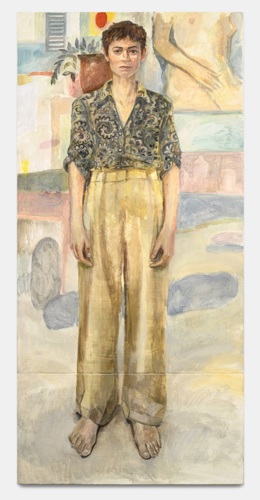
MA: There is a particular quality of incompleteness in your paintings. Figures, gestures and spaces can remain slightly uncertain, as though the image were still taking shape.
What role does this openness play in your practice? Is there a point at which defining a
figure or gesture too precisely would change the nature of the work? How do you
recognise the moment when a painting has reached its necessary degree of resolution?
Can uncertainty bring an image closer to the instability of lived experience?
NH: The openness in my painting is related to the fact that I am a very indecisive person. I don’t like to renounce anything, and I find that the best solution is often to find a middle between two lines. To make a decision is almost like killing all the other possible options, whereas leaving them open allows anyone to find their own place within the painting and arrive at their own definition. I find that if a figure or a gesture is too precise, it becomes almost clinical; it suffocates the space in which emotions can appear. For instance, when I paint my partner or my daughter, I feel that they must be portrayed as unmistakably themselves. It is not anyone else’s story.
My paintings stay with me for a long time in the studio. I know they have reached the necessary degree of resolution when they no longer disturb me, after weeks or months of retouching them again and again. My studio is also a place of encounter, with many people passing through every day. I ask them what they think of my paintings, and through their feedback I continue to refine the distance between what they see and what I am trying to convey.
Creating uncertainty in an image is, in fact, my way of resisting the imposed stability or univocal character of life.
MA: The naked body appears in your work within intimate situations: in the bath, in the
bedroom, during acts of care or moments of private exposure. The body can simultaneously carry vulnerability, desire, pleasure and questions of gender. Female
pleasure and the maternal body also enter this visual vocabulary.
What does nudity allow you to explore that clothing conceals? How do you consider the
position of the viewer when representing an intimate body? How can female pleasure be depicted while preserving the subject’s agency? How have motherhood and care changed your understanding of the body as a subject for painting?
NH: I feel that nudity is a way of connecting with a moment in which we are all equal, with no shield and no clothing designed to project or perform a certain personality. It can allow us to connect with something more ancestral and universal. I try never to represent the body simply as a sexual object or as an instrument of seduction. If anything, I feel that what I am actually painting, or shaping, is the viewer’s experience.
Many of my nude paintings depict friends who feel close enough to me to undress in the studio. More recently, other opportunities have come my way, allowing me to explore a wider range of body types. It is not easy to reach the level of intimacy I am interested in with people with whom I do not already have an established relationship, it is extremely enriching to try to create that intimacy during the sessions, especially when the subject is naked.
Since the birth of my daughter, I have painted myself giving birth three times. It felt like a way of processing and healing from an extremely intense physical experience, but also of preparing myself to go through it again. That recently became a reality with the birth of my baby boy.
MA: You have described painting as a way of belonging to the world and of caring for it. Your works begin with specific people, places and experiences, yet the finished image can
acquire a life independent of its original circumstances. A private moment can become
anonymous, shared or timeless.
What remains of an intimate experience once it has become a painting? Can an image
preserve something that memory alone cannot retain? What could it mean for painting
to care for something through sustained attention? What possibilities does painting still
offer for making personal experience visible while preserving its complexity?
NH: Like photography, painting can almost kill the memory itself and replace it. When we look at a childhood photo album, childhood comes to be pictured the way it was photographed rather than the way it was actually experienced. I do not think this is necessarily dangerous, but there is a certain distortion of truth involved.
Sometimes, the time it takes me to paint something, whether a portrait or a room, feels like a way of celebrating the memory: the time I spent with that person in the studio, or the sensations I experienced while being in the space I am trying to reconstruct. Earlier, I mentioned the time a painting spends with me in the studio before I understand that it is finished. Sometimes I feel that this time, too, and the things I experience during it, as well as the people who see the painting while it is standing there between one retouching and another, also become embedded in the work.
The time I devote to each detail is undoubtedly an act of care, but there are also traces of anger, confusion, and insecurity. There is not only love and tenderness in my painting; there is also a great deal of frustration present, which perhaps sometimes goes unnoticed by the viewer. I am not entirely sure why.
For me, a painting is a record of a period of time, one that cannot be reduced to a single colour or emotion, but rather holds a complex dynamic of movements.
Main Image: Nathanaëlle Herbelin Arie, 2024 oil on canvas. Photo Thomas Merle Courtesy: the Artist and Xavier Hufkens, Brussels