
Marina Perez Simão: The Landscape Within the Image
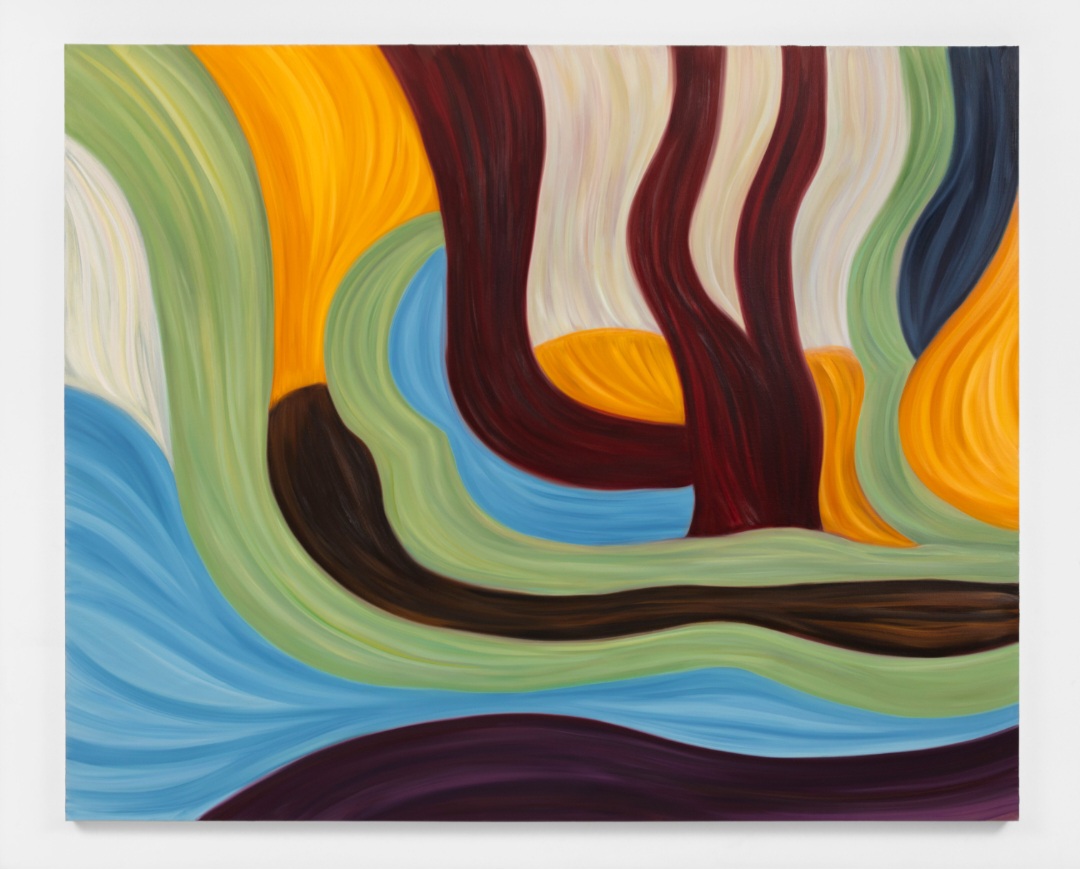
In an age saturated by images, Marina Perez Simão’s paintings return to a slower and more attentive mode of seeing. Working across painting, watercolour, textiles and drawing, she develops a practice rooted in accumulation, intuition and the gradual emergence of images from experience.
Landscape occupies a central role in her work as a space of encounter rather than a subject to be represented. Mountains, atmospheric conditions and natural phenomena become points of departure for a visual process in which external experience is absorbed into an inner landscape. As the artist has described, her paintings are rooted not in the landscape itself, but in the feeling of living within it.
This relationship between place, perception and memory was central to Amore a prima vista, her exhibition at Palazzo Marchetti in Salina. Developed from an immediate response to the island, the works emerged through drawings and watercolours before becoming paintings. Salina was not translated into depiction, but became a field of
sensations, structures and chromatic relationships through which an encounter with nature could take pictorial form.
For Simão, colour is not an applied element but a force that determines the internal movement of the painting. It is something learned over time, through a continuous process of discovery and negotiation. Her works reveal a sensitivity to the unstable relationship between light, atmosphere and perception, where colour does not describe the world
but alters the way it can be experienced.
Individual works remain connected through recurring structures and gestures, creating a sense of continuity across her practice. This tension between continuity and emergence is central to Simão’s practice: painting becomes a space where memory, nature and imagination meet.
In the context of contemporary image culture, her work proposes painting not as an image among images, but as an experience of duration, attention and presence. Through abstraction, Simão investigates what remains beyond immediate recognition, opening a
space where seeing becomes a form of knowledge.
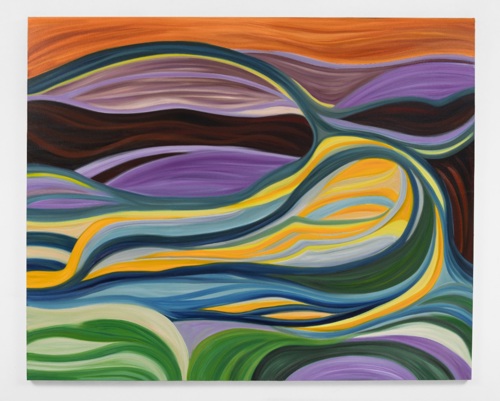
Marina Perez Simão Untitled, 2026 oil on canvas Courtesy of the artist and Mendes Wood DM, São Paulo,Brussels, Paris, New York
Margherita Artoni (MA): Throughout your work, landscape appears less as a subject to berepresented than as a condition of perception and memory. You have said that your paintings are rooted in the feeling of living within a landscape rather than in the landscape itself. In Point and Line to Plane, Kandinsky describes the movement from external perception toward an inner necessity. How does a place become an interior landscape within your paintings?
Marina Perez Simão (MPS):The boundaries between one’s internal world and the outside landscape can sometimes be a bit blurred. Your state of mind and personal experiences are constantly shaping your perception of your surroundings, just as walking around in nature or taking a dip in the sea can alter how you feel.
Nature is a vast and complex system that we are all part of, and it’s far more complex than we can ever understand. It’s an eternal source of learning. I’m very interested in its movements, its rhythms, and in light. I really love movement. Maybe my work is a bit about that.
I also tend to choose, from the drawings and watercolours that I do, the ones I don’t fully
understand. I like the feeling of doing something and thinking, “I don’t know what that is, but it seems alive to me,” because I can see that it has an internal logic of its own.
I like feeling a bit ignorant towards what I’m seeing, and I also like feeling surprised. I tend to think in abstract terms in my life as well. I like when something happens to me that I can’t really classify. The meaning always ends up coming later, or not. Anyway, I think life is richer that way.
So when I paint, I like when some ambiguity happens. And I never name the works. For me art as an instrument of freedom—of thought and emotions, of wonder. I have no intention of limiting, in any way, the perception of someone else interacting with my paintings.
It’s fun when someone comes to me saying that they see a lemon in a form, and somebody else comes and says they see a mountain. Everybody sees and constructs on top of it according to their own personal internal logic, which is complex in its own way.
All I do is try to create a fertile territory for people to do that, including myself.
MA: In Amore a prima vista, your exhibition at Palazzo Marchetti in Salina, Mirta d’Argenzio describes artistic creation as a process of becoming, where interiority and exteriority gradually merge. The works emerged from an encounter with the island—an immediate response to a place where nature itself becomes a generative force, unfolding through drawings, watercolours and paintings. How does an encounter or intuition transform into a painting? At what point does a feeling become form?
MPS: Art is, of course, a language in itself. A language that we learn: composition, structure, the passage between colours, etc. To find the purpose of forms within the context of the painting, their raison d’être within the totality of it, without them turning into a gratuitous element or a dead weight… it’s really difficult. The forms and colours exist in relation to each other. I tend to think a lot about rhythm and cadence between forms, almost like music.
It’s important to try to acquire a vocabulary and understand the language. If you want to write poetry, you have to know grammar and syntax. But learning that vocabulary doesn’t guarantee that you will be able to say something or convey a feeling through that medium. Sometimes you can know how to work with the materials, but that doesn’t guarantee that your painting has something to say. It also happens that we find artists who barely know any of these things and can nevertheless produce paintings that have a lot to say. Everybody feels; not everybody paints.
On the other hand, I don’t believe a person has to be familiar with its language in order to
appreciate a painting. I believe it’s a very democratic medium.
I like painting instead of writing poetry or essays because I’m more interested in this world where words become pointless when approaching things that are more visual, ambiguous, and difficult to name. Or maybe I was never a good enough writer to convey my visions.
I also have very little interest in myself and the little dramas of my personal life as a subject for something that could eventually last a long time, like art. I’ve always been interested in things that are bigger than myself, things that I don’t fully understand, or that I’ve never seen or never felt before.
For example, I love imagining what it might be like on other planets—how elements behave, what other states of matter they might have, whether they have mountains, what shape those mountains might have. Could they have liquid mountains? I don’t know… .
But having said all that, I really don’t fully understand how an intuition or a feeling actually
becomes a form. I have some idea, but there is a component of mystery to it. Learning the
vocabulary certainly helps, but I can apply colour theory as much as I want, and yet there are so many moments when I simply know, with a gut feeling, that this region of the painting has to be yellow, with no explanation. Or that over there, there has to be a curve that contradicts another form… for me it’s a negotiation between science and intuition.
MA: You have described colour as something that must be learned and conquered over time. In your paintings, colour is not simply a formal choice but a force that shapes the atmosphere and movement of the work. How has your relationship with colour evolved, and how do you recognise when a particular chromatic relationship has reached its
necessary balance?
MPS: I learn every day in the studio, I’m constantly humbled by how much I still don’t know about the infinite possibilities of colour. Pigments also behave differently because of their chemical composition, so you have to respect their nature. Some become more opaque when they dry, others more brilliant; some are slower, and some dry faster. There is also a period of time between layers that has to be respected. But sometimes rules are made to be broken and you must take risks here and there. I can choose not to sacrifice light in a painting by re-working it too much for example.
People see so much art online now that they sometimes forget that the surface of a painting can be uneven. A lady came to me one day and asked why there was more opacity here and more brilliance there in a painting. I explained that it was because pigments have different natures, and that I don’t use varnish because I like that to show. But what I really wanted to say was: “Lady, because this is a real painting, not an Instagram picture.”
Colour took years to come to me, and it came slowly. In the beginning, I found it difficult because it is too beautiful. When I was at school, my work was almost black and white. I was interested in structure first, and in movement. Colour, especially oil paint, is just too beautiful to manipulate, too seductive in a way. I was terrified of it at first.
As time went by, the work became more complex in itself and more and more detached from figurative elements. Colour slowly became a necessity in the work. I had no choice but to learn.
I had a teacher who used to say that painting is like learning how to cook, referring to the mixing of paints. And in a way, it is. You learn the ingredients, you learn how they behave, how they react to each other, and how much of each one you need. But eventually, you also have to develop an intuition for it, your own way of doing things.
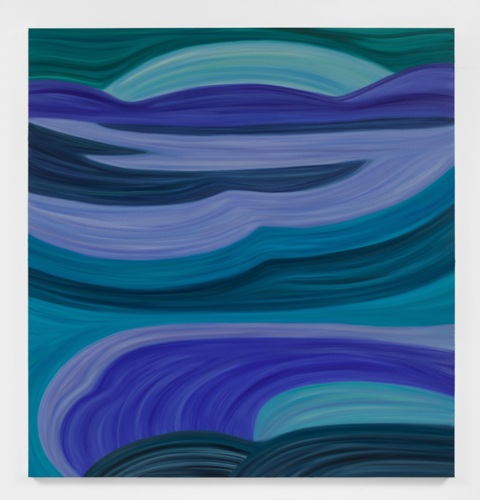
Marina Perez Simão Untitled, 2026 oil on canvas Courtesy of the artist and Mendes Wood DM, São Paulo,Brussels, Paris, New York
MA: The title Diapasão evokes the idea of resonance and tuning. Across your paintings, watercolours and drawings, works seem to echo one another, as if each piece belonged to a larger visual conversation. At the same time, the gestures, lines and traces of the hand remain deeply present within the surface. Do you think of painting as a space where
the artist’s presence gradually transforms into something autonomous? When does a painting begin to acquire its own life beyond the intentions that brought it into being?
MPS: Absolutely. At least in my personal experience, I’m there to allow it to come into existence. I don’t think about myself or my life at all while I’m working. I do that later, outside the studio, with my friends or my therapist. It doesn’t matter while I’m painting.
Of course, who I am, what I’ve lived through, my experiences—all of that is part of the playground of life where we all develop the skills and ways of seeing that take part in this negotiation with the painting. It’s not like I’m only another tool, either.
It has always had something to do with an attempt to come closer to things that are mysterious to me, to discover something new, to discover the patterns underneath. It has to do with the movements of nature, its rhythms, and glimpses of the complex dance between the invisible world and the visible one. It is never about the description of a subject matter, although there are elements that we can recognise here and there: motifs, mostly ones that belong to everybody—boats, mountains, bodies of water, very archaic elements of landscape.
Right from the start, when I begin the drawings for a painting, I have no idea what they will turn into. I start with almost nothing. Sometimes it’s just two parallel lines that gradually become a more complex structure.
My intervention is to make them more rhythmic, to intensify a tension here, to allow a bigger space there, or to take out an element that has no function, in order for the whole thing to become cohesive and unified. To allow its own logic to show, it’s not about imposing; it’s more about flexibility and negociation. I like when something happens that I haven’t predicted. I also want to be surprised. It’s funny when in the studio i have all the canvases on top of each other, and little ressonances and coincidences of form and lines happen between them. It becomes clear they are part of a bigger scheme beyond them. I’m constantly looking for little moments of surprise like these, I guess its because I get bored very easily.
MA: Your work moves between abstraction and the traces of the visible world: mountains, weather, light and memory are transformed into structures of colour and form. There is often a sense of fluidity in your paintings, as if forms remain in a state of transition rather than becoming fixed. Some critics have described your paintings as opening possibilities for states of perception beyond familiar categories. What interests you in this space between recognition and uncertainty?
MPS: I don’t know, the world feels so dogmatic and narcissistic these days… .
Having a practice that revolves around movement, fluidity, openness, and ambiguity gives me a sense of relief. Growing up in Brazil, so close to nature, you learn very early on to respect the sea, for example. You learn that nature has its own force, its own rhythms, and that there are things you simply cannot control.
Standing in front of the sea, I feel very small in the face of that immensity and unpredictability, and I love that feeling. I feel embraced by nature, somehow, and part of it—almost protected by it. There is a feeling that if I follow the flow of things, I will be fine; that I will somehow end up where I am supposed to be. It sounds a bit mystical, but I don’t mind. It’s true for me.
Maybe that is also why I don’t really like defined borders. I find them too artificial. I like things that can move into one another, that are not completely fixed or resolved. I want the paintings to have flow, to remain open, to leave room for something unexpected to happen.
I want the painting to leave space for the viewer to enter it. I don’t want to tell them what to see or what to feel. All I want to do is to create the conditions for something to happen between the painting and the person looking at it.
MA: At a moment when images are produced and circulated with unprecedented speed, painting continues to insist on duration, attention and material presence. What can painting still offer that cannot be reduced to the circulation of images? And what possibilities do you think remain unexplored within the medium?
MPS: I think we, as a species, will paint forever. Some people say that we painted in caves before we even spoke. Others say that spoken language developed at the same time as painting, but in parallel. Either way, it’s part of who we are, and I have a sense that it is one of the most direct forms of communication we have.
Time also happens differently in a painting than in other mediums of communication. When you read a book, you need time to go page after page. When you listen to music, you need time to pass. Time in painting happens differently. You can see a painting in one second, and yet you never finish “reading” it entirely.
A good painting, when I see one in a museum, for example, is one that I keep looking at and keep finding resonances and meanings for myself as a viewer. When I go to the Louvre, I go back to the same paintings every time, and I happen to see something new in them. It’s never-ending, and its meaning keeps changing.
I own a piece of pottery made by one of the Original peoples of Brazil; it’s from the 1700s. I like to put my hand on it and imagine that I’m touching the hand of the woman who made it so many years ago. And, in a way, I am. Time can dissolve like that. And distance can dissolve as well.
Art can be quite something when you are standing in front of it. No image circulating online has the same power. But, of course, it’s very helpful sometimes to see images of paintings online or in books. I don’t believe, as some of my old teachers used to say, that you can only say you know a work of art if you have seen it live. I don’t think that’s necessarily true. Also, it sounds a bit elitist. I get so inspired by things I haven’t had the opportunity to see in person, and they inhabit my world and nourish my practice just as well.
Main Image: Marina Perez Simão Untitled, 2026 oil on canvas Courtesy of the artist and Mendes Wood DM, São Paulo,Brussels, Paris, New York