
Louis Fratino, Prose: The Ordinary as a Claim on Painting
What does it mean to paint the everyday when the everyday has already become art
history? In Prose, Louis Fratino’s first solo exhibition with David Zwirner in London, the
answer might seem straightforward: to take life as it is—rooms, bodies, sex, friends, family, subway cars, cafés, saunas—and return it to painting.
Yet Fratino’s painting has no access to a simple “as it is.” Every seemingly private scene arrives already traversed by the memory of images. Corot, Bonnard, Hockney, F. N. Souza, Dix, and Beckmann are not merely references; they are interlocutors through whom Fratino tests the very possibility of making contemporary intimacy visible.
The title Prose promises the ordinary, but the images are anything but innocent. The
prosaic is transferred into the language of painting and, with it, into the historical system
that determines which bodies, desires, and forms of life are worthy of representation. In
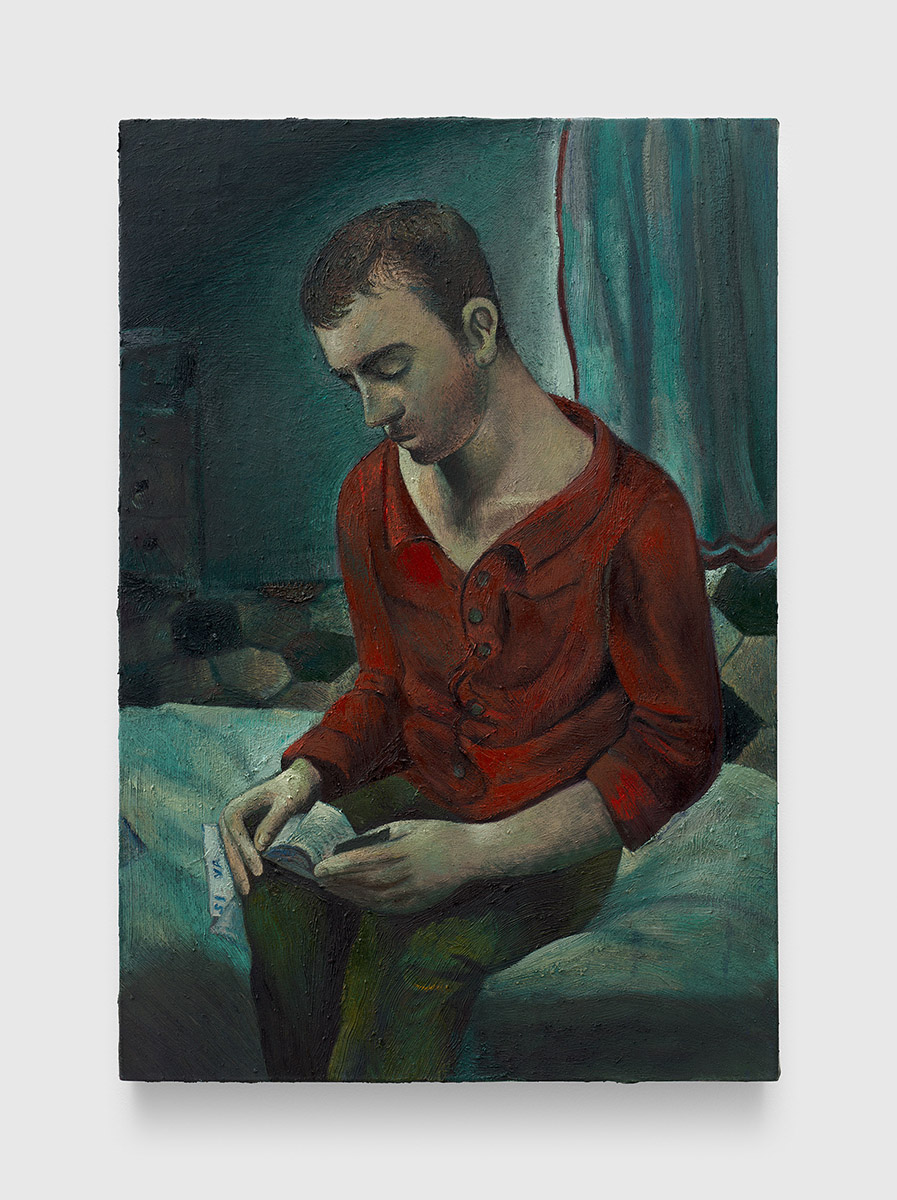
Ale in his mom’s bedroom (after Corot), the domestic scene is already an exercise in
pictorial memory: queer intimacy does not simply ask to be seen, but to be recognized as
legitimate material for painting.
Fratino’s genealogy runs through David Hockney’s domestic freedom, Patrick Procktor’s
discreet sensuality, Fairfield Porter’s attention to everyday intimacy, and, on a different
register, Félix González-Torres’s politicization of the private. But the point is not to
establish a lineage. It is to observe how Fratino progressively transforms a history of queer representation into a history of painting tout court.
In 2017, Roberta Smith identified in his work the pleasure of “domesticity” and “shared
privacy,” alongside a sophisticated pictorial intelligence that demanded an equally attentive gaze from the viewer. The definition remains remarkably precise today. Fratino’s intimacy is not a shortcut to sentiment: it is a formal construction. Body, fabric, furniture, wall, light, and colour participate in the same grammar; desire does not simply occupy the scene—it determines its organization.
In Prose, the painting that gives the exhibition its title, the male body engaged in sex is not
isolated as an exceptional event. Body, fabric, and pattern belong to the same pictorial
surface. Eroticism thus becomes a condition of the everyday rather than an interruption of
it.
This is where Antwaun Sargent’s reading of Fratino—as part of a search for those “mostly
unseen interior lives” that remained at the margins of representation—needs to be
updated. The problem is no longer simply to make visible what has been excluded, but to
make that visibility ordinary. A queer body can lie on a sofa, have sex, sleep, cook, or ride
the subway without becoming an emblem or a declaration.
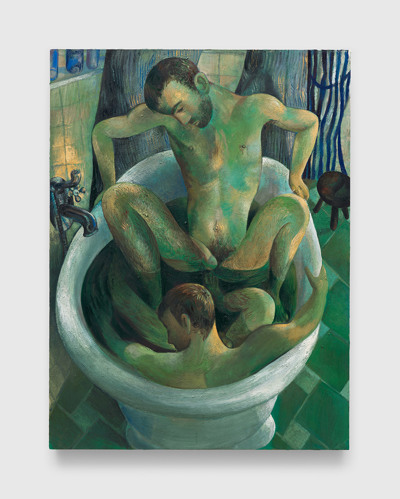
Louis Fratino, The Green Bath, 2026 © Louis Fratino, Courtesy David Zwrner. Photo by Stephen Arnold
Summer in the city takes this logic beyond the private room. The urban crowd introduces a
collective dimension of intimacy, while Self-portrait in studio (after F. N. Souza) makes
explicit Fratino’s determination to confront the canon and complicate its genealogy. He is
not seeking a queer painting detached from tradition; he places tradition itself before
bodies and relationships it had, for so long, been unable—or unwilling—to see in the same
way.
The radical proposition of Prose therefore lies in a paradox. In order to become “ordinary,”
the queer must enter the canon; but once inside, it can retroactively alter the canon’s meaning. Normalization does not necessarily amount to neutralization. It can become a
strategy for changing what we understand as normal.
This is also where Fratino’s relationship with David Zwirner becomes critically significant.
His institutional ascent—from the Venice Biennale to his solo exhibition at Centro Pecci
and his engagement with Matisse at the Baltimore Museum of Art—coincides with a
painting that continues to insist on vulnerability, domesticity, and desire as ordinary
experience. The system that consecrates this painting is also the system that turns
intimacy into cultural and market value. This is not a contradiction to be resolved, but a
tension to be observed.
The final question posed by Prose is therefore not whether Fratino’s painting is queer. It is,
explicitly and structurally. The more compelling question is what happens when queerness
no longer has to ask to be seen, but instead claims to become one of the forms through
which painting defines its ordinary.
Fratino is not simply asking for a place within the canon. He is asking the canon to change
the meaning of what it considers ordinary.
Main Image: Ale in his mom's bedroom (after Corot), 2026 © Louis Fratino, Courtesy David Zwrner. Photo by Stephen Arnold