
Lisa Yuskavage at David Zwirner: When Transgression Becomes Prestige
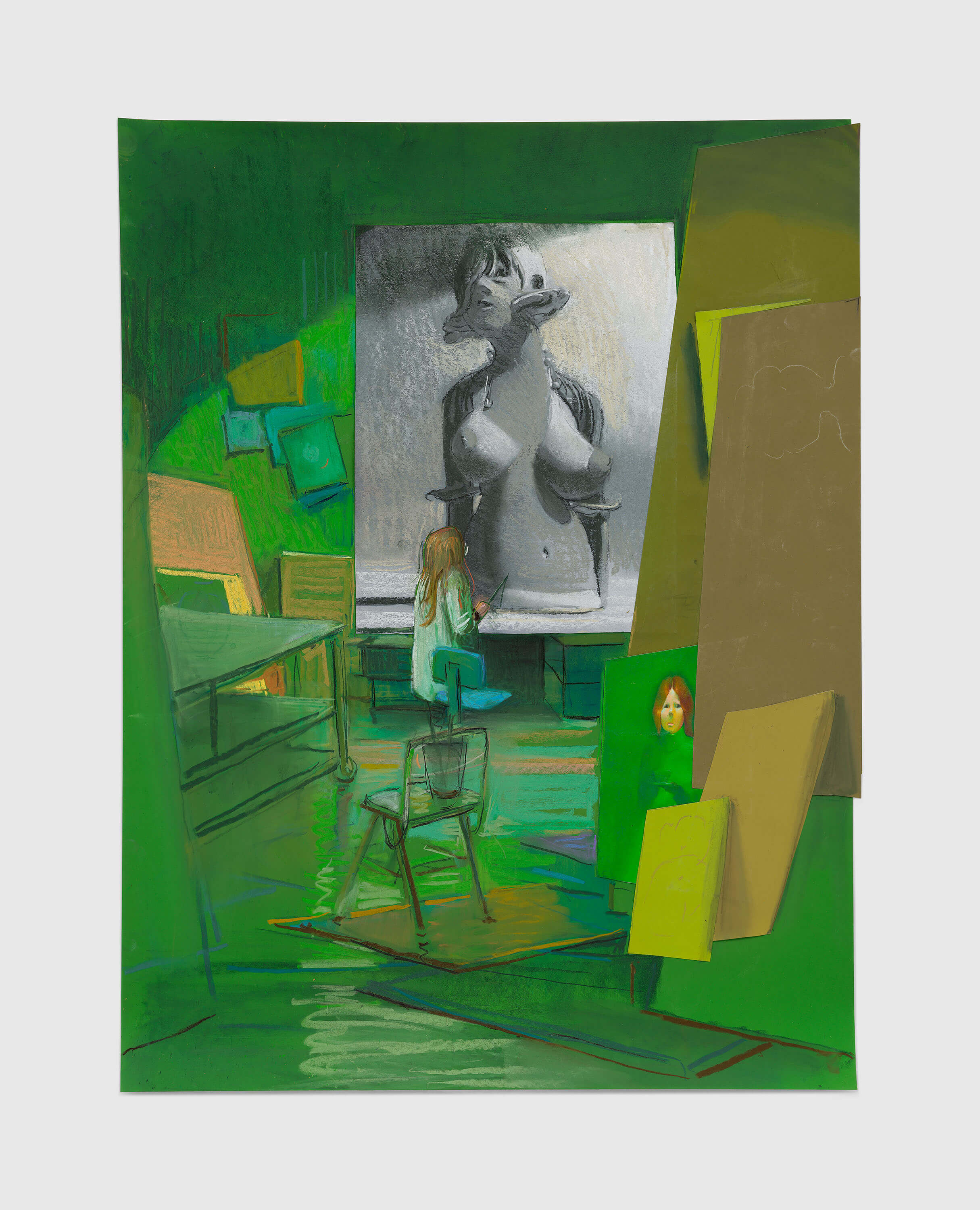
The exhibition by Lisa Yuskavage at David Zwirner unfolds within a stabilized field of painterly recognition. New collages, chromatic systems, and recursive studio compositions mark a practice that has shifted from aesthetic instability toward institutional consolidation. The work now operates at the center of a system that once derived its force from friction.
Across decades, Yuskavage developed a pictorial language of distortion, where erotic figuration, saturated color, and exaggerated anatomy generated ambiguity between attraction and discomfort. Images held force through refusal of resolution, where desire remained unstable rather than fixed into meaning. Early work was defined less by subject than by perceptual uncertainty.
The current works reorganize this vocabulary through self-referential construction. The studio becomes the dominant setting: paintings embedded within paintings, suspended fragments, interior architectures folding perception back onto itself. The studio functions less as subject than device, where painting stages its own conditions of production. Each composition forms a closed circuit in which elements circulate with pre-established clarity.
Painter Painting (2024) stages the artist as a reduced figure inside an expanded pictorial field. The painter is absorbed into monumental forms, oversized bodily fragments, and incomplete canvases that dominate the space. Authorship appears as operational presence, where making merges with the system it sustains. The figure of the painter becomes residue rather than origin.
Gigantic Studio, Act II (2026) extends this condition across a fragmented field. Floating
canvases, fractured perspectives, and chromatic interruptions reorganize depth as continuous displacement. Flesh dissolves into unstable pink luminosity; green and violet fields generate shifting atmospheric pressure; hierarchy gives way to perpetual reconfiguration. Painting operates as a self-propagating structure where variation replaces rupture.
The collage works on Color-aid paper introduce another register. Color gains autonomy,
recalling Bauhaus pedagogy and Josef Albers. Compositional relations remain open longer, producing brief moments where structure loosens and image formation hesitates. These intervals expose a slower temporality of construction.
Lisa Yuskavage, Night Classes in Color Theory, Lesson One: Green IV, 2026 © Lisa Yuskavage Courtesy the artist and David Zwirner
A comparative frame emerges through Philip Guston and Paula Rego. Guston allowed
figuration to collapse into instability, where contradiction remained unresolved. Rego
constructed narrative fields of sustained psychological force. Yuskavage preserves the syntax of disruption while organizing its effects through full formal control, where ambiguity becomes design. Disturbance is administered rather than encountered.
The exhibition converts pictorial risk into institutional clarity. Scale, installation logic, and
historical reference secure the work inside the category of established major painting. At David Zwirner, visibility operates as validation, and validation as closure. The gallery completes conditions of legibility.
Robert Hughes’s formulation of contemporary culture as “the shock of the new turned into the chic of the new” operates here as structural condition. Transgressive vocabulary persists as surface while its charge is absorbed into aesthetic continuity. Excess becomes stabilized code.
The exhibition’s apparent generosity of image conceals a stricter condition. Painterly excess operates here as managed evidence rather than rupture. What reads as instability functions as pre-approved intensity, calibrated in advance of perception. The work does not risk disorder; it distributes its appearance.
The viewer is also structured. Perception unfolds along pre-organized paths where attention follows chromatic and spatial cues. Looking becomes participation in a system of visual confirmation rather than external observation.
Color continues to operate at thresholds of instability, where saturation produces perceptual excess and transitions briefly escape resolution. These moments define the most active zones of the exhibition.
The structure surrounding them remains absolute. Even excess is administered as coherence. What appears as overflow is already formatted as part of the system.
The exhibition describes a condition in which painterly language persists as regulated
expansion. Embarrassment, excess, and erotic charge circulate within a fully administered field of visibility. Painting becomes environment rather than event.
Across her practice, this presentation marks consolidation. Early works relied on instability of tone and scale to generate friction, where grotesque figuration and sexual ambiguity remained unresolved forces. Later phases relocated instability into the studio, transforming it into recursive motif. The studio expanded from subject to structure, from represented space to generative device. In the current moment, recursion completes its trajectory. Distortion stabilizes into syntax, excess becomes method, and transgression survives as refined internal grammar. The evolution of Yuskavage resolves into a system of painterly control, where what once unsettled perception now sustains coherence.
Main Image: Lisa Yuskavage, Night Classes in Color Theory, Lesson One: Green VI, 2026 © Lisa Yuskavage Courtesy the artist and David Zwirner