
Jordan Casteel’s Winter Sun: The Politics of Visibility
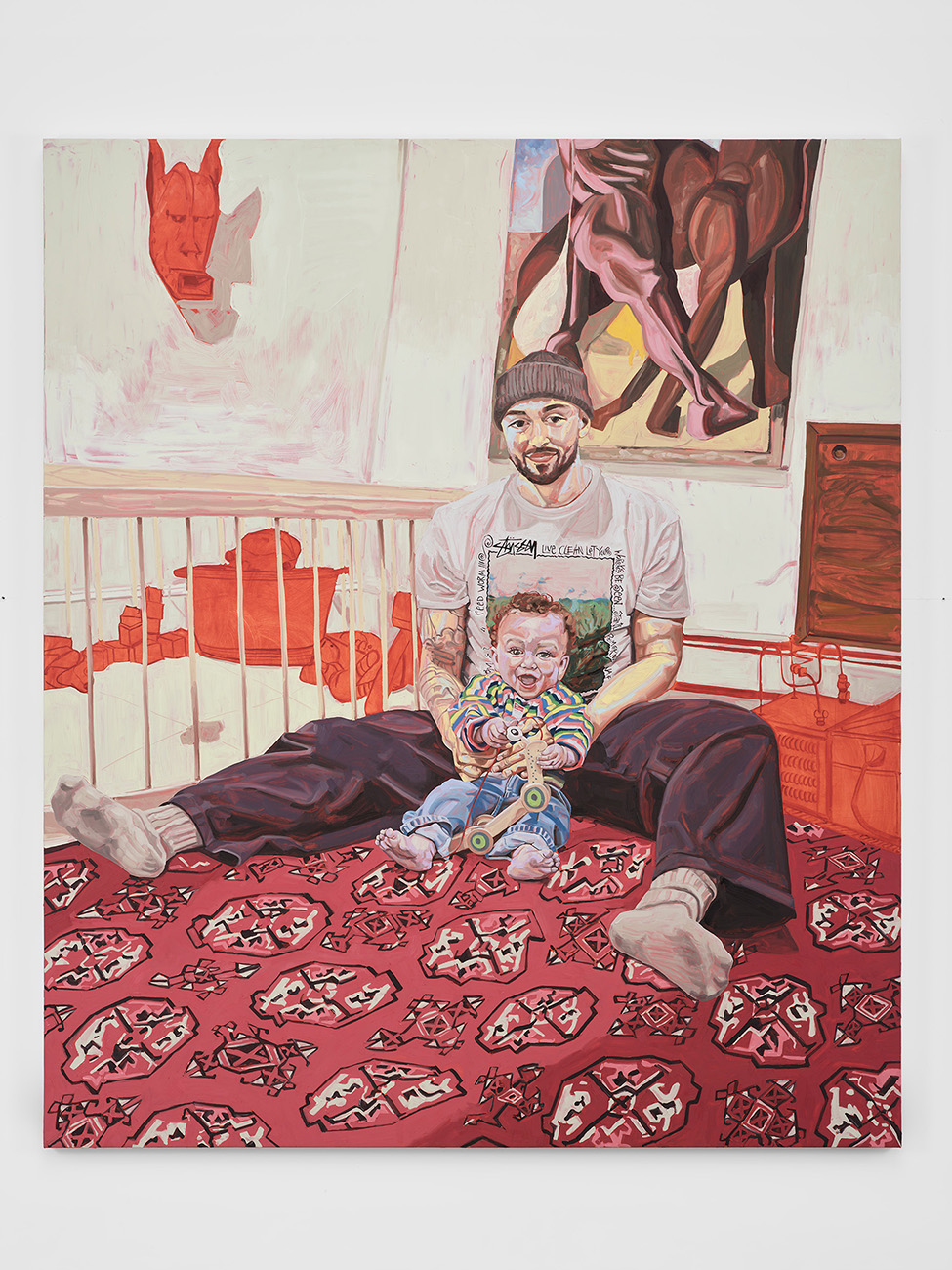
On view at Thaddaeus Ropac’s Paris Marais gallery from 19 October to 23 December
2026, Winter Sun marks Jordan Casteel’s first exhibition in France and her most significant presentation in Europe to date.
Bringing together paintings created in the first half of 2026, the exhibition expands the artist’s exploration of Black life, social belonging and the relationships that shape everyday experience, introducing a more intimate perspective following the birth of her son.
The winter light evoked by the title suggests a world suspended between dormancy and
renewal. Its homophonic relationship with son introduces motherhood as a new point of
departure within Casteel’s practice, connecting personal transformation to broader
questions of memory, vulnerability and collective life.
The exhibition’s central proposition concerns the politics of visibility. In Art on My Mind:
Visual Politics (1995), bell hooks examines how representation intersects with power and
cultural recognition. Joan Tronto’s Moral Boundaries (1993) establishes care as an ethical
and political practice essential to sustaining a shared world. These perspectives illuminate
Casteel’s commitment to subjects whose significance emerges through their presence
within ordinary life.
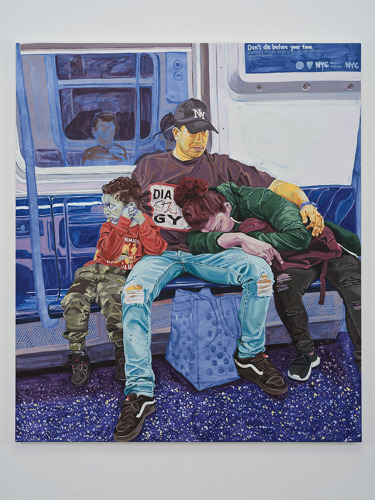
Jordan Casteel, Before your time, 2026 © Jordan Casteel. Photo: David Schulze Courtesy Thaddaeus Ropac gallery, London · Paris · Salzburg · Milan · Seoul
Conceptual affinities can be found in Kerry James Marshall’s reclamation of monumental
painting for Black subjects, Njideka Akunyili Crosby’s exploration of domestic intimacy and
cultural belonging, and Faith Ringgold’s interweaving of personal memory with collective
history. These parallels provide a critical framework rather than evidence of direct
influence. Casteel’s distinctive contribution lies in giving everyday encounters the visual
authority traditionally reserved for exceptional subjects.
In before your time (2026), part of her ongoing Subway Series, a family gathers within the
geometric confines of a subway carriage. Their intertwined bodies form a protective unit
beneath the warning “Don’t die before your time”. The public transport setting introduces
mortality into an otherwise intimate scene, situating familial care within the uncertainties of
urban life. The painting transforms an ordinary encounter into a statement about belonging and the visibility of Black communities.
In Weighted (For Clyde) (2026), Casteel depicts herself carrying her newborn son against
her chest. With both faces outside the frame, the composition concentrates on hands,
fabric and the physical weight of the child. Touch becomes the principal language of
maternal attachment. By granting this private gesture monumental presence, Casteel
challenges the cultural hierarchy separating domestic experience from subjects deemed
worthy of public representation.
The garden extends this investigation into the natural world. In Last Blooms (2026),
flowers emerge with concentrated intensity against a cooler palette, their delicate forms
suggesting the passing of a season. Since moving to the Hudson Valley in 2021, Casteel
has increasingly drawn on her rural surroundings, treating cultivation as a process of
attention, patience and renewal. Her approach finds a conceptual parallel in Lois Dodd’s
close observation of gardens and everyday environments, although Casteel places
particular emphasis on the relationship between growth, maternal care and
impermanence.
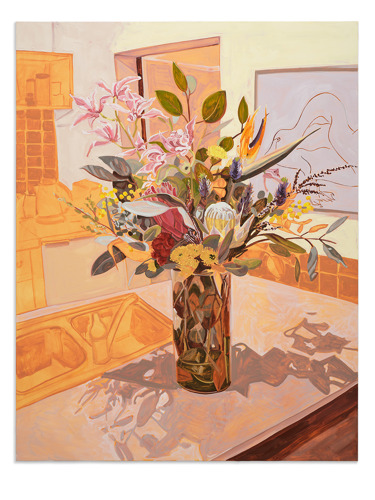
Jordan Casteel, Memorial (For John), 2026 © Jordan Casteel. Photo: David Schulze Courtesy Thaddaeus Ropac gallery, London · Paris · Salzburg · Milan · Seoul
Memory acquires a more elegiac dimension in Memorial (For John) (2026), which revisits
a floral tribute the artist encountered discarded on a Harlem street in 2017. The bouquetrecalls the memento mori tradition, transforming flowers into signs of affection and loss. Its discarded state introduces a further question: how does remembrance persist when the material forms that sustain it begin to disappear? Casteel gives this fragile offering renewed visibility, allowing an overlooked object to carry the weight of collective memory.
Across these works, portraiture, still life and landscape converge through a shared
attention to transience. Cool, earthy colours establish emotionally charged environments,
drawing the paintings beyond descriptive realism. Beauford Delaney’s expressive
chromatic language offers a relevant historical reference, while Alice Neel’s
psychologically attentive portraiture provides another point of comparison.
Winter Sun ultimately redefines monumentality as an ethics of attention. A family travelling
through the city, a mother holding her child and flowers nearing the end of their season
become equally compelling subjects. Their significance resides in the relationships they
embody and the time they preserve. Through these images, Casteel establishes painting
as a form of witnessing, affirming the cultural and emotional value of lives shaped by
vulnerability, change and connection.
Selected references:
hooks, bell. Art on My Mind: Visual Politics. New York: The New Press, 1995.
Tronto, Joan C. Moral Boundaries: A Political Argument for an Ethic of Care. New York:
Routledge, 1993.
Main Image: Jordan Casteel, JD & Yves, 2026 © Jordan Casteel. Photo: David Schulze Courtesy Thaddaeus Ropac gallery, London · Paris · Salzburg · Milan · Seoul