
Jonathan Lyndon Chase: The Body, the Home, and the Image
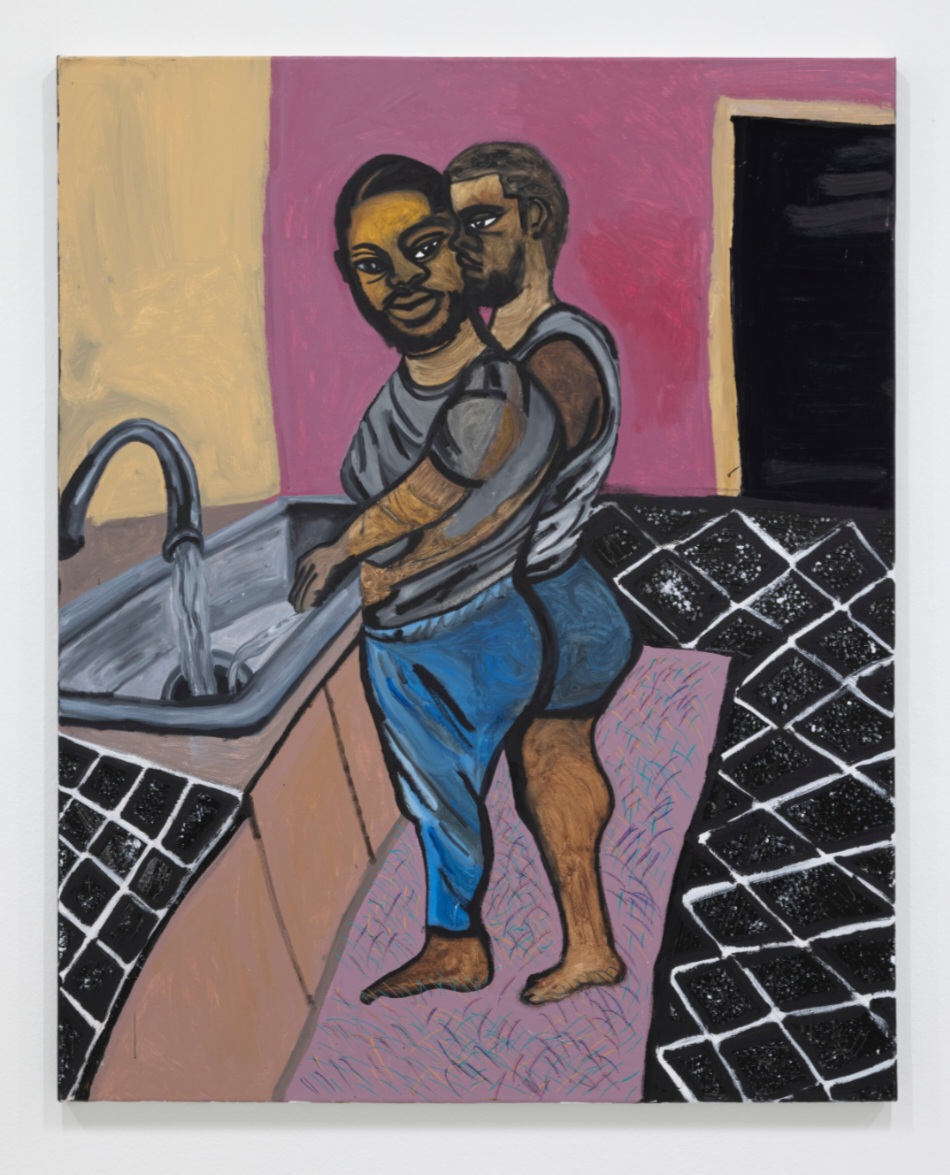
In Jonathan Lyndon Chase’s paintings, the body becomes a site of identity, intimacy, vulnerability, and transformation. Moving between figuration and abstraction, Chase creates visual worlds in which bodies, objects, and environments are inseparable, shaped by lived experience, everyday gestures, and community.
At the centre of the practice is an exploration of Black queer life as a continually evolving experience. Bodies appear fragmented, multiplied, obscured, or absorbed into their surroundings, resisting stable representation. The figure becomes a space in which identity remains open and in process.
Domestic and urban environments play an equally important role. Homes, neighbourhoods, shops, and streets become relational landscapes shaped by encounters, memories, and everyday routines. Cooking, cleaning, waiting, gathering, shopping, leaving, and returning become forms of presence.
This approach was particularly evident in Keep thinking nobody does it like you here comes the sunset, Chase’s first solo exhibition in Italy at Gió Marconi in Milan, and resonates with the recent body of work presented in Downpour at Sadie Coles HQ in London. In Milan, the living room, bedroom, kitchen, and bathroom became spaces in which walls, objects, bodies, and traces of use formed an emotional landscape. Rather than functioning as simple settings, these environments participate in the construction of the figures, suggesting that identity is produced through relationships between bodies and the spaces they inhabit.
Chase’s paintings are distinguished by their intense material and chromatic presence. Layers of bright, visceral paint coexist with makeup, glitter, and other materials, creating surfaces that appear bodily, tactile, seductive, excessive, and vulnerable. Colour contributes to the physical and emotional presence of the figure.
This material approach extends into an interdisciplinary practice encompassing painting, video, sound, and sculpture. Ideas, forms, and sensations move between mediums, allowing Chase to explore image-making as physical, temporal, and relational.
At a time when bodies are increasingly photographed, reproduced, circulated, and transformed into images, Chase’s work insists on the physical presence of the painted body. Their figures resist instant recognition and demand time and attention. Painting becomes a space in which bodies, identities, memories, and relationships can continuously come into being.
In this sense, Chase’s practice speaks directly to AFTER THE IMAGE: how can painting create forms of presence and emotional experience that exceed the image itself?
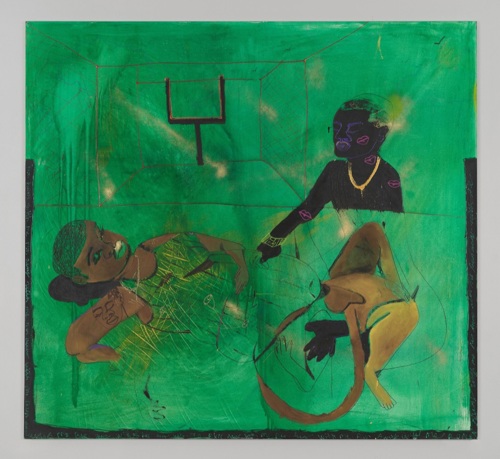
Jonathan Lyndon Chase, Run away with me, 2018 Acrylic paint, marker, glitter on muslin
Margherita Artoni (MA): Your work is deeply informed by Black queer life, experience, intimacy and community, while resisting fixed definitions of queer identity.
How does queer life enter your practice? How do lived experience, intimacy and memory shape the worlds you create, and what can painting make visible that language cannot?
Jonathan Lyndon Chase (JLC): I draw a lot of my inspiration from my own everyday life experiences. That includes my friends and family and my relationship with my husband. I like mundane and quiet moments where people are cooking, cleaning, sleeping. I like specificity, but also openness. I guess through my painting language, that’s where I sort of fluctuate between figuration and abstraction.
I think about private and public a lot, in the direct sense of spaces that we can relate to or identify, and then also in terms of more emotional and psychological and spiritual states of being. I think that painting is kind of like magic or something spiritual in a lot of ways, and that it provides for me, and I hope for others too, a place for a firmament, but also openness, questions about those pushes and pulls and contradictions that are, I think, hard to articulate. I believe painting is definitely a language, a visual language. It’s just a different way of communicating.
MA: The Black body occupies a central place in your paintings, appearing fragmented, transformed and sometimes absorbed into the surrounding space. Intense colour and layered surfaces further complicate its presence.
How do you approach the representation of the Black body? Can painting become a space of visibility that also allows for pleasure, vulnerability, intimacy and care?
JLC: My approach is that of honesty and what I think some have coined as emotional realism. I think about a lot of things, such as whether the body is inside or outside, if it’s warm or cool, that kind of thing, the type of day. And I think about the physical body’s relationship to space and time. I also think about, very importantly, what is left unseen, in a way: what’s maybe more precious or secret, or those emotional and psychological energies.
I think a lot about how paintings are, in some ways, static, but also they are always moving. They are activated by so many things. There are lots of things happening, and that’s how I think about the body. We’re shaped by so many things from our past, present, and our future, and we are always changing and transforming. I think about this a lot, especially as a Black queer person.
I absolutely believe that painting can be a place for pleasure, vulnerability, intimacy, and care. Because I wasn’t seeing a lot of these things in a way that related to me or people who looked like me, I wanted to go and put them out in the world. I think unapologetically showing Black people in modes of pleasure and intimacy and vulnerability is also very political.
MA: In Keep thinking nobody does it like you here comes the sunset at Gió Marconi in Milan, domestic interiors became spaces shaped by memory and everyday actions. Elsewhere, neighbourhoods, shops and streets form an extension of these intimate geographies.
What role do domestic and urban spaces play in your imagination? How do ordinary actions such as cooking, cleaning, waiting, gathering, shopping and leaving enter your visual language? What do these environments reveal about belonging and community?
JLC: I think that there are these longstanding, often misleading or dangerous narratives of the super-fantastical or super-otherworldly Black person or queer person. And because I draw so much of my inspiration from life, I see it as a mirror that reflects and also a way of archiving memories and feelings, if that makes sense.
I think these moments of domestic and city life resonate with me because they are an extension of home and belonging: being an everyday, regular person who does everyday, regular things in a world that often tries to dehumanize and fantasize us in a dangerous way.
I like this idea of there being specific places that maybe I have documented with photography or a sketch or even a poem. And then the work, whether it be a painting or drawing, opens up this portal of possibility that is super familiar, that I think is important to document for the art-historical canon.
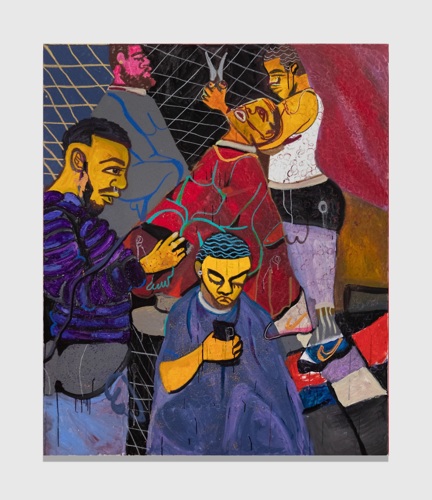
Jonathan Lyndon Chase, City of Beauty, 2023 Acrylic, oil stick, marker, rhinestone on canvas.
MA: Your paintings are animated by movement. Bodies, colours, gestures and fragments of space shift across the surface, emerging and dissolving between figuration and abstraction. Your compositions also resist linear narrative: scenes are fragmented, moments unresolved and connections left open.
How important are fragmentation and narrative ellipsis to your practice? Do you think of painting as a space in which a story is deliberately interrupted or withheld? How do movement, gaps and unresolved moments allow different narratives or emotional readings to coexist?
JLC: I don’t think I’m necessarily interested in giving answers, but more so in raising questions and, in some ways, objectively showing something or someone as they are at a moment or in several moments. I think, for me, it gives it more life to have that open-endedness.
I really love collage, and it’s also a huge inspiration of mine in both material and form, along with this idea of being multifaceted and things being nonlinear. I think an important question for me is: what does it mean to be whole? Perhaps to be fragmented is to be whole?
I do think painting is a site for give and take, push and pull, open and closed, filling and emptying. I think very interesting paintings have contradictions, and the moments in between them are super satisfying.
MA: Your practice moves across painting, sculpture, video and sound, while challenging conventions around the body, sexuality, identity and representation.
How do you understand your role as an artist today? Do you see transgression as something you consciously seek, or is it inherent in your way of seeing and expressing the world? In a culture where almost every provocative image or gesture can be rapidly circulated and absorbed, is it still possible to truly transgress? And does taking risks remain essential to making art?
JLC: For me, it comes naturally, I guess! I don’t think, “Oh, this will be so wild or edgy.” I understand my role as being a part of a bigger history of creatives and thinkers and desiring to honor those ancestors and elders while reflecting my own generational lenses.
Being true to myself and what my vision is naturally reads as transgression for many. In some ways, I like that. I spend time looking at how they relate and function.
I think it is totally possible to transgress. I think the bigger question is the individual versus the group. I think taking risks is vital to life and, by that logic, vital to art-making. There’s so much empty, vapid, and cold junk out there to absorb. It means even more so that we have to remain vigilant and take risks for humanity’s sake. I see myself as a truth-teller, a disruptor, a mirror, a safe place, a storyteller, and an activist.
MA: We live in a culture in which bodies are constantly photographed, reproduced, circulated and transformed into images. Painting remains slow, physical and materially present.
Your work asks the viewer to encounter the weight, texture, intensity and emotional atmosphere of the painted surface.
What can the physical presence of painting communicate that other forms of image-making cannot? And what possibilities remain for the painted body in a world saturated with images?
JLC: What I think about painting is that we always discover more. When we think we understand it, we actually don’t. I think that’s also part of the love for the practice, history, and material of the field.
I can’t help but think of the dangers of capitalism and, in our current age, of authorship and ownership, and how a lot of these questions are coming up a lot in terms of things that are physical versus nonphysical, real versus unreal. They’re all very important and interesting problems to have that, inevitably, we will always have.
The possibilities are truly endless for painting, I think. I’m so interested in its physicality. Something that painting does so well is invoke all of the senses, which go back, in some way, to being physical.
There is a sense of urgency that goes into the physicality of the physical presence of a painting. I think that physicality is a kind of liminal state or quality that simultaneously affirms and raises questions but doesn’t provide concrete answers all the time, and inherently positions itself as a body that changes over time, just like the human body does.
Main Image: Jonathan Lyndon Chase, Running Water 2025 Oil, oil stick, marker, graphite, and acrylic paint on canvas