
John Currin at Sadie Coles: The Virtuosity of the Already-Made
In 2003, writing in Artforum, David Rimanelli dismissed one of the founding claims of John Currin's early reputation as a "red herring": the notion that his brushwork constitutes a genuine revival of Old Master technique, arguing that technical finesse develops in step with the artist's content rather than existing for its own sake.
A year later, Arthur C. Danto took the opposite position in The Nation, calling Currin a virtuoso whose manner would have earned admiration in Ferrara or Parma in the 1550s — a line Calvin Tomkins later folded into his 2008 New Yorker profile of the artist, alongside Currin's own account of where that manner came from. It wasn't the Uffizi, where he first went looking for it, but the Accademia in Venice, where paintings hang
close enough on their easels for a viewer to see exactly which passages were glazed and which were not. Twenty years after Rimanelli and Danto staked out opposite positions, Opening Credits forces their disagreement into sharper focus, because the source material behind these new paintings removes any ambiguity about where that Venetian lesson is now pointed.
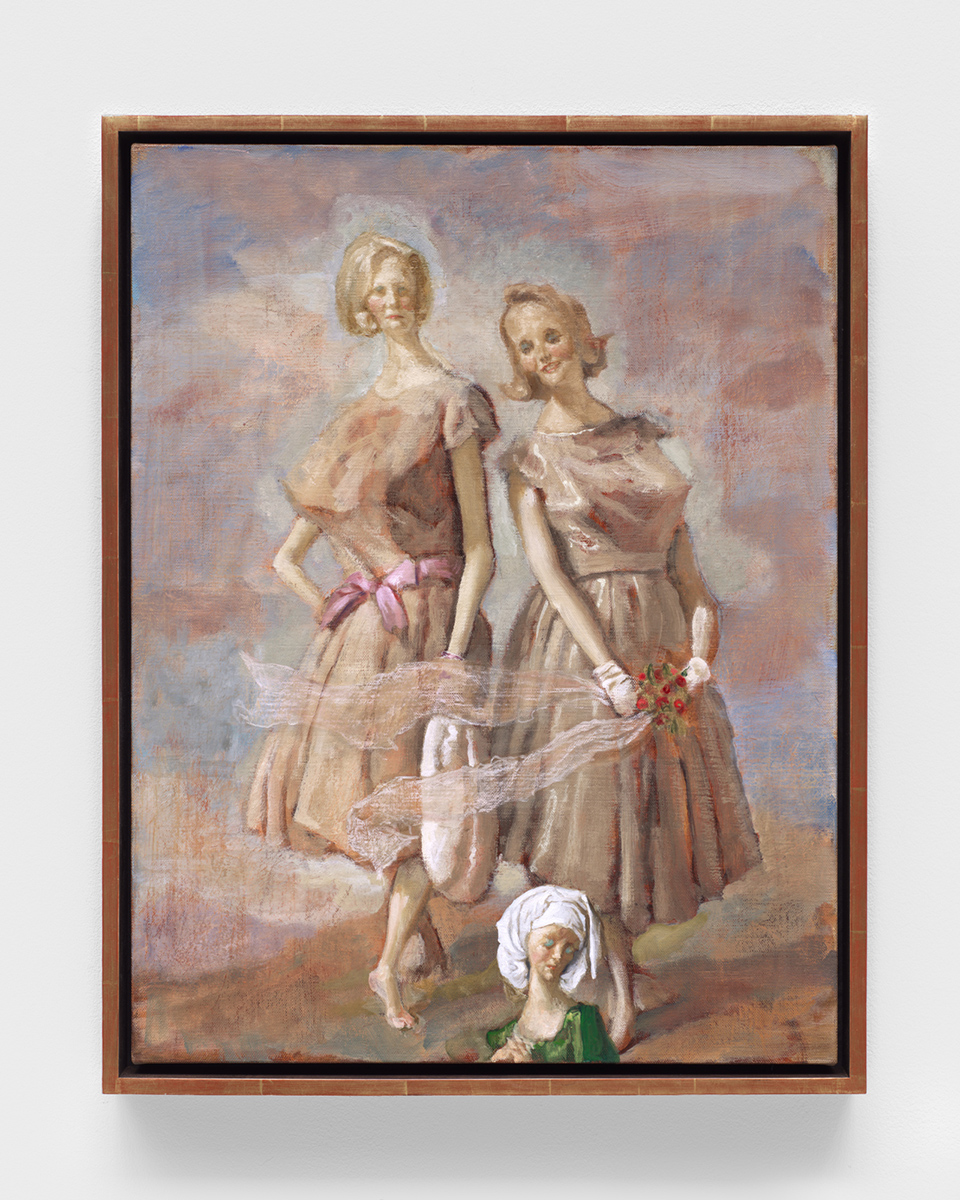
The twelve paintings and five ink drawings in the exhibition draw on clothing catalogues from the 1970s — pose, garment, attitude lifted from a vernacular already saturated with artifice before Currin touched a brush. This is one image-making system absorbed into another, not observation transformed into image. Currin has described working from photographic sources, sketching a figure's proportions before introducing deliberate distortion during the transfer to canvas, treating the source photograph as raw material to be reworked rather than a subject studied from life. Over that already-constructed starting point sits the full weight of his technical inheritance: underpainting in unconventional hues to seed the flesh tones beneath, then the successive transparent glazes he traced back to Venice.
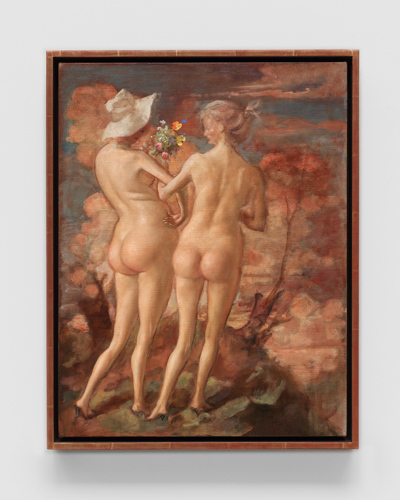
John Currin, Beach Cliff, 2026 Oil on canvas © John Currin. Courtesy The Artist and Sadie Coles HQ, London. Photo: Maris Hutchinson
Jamita's Sister (1993) shows the same operation at an earlier, rawer stage. The portrait of an elderly woman knots together Northern Renaissance portraiture and twentieth-century figuration into a single face, a collision of borrowed vocabularies assembled rather than inherited whole — the template Currin kept refining for the next three decades. Tilted Head (2014) narrows the operation to a single technical device: sottopittura built in the sixteenth-century manner, slowing the eye's read of the canvas so a complexity invisible at first glance surfaces only on return. In both, mastery functions as a delivery mechanism for an image already constructed before the
technique arrived — the structure Rimanelli identified, and exactly what Danto admired without asking what it was serving.
Lisa Yuskavage, a Yale contemporary working the same seam, has been open about doing something structurally identical: she searched vintage issues of Penthouse for her figures, aware of how it looked. It was considered pretty incorrect of her to be using those images, she has said, but she was intrigued. The admission matters because it names, without Currin's obliqueness, what both artists do — apply an inherited, historically prestigious technique to material the tradition itself would have excluded. Yuskavage names the source directly; Currin lets the viewer discover it. Nothing in Opening Credits announces "1970s catalogue" the way Yuskavage announces Penthouse. The virtuosity performs the concealment her own commentary refuses.
Opening Credits removes the question from the realm of style entirely. When the underlying image is a catalogue pose, virtuosity can no longer be mistaken for a return to observed reality dressed in period clothing, since there was no observed reality in the chain to begin with — only one constructed image reprocessed through another. Carol, Alice and Mary (2026), listing three figures like a theater bill, stages exactly this: bodies already arranged for display before Currin painted them, arranged a second time by his brush. The Old Master glazing doesn't redeem the catalogue pose or elevate it. It makes visible how much labor a fully constructed image can absorb without ever touching anything real.
Rimanelli and Danto were each right about something the other missed. The technique never functioned as straightforward homage to the Old Masters, as Rimanelli argued — Opening Credits confirms that more literally than he could have known in 2003. The skill was never incidental, as Danto insisted — the paintings wouldn't work as images of desire, discomfort, and spectacle without it. What neither reading names is the specific labor Currin's virtuosity performs today: not disguising an artificial source as something observed, but making the artificiality of the source the actual subject, rendered with a level of craft ordinarily reserved for painting from life. The technique hasn't changed direction since 2003. What has changed is how openly the source material admits what it always was.
Main Image: John Currin, The Hidebehinds, 2026 Oil on canvas © John Currin. Courtesy The Artist and Sadie Coles HQ, London. Photo: Maris Hutchinson