
Jesse Mockrin: The Weight of Inheritance
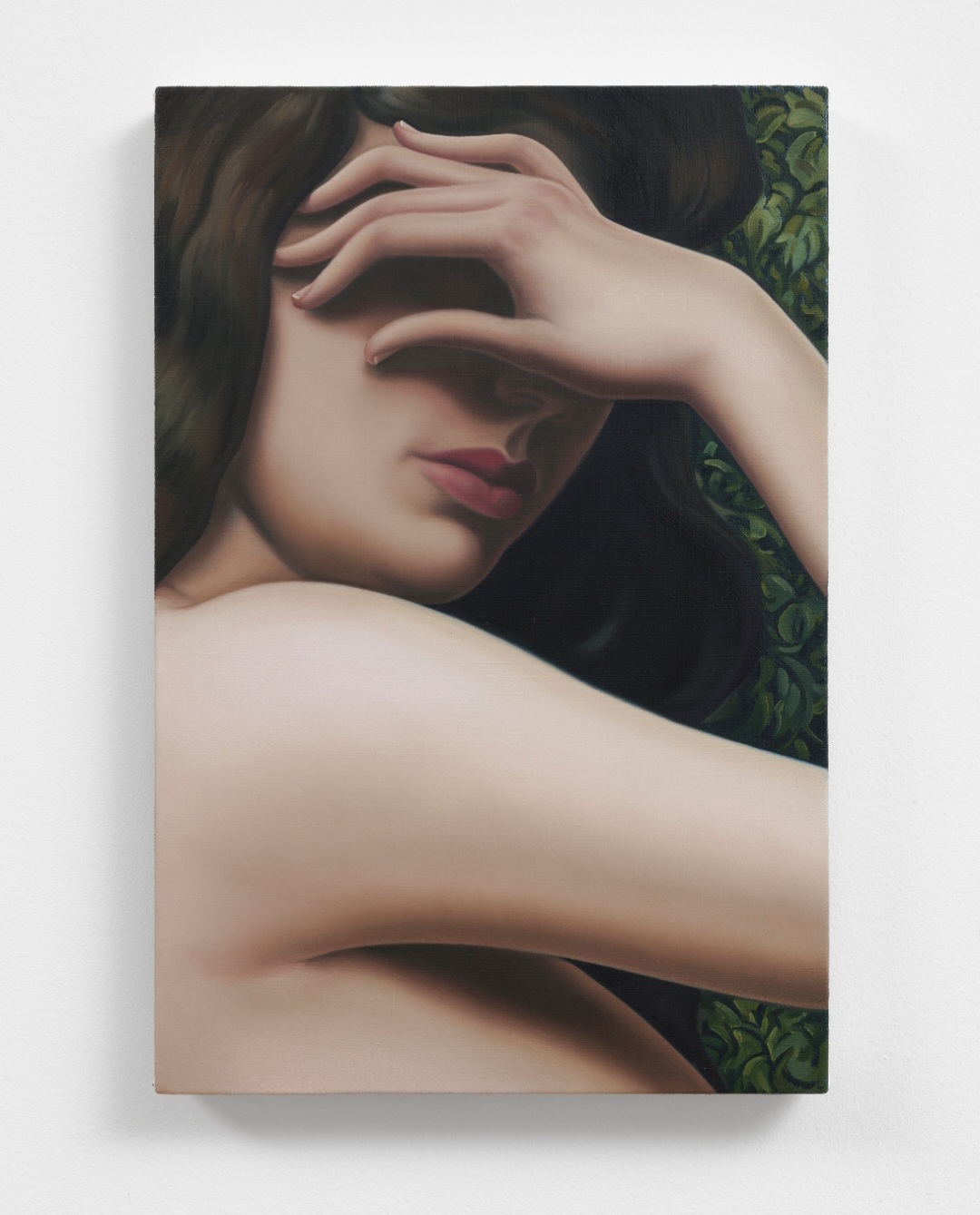
Jesse Mockrin’s paintings begin with images that already carry the weight of art history. Drawing on Renaissance and Baroque painting, she isolates bodies, gestures, and fragments from canonical compositions, reconstructing them within new pictorial narratives.
Her first solo museum exhibition, Jesse Mockrin: Echo, at the Art Gallery of Ontario in Toronto, brought this engagement with European painting into direct dialogue with the museum’s collection. The exhibition concluded on March 8, 2026.
Through cropping, repetition, and recombination, Mockrin explores how bodies have been represented, desired, controlled, and remembered. Her figures occupy a space between historical archetype and contemporary subject, and painting becomes a site for examining inherited ideas around gender, power, and agency.
Her recent work extends this inquiry across different moments in time. Bitter Seeds connects seventeenth-century representations of Mary Magdalene with the twentieth-century history of Ireland’s Magdalene Laundries. Across these works, painting becomes a way of placing images, bodies, and memories into new relationships.
Margherita Artoni (MA): Cropping is central to your practice: a body, gesture, or section of a composition is isolated and made autonomous. Once separated from the original scene, the fragment acquires its own visual and psychological charge.
What does the fragment allow you to see that the complete image might conceal? How can removing a figure from its original context alter our understanding of its presence? And how do you determine the precise point at which an image should end?
Jesse Mockrin (JM): The fragment allows the viewer to imagine what lies outside the frame, replacing the original, fixed context with many possibilities. The complete image can conceal misogynistic content through its very completeness, as well as its seductive beauty and its narrative. Patriarchy is a poisonous current running through our image culture, sometimes well-concealed. How to make that visible? Weirdly, sometimes
erasure helps to reveal it.
There are rules of composition I have absorbed that help me determine how an image should be framed. I studied photography as an undergrad, so that sense of photographic composition influences the way I see. I am often focused on hands and their actions, and one rule is never to crop someone at the wrist or ankle. Rules are made to be broken.
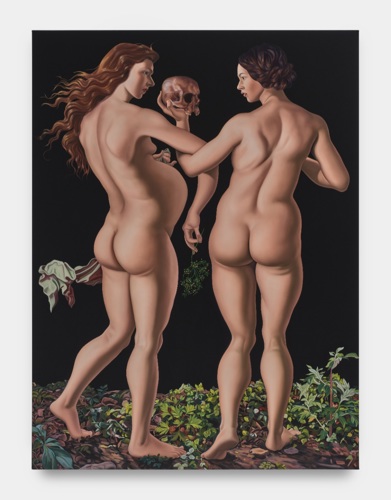
Jesse Mockrin, Natural Order, 2025 Courtesy of the artist and Night Gallery, Los Angeles. Photography by Nik Massey.
MA: Your figures often possess a particular delicacy and grace, coupled with a quiet sophistication, while seeming suspended in time. Their gestures suggest a moment that feels intensely physical yet remarkably still, as though the narrative had paused and something remained just beyond the frame.
What does this suspension make possible within the painting? Are you interested in releasing the figure from a fixed narrative or temporal position? And can a body held in such a state acquire a different form of agency—one rooted in presence rather than action?
JM: That’s very insightful. I do want to release the figures from a specific narrative and from a fixed moment in time, to think about how these human behaviors cycle and repeat. I want them to feel outside of time. Yet I am often painting figures in intense physical motion, so that sense of stasis is at odds with their physicality.
The way I paint, which is very smooth and blended, also seals them into a frozen state. I think a lot about interior and exterior - the emphasis we place on the visual and the impossibility of seeing the interior psychological realities of human behavior but attempting it anyway. I aim to create space in my work for agency and resistance through presence.
MA: The sources you draw from remain perceptible, yet their identities shift through cropping, recombination, and displacement. An existing image enters a new visual structure, carrying traces of its origin alongside new associations.
When does an appropriated image become a new image? How has working with pre-existing visual material shaped your understanding of authorship? And when you return to an image from the past, what kind of relationship do you establish with the artist who first made it?
JM: I want to bring images into conversation with each other, referencing their histories and expanding their associations. My subject matter is our cultural image history. I think an appropriated image becomes its own image when it has its own presence and enters a new context. I mostly work from images that are old enough that they are outside of copyright restrictions, and eventually my works will become public domain as well. I think artists are constantly inspired by other artists, past and present, and participating in this chain of influence feels invigorating to me. I greatly enjoy re-imagining the work of an earlier artist for the chance to walk through their decisions and then make my own. It keeps their art work alive in a different way than a museum does.
MA: Certain traditions of European painting have shaped ways of looking at the female body through desire, possession, idealization, violence, and vulnerability. Your paintings retain the sensuous qualities of this visual language—the luminosity of flesh, the tactility of fabric, intimate gestures—placing them within a different field of meaning.
How do you work with the seductive power of these images as you examine the gaze they carry? What role does desire play in your paintings? Can visual pleasure itself become a way of reconsidering the narratives attached to the female body?
JM: Yes, I believe that visual pleasure is a pathway into upending the narratives weighing down the female body. Feminine desire is comparatively rarely pictured in our cultural image stream, to the point where it is difficult to identify. It is both psychological and visual.
Like most people, I respond to visual pleasure. I think we deserve it and I feel driven to create it myself. I am a desiring subject - I consume and recreate beautiful images. At the same time, I do want to avoid re-objectifying the female body. It’s been done plenty; there’s no shortage of work that achieves that end. To prevent this, I think about what should be shown and what should be concealed, and I use strategic cropping and androgyny. It’s a difficult needle to thread, to make work about the histories of objectification and violation of the body without repeating the same crimes. Desire is present in my work in touch: my touch on the canvas, the depicted figures touch themselves, each other, and are touched by disembodied hands.
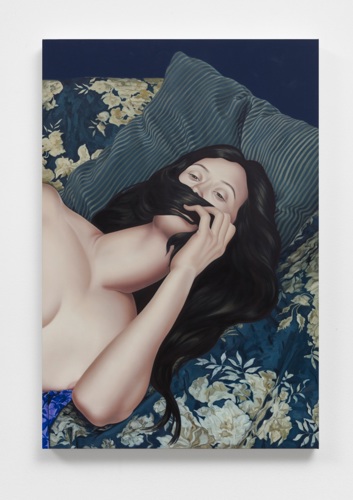
Jesse Mockrin, Nothing to Hide, 2026 Courtesy of the artist and Night Gallery, Los Angeles. Photography by Lance Brewer.
MA: In Bitter Seeds, the representation of Mary Magdalene becomes connected to the twentieth-century history of Ireland’s Magdalene Laundries. In Echo, your paintings entered into dialogue with works from the European collection of the Art Gallery of Ontario. These projects bring distant moments into the same visual and conceptual space.
What emerges when images from different historical circumstances are placed in relation to one another? Are you drawn to the continuities that surface between them, or to the tensions produced by their encounter? What can painting make perceptible about the past that a linear account might leave unseen?
JM: I am drawn to both the continuities and the tensions between contemporary and historical works hung together. Art history typically groups works together biographically, or by style, or by time period - a Rubens show, Caravaggio and his followers, the Dutch Golden Age. I am interested in the history of iconography, the way Aby Warburg grouped imagery according to subject and pose (i.e. versions of Susannah and the elders made over hundreds of years). I am fascinated by the variations but mostly by the repetition, the cultural inheritance of these stories, the continued relevance of them over time. I think that kind of account shows how much artists influence each other and the societal shaping of the narratives that are considered important to the culture. When we see them laid out, we can ask what messages are embedded within them and why these narratives have so much sticking power.
MA: Your practice engages with images that carry centuries of meaning, and your commitment to oil painting places you within a material vocabulary shaped by the tradition itself: surface, colour, light, flesh, fabric, and the painted mark.
How do you experience this inheritance as an artist? Does the weight of the past ever limit the creative field, or can it generate new possibilities? And what becomes possible for painting when its own history becomes part of the material from which a new image is made?
JM: I don’t experience the inheritance of oil painting as burdensome or intimidating. Oil painting itself is such a sensuous and pleasurable act: the physicality of it overrides fear. I love images and painting and that’s why they are my subject matter. When I appropriate from a historical painting, the original work remains pristine even as it opens up to a future that was unimaginable when it was made. It’s a kind of time travel. I feel like I am in dialogue with the people of the past. I would be thrilled if an artist 300 years from now found something in my work that spoke to their present moment.
Main Image: Jesse Mockrin Almost Caught, 2026 Courtesy of the artist and Night Gallery, Los Angeles. Photography by Lance Brewer.