
Jennifer Packer: The Intimacy of Looking
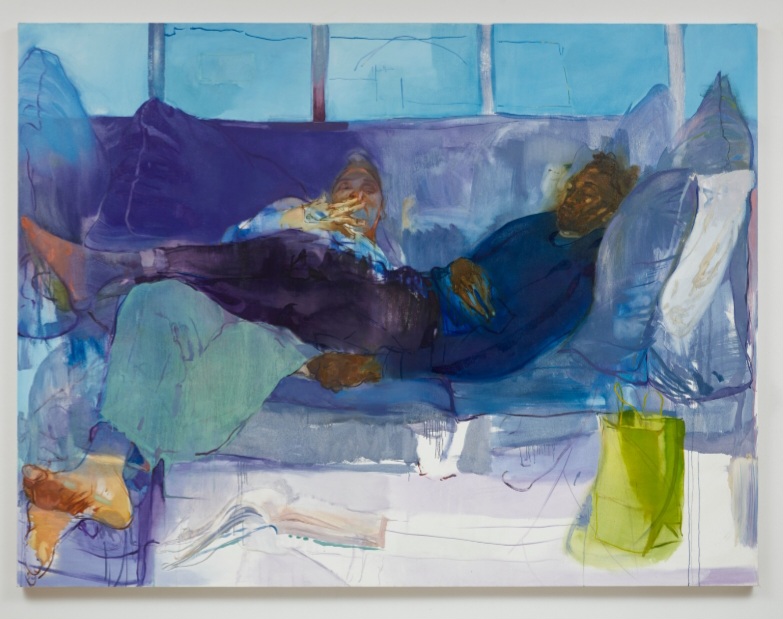
Jennifer Packer approaches painting through intimacy, attending to bodies, relationships, and lived environments. Her portraits, interiors, and still lifes emerge from an interplay of observation, memory, and improvisation, transforming ordinary encounters into images of remarkable emotional depth.
Born in Philadelphia in 1984 and based in New York, Packer has developed a distinctive visual language characterised by a restrained palette, fractured lines, passages of colour, and an open, expressive brushwork. Figures, objects, and spaces shift between definition and dissolution, allowing recognition and abstraction to coexist.
The representation of American lives is central to her practice, articulated through an understanding of presence, personal experience, and privacy. Her subjects, often people from her own circle, remain irreducible to a fixed narrative, retaining a degree of opacity that protects their individuality.
This sensitivity becomes especially poignant in works shaped by grief and remembrance. In Dead Letter, presented by Sikkema Malloy Jenkins in 2025, Packer responds to the death of poet and her partner April Freely, confronting the task of rebuilding her artistic practice through loss. Domestic life becomes a site of reflection, while painting searches for forms capable of holding what remains alongside what has disappeared.
The Eye Is Not Satisfied With Seeing, presented at Serpentine Gallery in London in 2021 and subsequently at the Whitney Museum of American Art in New York, brought together more than thirty works spanning a decade. Its title points towards a fundamental question in Packer’s work: seeing is never instantaneous. Her paintings demand sustained attention, allowing meaning to emerge gradually through what is revealed, obscured, and left unresolved.
Her practice ultimately asks how a person can be rendered without being reduced to an image, turning painting into a space where intimacy, distance, and recognition remain in continual negotiation.
Margherita Artoni (MA): Your paintings are immediately recognisable through a highly specific vocabulary of colour and mark. A restrained palette, broken lines and loose brushwork establish a visual language in which figures and spaces acquire definition through shifting degrees of clarity.
Which artists, images or artistic traditions have most deeply shaped the way you see and paint?
Jennifer Packer (JP): I have spent a lot of time in museums and have really loved feeling connected to histories of making, but the history of painting represented in them has often felt pretty gratuitous, self-satisfied and poorly contextualized. This relationship has affected a lot of what I think of as possible or needed. That said, I am open to being changed by almost anything. Right now I look for works that feel dense with time or objects that seem like ruins or sites for excavation. This might be weathered graffiti or discarded children’s drawings. There's no hierarchy for me. But The Buddha of Medicine is one of my favorite works anywhere.
MA: Do you think of colour and mark-making as a form of personal syntax?
JP: Painting is as much a form of personal syntax as found poetry.
MA: When you begin a work, how much of this language is deliberately constructed, and how much develops through the encounter with the subject?
JP: All of the work has a specific scaffolding, whether that has to do with how a subject is presented or what the vocabulary of expression is. I always begin with a particular direction and an end in sight, but the works are not overly determined and never land where I expect. There is an openness to process and to being changed through making that wasn’t always there. Subjects don’t really require it, but as an artist, I need to feel like the work is happening for a reason other than an occasion for description.
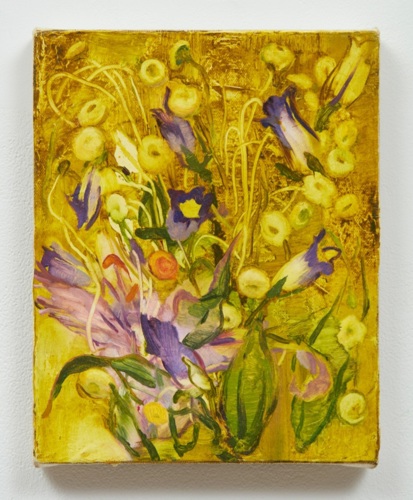
Jennifer Packer, Untitled, 2025 © Jennifer Packer, courtesy of Sikkema Malloy Jenkins, New York; Corvi-Mora, London
MA: A line in your work can indicate a contour without completing it; a brushstroke can function as a trace rather than a description; a figure can hover between emergence and disappearance. The mark therefore seems to point towards something without fully naming it.
How important is the suggested or unfinished form within your practice? Can a trace communicate through what it leaves open for the viewer? What kinds of meaning become possible when a painting resists closure?
JP: I think sometimes when you attempt to finish or close a form, it loses some of its flexibility to familiarity.
MA: Your portraits move beyond physical likeness towards an intensely psychological encounter. Gesture, posture, colour and spatial relationships convey aspects of a person that remain beyond direct description. This gives the portrait a distinctly poetic dimension: the painting seems capable of preserving something that language cannot completely articulate.
What does a portrait mean to you today? Where do its emotional, psychological and poetic dimensions meet? Looking at the history of the genre, how do you understand your own position within its continuing transformation? Has your perception of the inner life of those you paint changed throughout your practice?
JP: I don’t consider myself a portrait painter anymore than i think of Morandi as a still life painter or Monet as a landscape painter. I think about Elaine DeKooning’s paintings of JFK, but they are not really portraits. They are just works that happen to be defined by their subject. And unfortunately, sometimes the work doesn’t transcend its subject. Other times, the subject disintegrates under the process. This is a problem in the history of painting that highlights why gesture and touch is so meaningful when it intersects with an artist’s politics. It makes more sense to me to talk about categories of artists who are invested in meaningful processes of translation.
MA: You have described painting from life as a political act, insisting on the right of Black lives to be seen, acknowledged and represented with generosity and accuracy. Your paintings also preserve a degree of opacity, allowing the subjects to retain privacy and independence from the viewer’s gaze.
Could the tension between the right to be seen and the right not to be entirely accessible be central to your understanding of representation?
JP: The desire I think, is not just to be seen, but to be valued in a nuanced and loving way, and I don’t know if representation can do both of those things very well simultaneously, especially when tied to commodity. Obviously things are not valued simply because they are represented, so working in still images forces the issue of opacity into the frame quickly because of how easily one can associate image with fantasy. Writing deals with this better because reading is a private conjuring process. One has to deal with their own projections onto subjects and good writers can unravel those in time.
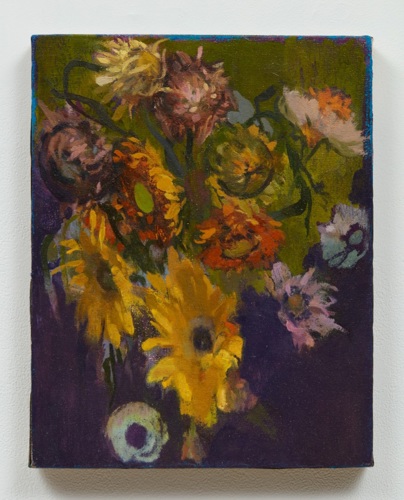
Jennifer Packer, Untitled, 2025 © Jennifer Packer, courtesy of Sikkema Malloy Jenkins, New York; Corvi-Mora, London
MA: What does it mean, for you, to look at another person without reducing them to an image, an identity or a fixed meaning?
JP: I think it means that you probably have a healthy ethical regard toward human life. In painting, I don’t have the actual ability to reduce someone to an image, even if I wanted to—no one does—but it can feel like an image is one of the fastest and most democratic ways to meet strangers and pass judgment. What you ask here is a problem of iconicity and bias, and our implication in how those things are undermined or reaffirmed through pictures.
MA: When your paintings come together in the studio, do they begin to form an imagined conversation—a field of associations, echoes and tensions—or do you encounter each work as an autonomous presence? How does a painting change when it enters into relation with others?
JP: I think the works have to be able to do both things to sustain any legitimacy. The associations aren't meant to be passive or incidental though. The works have some shared vocabulary but their juxtaposition usually highlights how some are better than others at communicating a specific position or urgency.
MA: What can painting communicate today that other forms of image-making cannot?
JP: I think painting can underline the distinction between keen observation and surveillance.
MA: What would you like to remain open within the viewer after the encounter with your work?
JP: I don’t wish anything for the viewer who doesn’t already hold the capacity to be changed by something
Main Image: Jennifer Packer Nate, Chey, 2025 © Jennifer Packer, courtesy of Sikkema Malloy Jenkins, New York; Corvi-Mora, London