
Hernan Bas — The Visitors and the Regime of Visibility
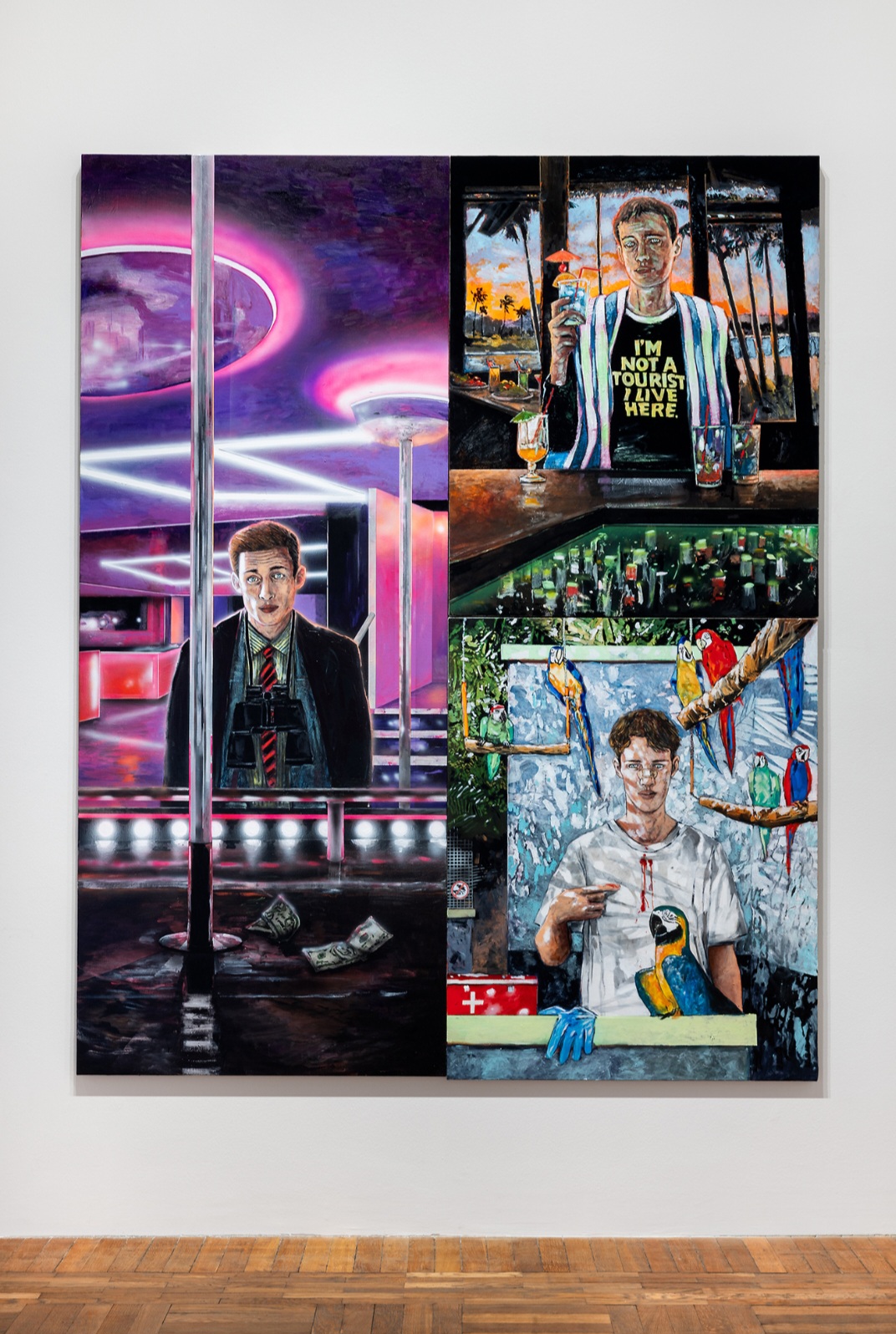
Contemporary pictorial practice no longer operates within the logic of representation, but within systems of circulation in which visibility precedes experience.
In this condition, Hernan Bas’s The Visitors at Ca'Pesaro does not represent tourism as subject matter, but as an epistemic regime: a field where perception is pre-organized by global image economies.
Venice is not a historical city or cultural symbol, but an exhibition context activated by a specific perceptual density. A space in which memory, infrastructural saturation, and aesthetic consumption converge into a single operative field. What is at stake is not the image of Venice, but its functioning as a codified environment of touristic visibility — a site where seeing is already mediated by repetition and expectation. Within this framework, the figures in Bas’s paintings do not function as characters. They are operators of a pre-coded visual economy, moving through spaces whose meaning is already exhausted by circulation. Their gaze is not exploratory but confirmatory: it verifies what has already been seen elsewhere.
© Hernan Bas Courtesy the artist, Lehmann Maupin, Perrotin and Victoria Miro
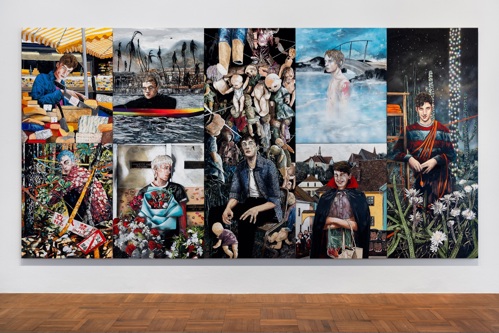
Dark tourism — as a global form of aestheticized access to sites of trauma and catastrophe — becomes structural rather than thematic. Places such as Chernobyl, Alcatraz, or Aokigahara are not destinations, but nodes within a planetary system of visual consumption in which extremity is formatted as experience. Tourism is no longer movement through space, but access to pre- coded intensities. The paintings do not distance themselves from this condition; they intensify it without commentary. Here Bas’s practice departs from critique: it does not stand outside visibility, but reproduces its internal structure of desire. The image does not critique circulation; it completes it.
The figure is no longer a psychological unit or narrative agent, but a surface of distributed perception. What emerges is not subjectivity, but patterned attention — already shaped by prior visual consumption.
© Hernan Bas Courtesy the artist, Lehmann Maupin, Perrotin and Victoria Miro
At a broader level, The Visitors can be situated within debates on the collapse between
perception and infrastructural mediation. Following Hito Steyerl, visibility is no longer revelation but distribution: what appears is what circulates. Boris Groys’s notion of generalized exhibition clarifies this condition: contemporary space functions as expanded display, where life itself becomes exhibition. Venice is not an exception but a prototype — an intensified model of urban musealisation.
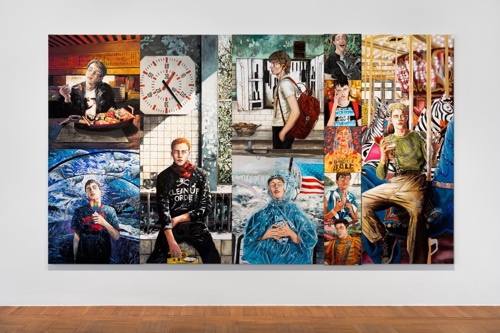
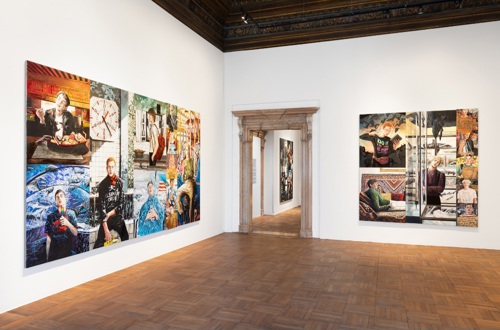
An additional layer concerns the exhibition structure itself, which does not present paintings as autonomous units but as compositional constellations. The works are shown through installation devices in which multiple pieces form visual aggregates. These are not curatorial arrangements but internal extensions of the work: paintings are designed in interlocking formats that produce configurations appearing as singular units. The image is therefore not isolated but modular, constituted through aggregation. Exhibition form does not illustrate content; it replicates it.
Within art-historical discourse, the tension between form and social structure in T.J. Clark and the post-medium condition described by Rosalind Krauss frame painting as a permeable field shaped by external regimes. Yet Bas’s decisive shift lies elsewhere. The Visitors does not register these systems; it reveals their affective logic. Tourism is not control but immanent desire within visual culture. Circulation is not resisted but inhabited.
© Hernan Bas Courtesy the artist, Lehmann Maupin, Perrotin and Victoria Miro
From this perspective, painting no longer produces critique as distance, but exposes the impossibility of distance. Perception and participation become indistinguishable: seeing is already implication.
Venice, as the site of the exhibition, is not the object of representation but the context that makes visible a broader condition of contemporary urban perception. Not as exception, but as an environment saturated by touristic circulation and musealisation. In this sense, The Visitors does not describe a place, but articulates a condition. Contemporary perception unfolds within systems where visibility, desire, and circulation are indistinguishable.
Artistic practice does not stand outside these systems. It persists within them as one of their most refined articulations — not as commentary, but as participation in the production of appearance.
Main Image: Installation view, Hernan Bas: The Visitors Ca’ Pesaro – International Gallery of Modern Art, Venice 7 May–30 August 2026
© Hernan Bas Courtesy the artist, Lehmann Maupin, Perrotin and Victoria Miro