
Henni Alftan: Painting as Picture
Henni Alftan (b. 1979, Helsinki) is a Paris-based painter whose work examines the relationship between painting and the image. Drawing from fragments of everyday experience, she constructs tightly framed scenes in which figures, objects and gestures acquire an intensity that exceeds their apparent simplicity.
Her paintings move between recognition and abstraction, using a precise economy of means to investigate colour, scale, perspective, surface and depth. Cropping and close framing create compositions that recall the visual language of photography and cinema, while the physical properties of oil paint remain central to the image.
Alftan’s process begins with observation, memory and deduction. Rather than working directly from life or photographic sources, she develops initial ideas through sketches and notations, gradually translating them into carefully constructed paintings. The resulting images retain a sense of specificity while resisting narrative closure.
Her practice is grounded in an awareness of painting as both image and object. Patterns, reflections, textures and framing devices become means of examining how marks acquire meaning and how perception turns an arrangement of colour and form into something recognisable. This conversation considers Alftan’s understanding of the picture, the processes through which an image is constructed, and the forms of attention that painting can generate through precision, fragmentation and material presence.
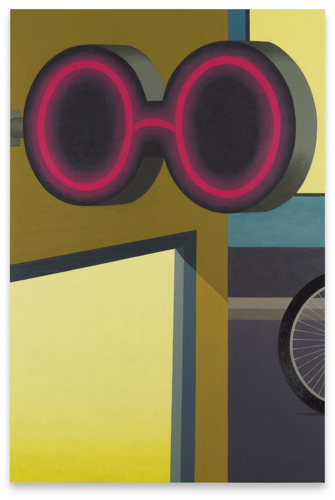
Henni Alftan, Optician, 2025 Oil on linen © Henni Alftan Courtesy of the artist, Sprüth Magers & Karma Photo: Aurélien Mole
Margherita Artoni (MA): You have described your practice by saying, “I paint pictures,” and that “painting and picture often imitate each other.” The statement places the material practice of painting in direct relation to the picture as a mode of representation, framing and communication.
What does the word “picture” mean to you in relation to painting? How do these two terms shape your understanding of the medium?
Henni Alftan (HA): I prefered saying "I paint pictures" rather than describing my painting as figurative. It felt more accurate. I'm interested in how we look, recognize and give meaning to what we see. I've never done a painting that would only refer to itself. I'm simply not interested in that.
MA: Your work also engages with the history of painting alongside photography, cinema and other forms of contemporary image-making. Which artistic traditions or images have been formative for your practice, and how have they influenced the way you construct a picture?
HA: I look at all types of pictures, as they all inform and teach us how to interpret what we see, whether we like it or not. I don't use any specific source material for the paintings. I construct my own models in drawing. But I'm pleased when they feel like we've already seen this; as if they were already in the collective unconscious.
MA: Your paintings frequently isolate ordinary fragments—a hand, a piece of clothing, a fruit, a piece of jewellery, a gesture—and bring them into close proximity with the viewer. Enlargement and framing give these fragments a distinct presence, almost as if the painting were holding them in place.
How do you decide what becomes a subject?
HA: Ideally, it would be something mundane and unassuming, but could say something about the act of looking, picture making or of painting itself. But then I also need to be able to pencil it into a drawing that is compatible and preferably complementary to that rectangular object on the wall that is a painting.
MA: What happens to an ordinary fragment when it is enlarged, isolated and given a precise boundary?
HA: In cinema, when anything is shown in a close up for a significant amount of time, we interpret this as "pay attention. This is or will become important". I guess I do it for the same reason. So that one would pay attention. The less there is on the canvas the more important it becomes. I think that applies to the picture as well as how it is painted.
MA: Does painting allow you to preserve something that would otherwise remain fleeting?
HA: My paintings are constructions. They're really the opposite of a snapshot. But I do believe there is an attempt to transmit an experience of the world. Not any specific moment in time; more like the memory of things. And memories are very unreliable and things get mashed up together.
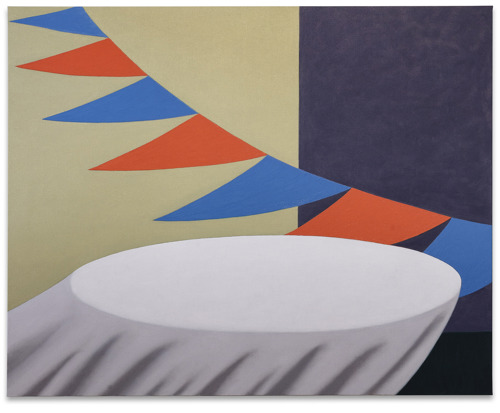
Henni Alftan,Windy, 2025 Oil on linen © Henni Alftan Courtesy of the artist, Sprüth Magers & Karma Photo: Michael Quemener
MA: Could the act of painting be understood as a form of possession, or of care?
HA: For me, it’s less of an act of possession than of communion with the world; what I’ve created now exists in the physical world outside of myself and without me. I love seeing my works go out into the world.
MA: Your close-up compositions can feel like acts of visual pointing. A cropped detail appears to say, “look here,” directing attention towards a particular part of the visible world.
Could enlargement and framing function as a deictic gesture in painting—a way of pointing rather than simply representing?
HA: I think the overall subject of all my paintings is the act of looking. They all have a determined point of view and often you can see that there is something you are not seeing. I guess the tight framing resembles a close up in cinema, where the protagonist is intensely observing something. But all my decisions are always also motivated by formal concerns; A tight framing permits me to put on canvas only what is absolutely necessary and thus let the paint remain paint as much as picture. But I think there is an element of showing and naming in my simplified drawing of things, which is very similar to pointing at things.
MA: What happens when an image directs the viewer towards something without determining exactly what should be seen?
HA: The less I show the more you will imagine. I'm hoping that you would then look instead of passively see.
MA: Can this gesture establish a particular “here and now” between the painting and the viewer?
HA: I don't know. As the author I'm not sure I'm qualified to answer that.
MA: You describe your practice as based on observation and deduction. Your figurative paintings also resist an explicit narrative: a person, object or situation appears as a fragment of an experience rather than as part of a defined event.
What does deduction involve for you as a painter? How do observation and inference shape the construction of an image? When does observation become imagination?
HA: I don’t draw after life and I don’t use photography as a model. Instead I observe and make deductions on what I have observed so that I can use them later in my paintings. Anything from softness or roughness of textures, different colors of light and shadow at different times of day or just a curve of the muscles on a folded arm seen in a certain angle. I make mental notes. Often the observation itself becomes the subject of the painting. And often that observation is merged with a memory of a preexisting representation of a similar subject, be it in painting, film, photo or other imagery.
MA: Pattern introduces repetition, rhythm and structure into your paintings. A motif can describe a material or texture while gradually becoming detached from its referent, suspended between recognition and abstraction. Your treatment of surface, flatness, depth and texture similarly draws attention to the physical conditions of the painted image.
How do you understand the relationship between pattern and signification? Can a repeated form become independent of what it represents, or does recognition retain a memory of the referent?
HA: An abstract pattern can play on that fine line between representation and non-referential paint. I'm always interested in trying to expand my vocabulary of what I can represent in a painting; patterns, letters, signs, duplication etc. But unlike someone like Jasper Johns, I always integrate them in a picture; the letters could become a neon sign or the pen that wrote them would be present.
MA: How does this negotiation between reference and material presence shape your understanding of painting?
HA: I consider my paintings first and foremost as objects. As a curious creation of our culture (what is a painting as opposed to a chair for example). This overdetermined object that whatever you put on it will be overloaded with meaning. When I paint an ear or a pointing finger I'm also making an image of a large ear on a wall, or a finger pointing somewhere in the room where it's hanging. This is why it's important for me to let the paint be paint as much as possible by making the drawing as simple as possible, so that the painting does not lose its objecthood.
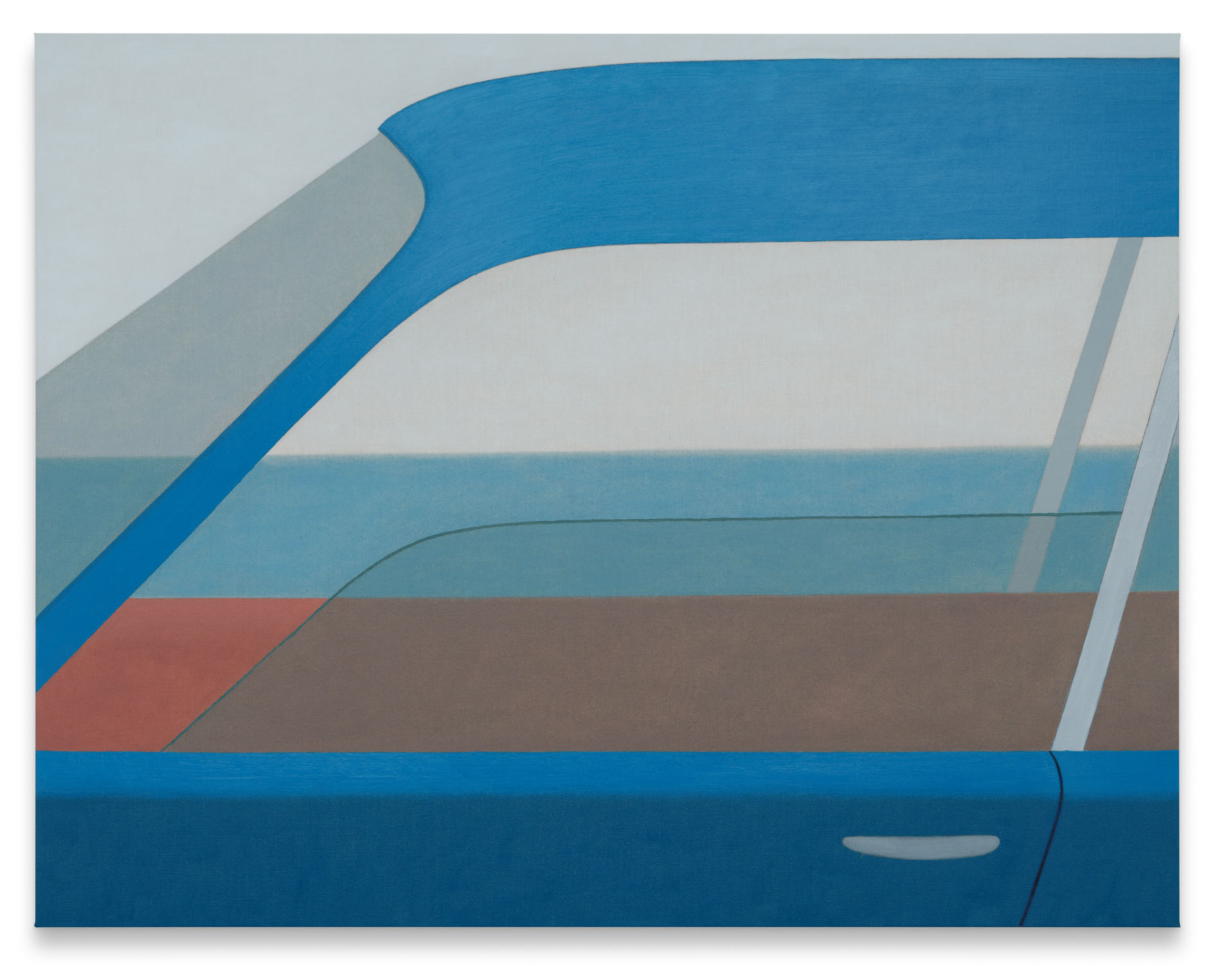
Main Image: Henni Alftan, Blue Car, 2026 Oil on linen © Henni Alftan Courtesy of the artist & Sprüth Magers Photo: Aurelien Mole