
Georg Baselitz: The Collapse of the Heroic Image
At Thaddaeus Ropac’s Ely House in London, The Heroes 1965–66, on view from 13
October to 18 December 2026, revisits a formative moment in Georg Baselitz’s practice.
Created amid the unresolved aftermath of the Second World War, the series transforms
the monumental figure into a site of confrontation between historical memory, masculine
authority and the conventions of representation.
Barefoot, dishevelled and dressed in torn uniforms or rags, Baselitz’s protagonists inhabit
devastated landscapes. Their elongated bodies, disproportionate limbs and arrested
gestures evoke the visual language of heroic painting while exposing its ideological
fragility. Monumentality grants these figures an imposing presence, yet their physical
vulnerability undermines the authority traditionally associated with it. The hero emerges as
an image suspended between inherited grandeur and historical disintegration.
Painted when Baselitz was twenty-seven, the series took shape during West Germany’s
post-war reconstruction. Growing economic confidence encouraged a return to normality,
accompanied by a desire to consign the recent past to history. Baselitz disrupted this
narrative through figures that resist the promise of national recovery. Their damaged
bodies evoke a society struggling to reconcile its present with the consequences of
catastrophe. In 1995, the artist recalled: “I was born into a destroyed order; a destroyed
landscape, a destroyed people, a destroyed society. And I didn’t want to reestablish an
order: I’d seen enough of so-called ‘order’.”
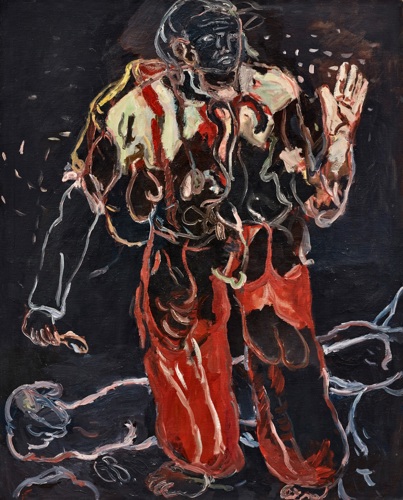
Georg Baselitz, Schwarzgrundig (Black Grounded) (1966; oil on canvas, 162 x 130 cm) © Georg Baselitz 2026. Courtesy of Thaddaeus Ropac Gallery, London · Paris · Salzburg · Milan · Seoul. Photo: Mick Vincenz, Essen. MKM Museum Küppersmühle for Modern Art, Duisburg, Ströher Collection
This refusal of restoration gives the Heroes their ideological force. In his essay The
Postheroic Hero Georg Baselitz and the End of a Failed Ideology, art historian Uwe
Fleckner examines the historical conditions behind the erosion of heroic authority. Baselitz
preserves the monumental figure while exposing the conventions that sustain its symbolic
power. Authority consequently appears as a precarious construction, vulnerable to the
historical contradictions it once concealed.
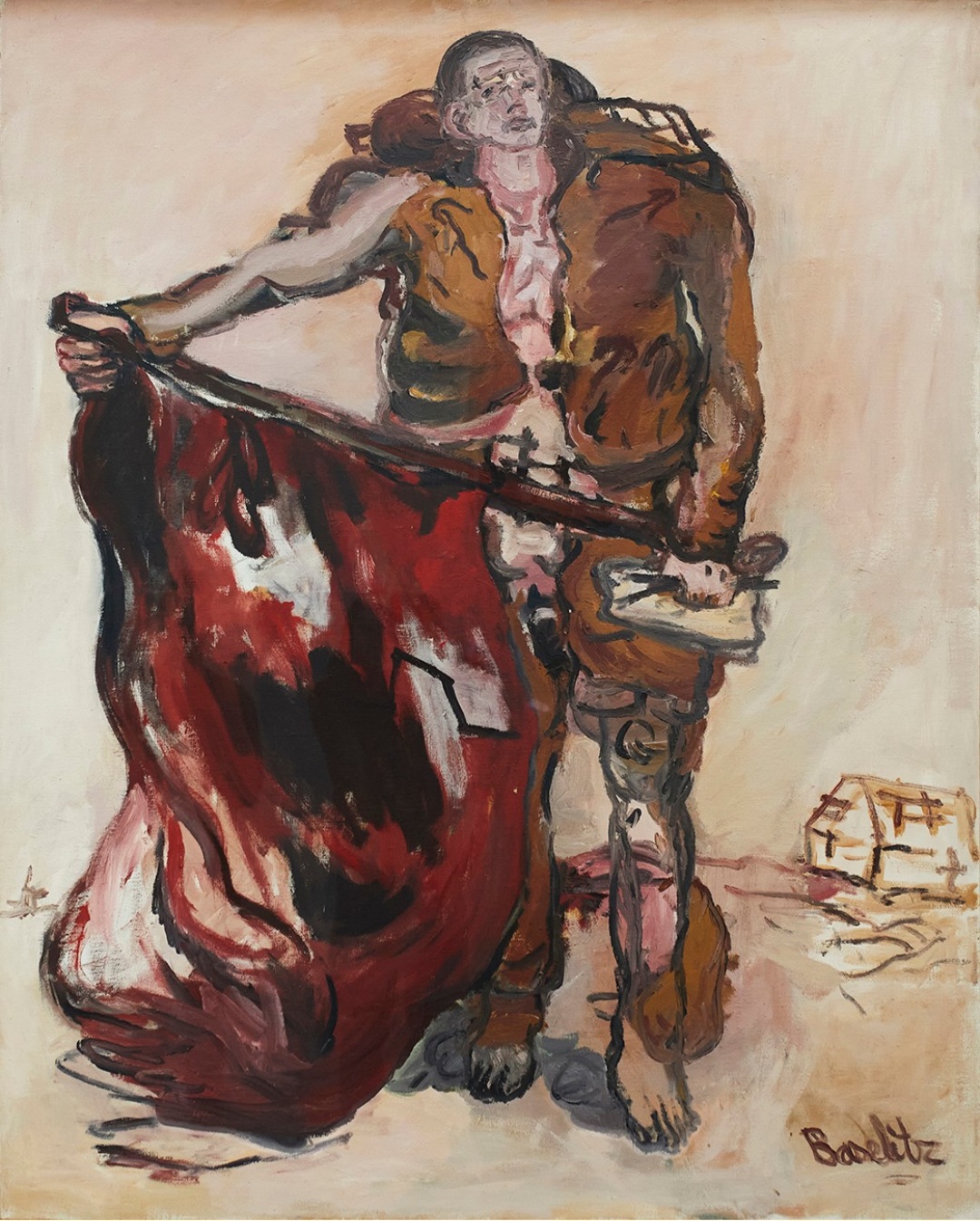
In Mit Roter Fahne (With Red Flag, 1965), pale flesh confronts crimson fabric, bringing
political symbolism into uneasy proximity with bodily fragility. The flag evokes collective
allegiance, while the figure resists any straightforward identification with conviction or
strength. Elsewhere in the series, broken tools, severed branches, damaged limbs and
torn clothing intensify the sense of physical and symbolic disintegration. The body
becomes the material site where the contradictions of historical representation are made
visible.
Baselitz also subjects the mythology of artistic creation to scrutiny. Modernist accounts of
authorship frequently associated the painter with masculine potency, expressive force and
sovereign control. His protagonists unsettle this model through their androgyny,
disorientation and impaired gestures. In Ein moderner Maler (A Modern Painter, 1966), the
artist himself becomes a figure of compromised authority. Creative identity shares the
instability that defines the series’ treatment of heroism.
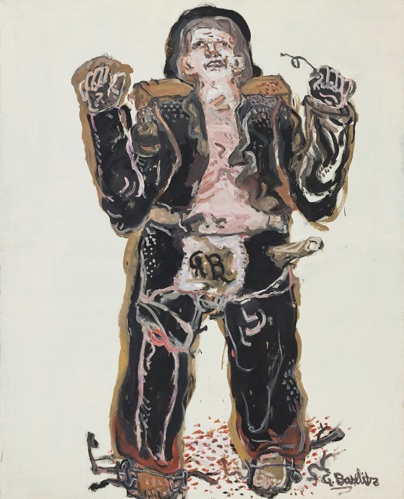
Georg Baselitz, Spekulatius, 1965. Mit Roter Fahne (With Red Flag), 1965. Photograph: Photo Service Art Basel. © Georg Baselitz 2026.
Eva Mongi-Vollmer’s essay Heroes without Deployment. The Years of Creation (1965/66)
situates the paintings within the tensions of their historical moment. Military associations
recall established structures of authority, while the protagonists’ damaged appearance
frustrates any reassuring interpretation of those structures. Historical memory persists as
an unresolved conflict between public narratives of reconstruction and the human
consequences of the past.
Baselitz’s engagement with heroic representation belongs to a wider history of artistic
responses to violence and collective memory. Otto Dix’s Der Krieg (1929–1932) confronts
the devastation obscured by military idealisation. Anselm Kiefer later examined the
persistence of German historical mythology and the ideological weight of cultural
inheritance. Gerhard Richter’s 18. Oktober 1977 (1988) investigates the relationship
between images, political violence and collective remembrance. Each artist challenges the
possibility of a stable visual account of history. Baselitz concentrates this problem within
the monumental figure, whose presence reveals the failure of the values it is expected to
embody.
The series also responds to painting’s uncertain position during the 1960s, when figuration
faced challenges from Pop Art, Minimalism and other avant-garde movements.
Representation carried the additional burden of its association with totalitarian
propaganda. Baselitz made these historical and artistic pressures integral to his practice.
His protagonists appear immobilised, while the paint retains considerable expressive force. The tension between damaged subject and vigorous execution gives the works their
distinctive intensity.
The Fracture paintings of 1966 extended this investigation through the division and
reassembly of the figure. From 1969, Baselitz’s inverted compositions further unsettled the
conventional orientation of the image. These developments demonstrate how historical
inquiry and formal experimentation converge in his practice: painting becomes a means of
examining the structures through which images acquire meaning and authority.
Baselitz’s heroes occupy the threshold between monumentality and collapse. Their bodies
bear the memory of an order whose legitimacy has fractured, while the paintings preserve
the force of its visual language. The resulting tension remains unresolved. Within these
devastated landscapes, painting becomes a space in which historical memory persists and renewal remains possible without the consolation of reconciliation.
Main Image: Georg Baselitz, Mit Roter Fahne (With Red Flag), 1965. Photograph: Ed Gumuchian/Courtesy private collection. © Georg Baselitz 2026.