
Georg Baselitz — Back Again, White Cube Bermondsey
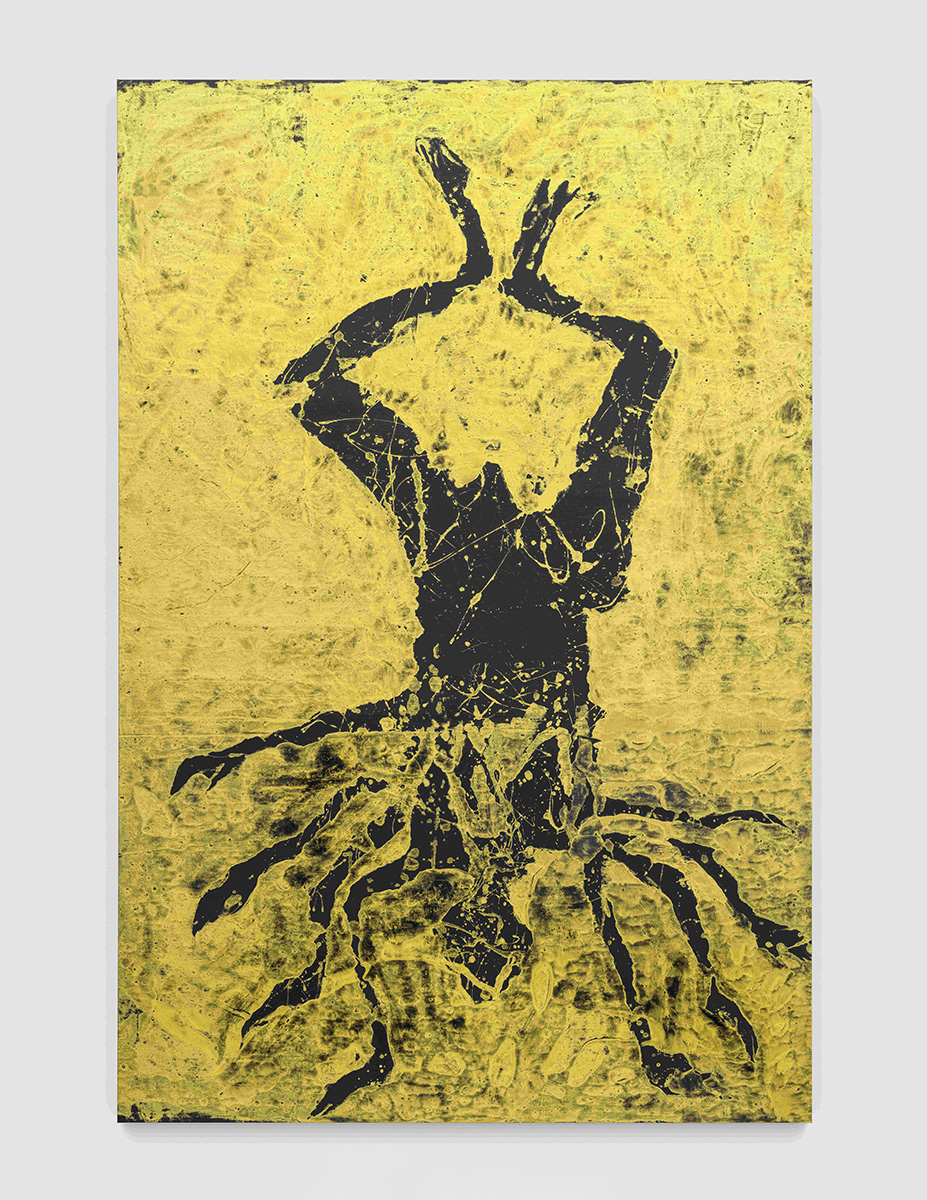
With Back Again, at White Cube Bermondsey, Georg Baselitz returns once more to his own history.
The gesture carries weight and resists closure. Conceived in the later phase of his
practice, the exhibition revisits recurring motifs in his practice — the eagle, the hero, the inverted body, the German landscape, Elke — and subjects them again to pressure. Nothing stabilises. This open condition defines the exhibition.
Much contemporary painting oscillates between decorative fluency and the rapid circulation of consumable images. Baselitz resists both. Painting remains a field of friction. Images do not explain; they insist. The recurring motifs do not return as quotations of themselves. They return altered, carrying the unresolved historical charge that Georges Didi-Huberman describes as survivance: images that persist by changing, never fully belonging either to past or present.
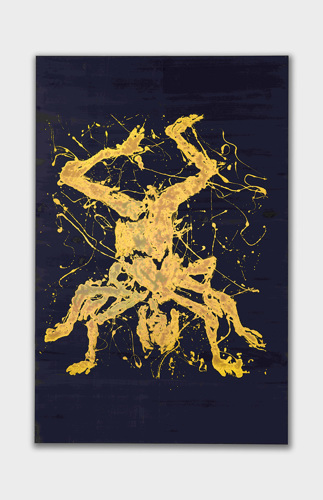
Image: Georg Baselitz, So Gewollt, nicht Anders (Wanted Like that, Exactly), 2025. © Georg Baselitz. Photo © Ulrich.
In the works produced between 2024 and 2025, Baselitz returns to his established language in order to test its remaining possibilities. The inversion of the figure, introduced in the late 1960s to interrupt narrative stability, appears here less as a device than as a condition. Bodies move between grounding and collapse, presence and disappearance. They never fully cohere. They remain suspended.
In Elkes Geburtstag am Teichdamm (2025), landscape and body fold into one another. Elke Kretzschmar, long-standing presence and recurring presence throughout Baselitz’s work, appears less as portrait than as persistence — a figure constituted through memory rather than likeness. The Saxon landscape returns not as nostalgia but as origin: a terrain marked by war, ruin, and formation.
The eagle reappears in Objekt naiv (2024) with altered weight. Embedded in Baselitz’s work since adolescence, the motif returns stripped of monumentality. Broken contours and nervous paint handling bring the image close to collapse. The symbol no longer secures meaning. It drifts, losing authority in the very act of appearing.
The Durga paintings shift register again. In Habe ich indische Tänze gesehen (2025), gold ground and multiplied limbs generate continuous motion. Creation and destruction become inseparable. Baselitz tests what a figure becomes when it can no longer come to rest. Time loosens. Historical certainty weakens.
Historicisation presses upon the exhibition. Baselitz has long entered the canon, and the late works risk being absorbed as retrospective confirmation. Back Again resists that movement. Even at monumental scale, the paintings remain exposed, unresolved, and vulnerable to contradiction.
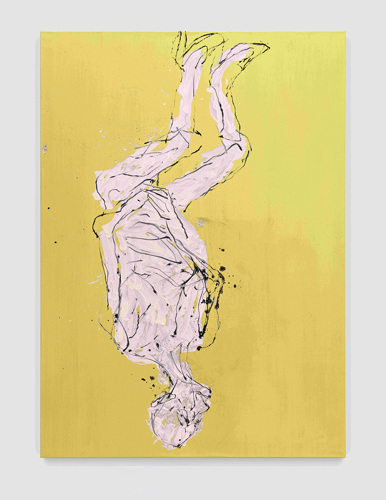
Image: Georg Baselitz, Kein dingsda, kein dingsda (Not a Thingummy, not a thingummy), 2025. © Georg Baselitz.
One phrase by Theodor W. Adorno returns with particular force: “It is part of morality not to be at home in one’s home.” Baselitz renders this condition visible. His figures occupy space without fully belonging to it.
There is a proximity, not of style but of logic, to Philip Guston. Both artists repeatedly return to exhausted forms, treating repetition not as redundancy but as a means of reopening unresolved questions. Nothing advances in a linear sense. Everything returns transformed.
Physical, historical, and emotional gravity remain the structural condition of these paintings. Inverted bodies, suspended eagles, and unstable figures articulate an ongoing negotiation between weight and release, attachment and estrangement.
The Salzburg Marionette Theatre project, L’Histoire du Soldat (2025), sharpens this logic. The marionettes — bodies suspended between control and autonomy — mirror the painted figures at the point where agency loosens. Nothing is fully held. Nothing is fully released.
Back Again holds painting in a state of productive friction. In a present increasingly defined by speed, repetition, and image neutrality, Baselitz insists on delay and resistance to consumption. The work does not conclude. It returns.
Within a broader international context, the exhibition represents a concentrated late statement from one of the central figures of post-war European painting. Yet its significance lies not in summation. Back Again refuses summation. The paintings return because the historical and formal questions that generated them remain unresolved. Baselitz appears here not simply as a canonical artist looking backward, but as a painter who continues to keep visible the fracture between history and image — a fracture much contemporary painting has learned to accommodate, but rarely still interrogates.
Main Image: Georg Baselitz, Indische Tänze in Pittsburgh (Indian Dances in Pittsburgh), 2025. © Georg Baselitz. Photo © White Cube (Eva Herzog).