
GaHee Park: The Controlled Romance of the Image
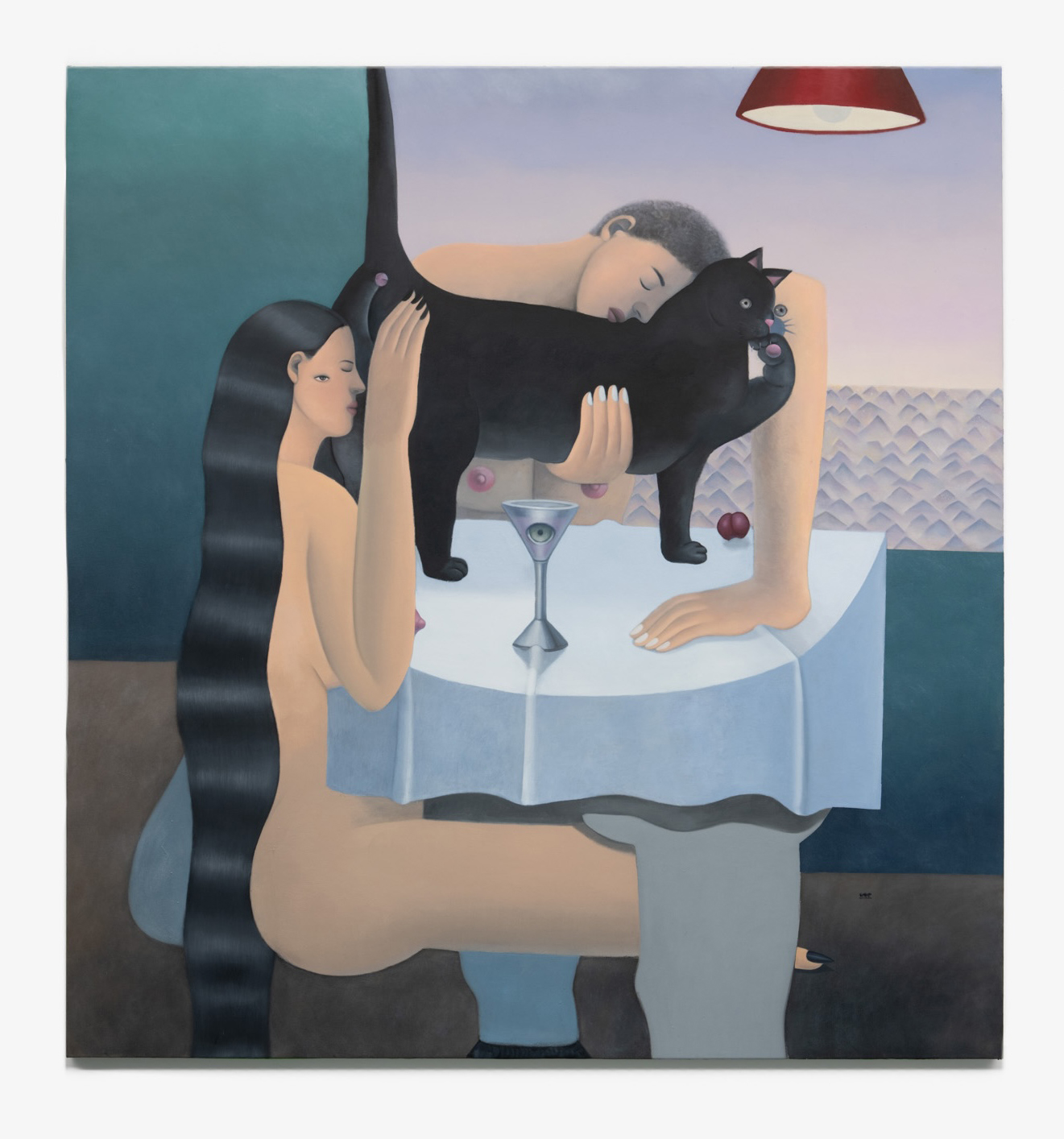
In an age saturated by images, GaHee Park’s paintings create an intimate and psychologically charged visual world. Her interiors, figures and arrangements of everyday objects occupy an ambiguous territory between recognition and estrangement, where domestic life becomes a stage for fantasy, memory and inner experience.
Park’s paintings may recall the apparent simplicity of naïve painting, yet their formal construction reveals a sophisticated engagement with desire, artifice and perception. Romantic scenes are rarely entirely idyllic: erotic tension, ambiguity and unease coexist with tenderness. Desire remains present as an undercurrent, shaping relationships between figures, objects and spaces.
This complexity is particularly evident in Park’s treatment of the female figure. Her protagonists often appear divided between presence and withdrawal, exposure and self-possession. Faces are sometimes doubled or interrupted, bodies partially concealed, and gestures suspended within uncertain encounters. The figure becomes a site where agency, vulnerability and the gaze intersect.
Her iconography extends this investigation into the domestic realm. Hands, flowers, fruit, food, bottles and furniture acquire an unusual intensity. Familiar motifs become carriers of suggestion, while gestures and arrangements imply narratives that remain incomplete. The recurring presence of hands is especially significant, occupying the space between touch and distance and introducing an understated erotic language.
Park’s treatment of space further unsettles perception. Exaggerated perspective and flattened depth bring woodgrain, brocade, texture and pattern to the surface, allowing materiality to become part of the meaning of the image. Mirrors, windows, framed pictures and curtains introduce reflections, thresholds and repetitions, creating a shifting relationship between interior and exterior, revelation and concealment.
Colour is central to this atmosphere. Park’s saturated palettes establish the emotional temperature of each scene, allowing sensuality, melancholy, tenderness and unease to coexist. Together with her stylized forms and carefully controlled compositions, colour contributes to a visual language that moves freely between the grotesque and the refined, the uncanny and the beautiful — a form of controlled Romanticism.
Her current exhibition, GaHee Park: Behind the Curtain at the Yerba Buena Center for the Arts in San Francisco, marks her first solo institutional exhibition in the United States. Curated by Dorothy Dávila, the exhibition brings together paintings spanning the last five years of Park’s practice and explores sexuality, mortality, fantasy, identity and alienation. Its title resonates with the recurring curtain motif in Park’s work, where concealment becomes a threshold through which the imagination enters the image.
At the heart of Park’s practice lies an investigation into the limits of representation. Her paintings suggest that an image can approach an interior reality without completely defining it. Meaning emerges gradually through the tension between what is given and what remains open to projection, allowing painting to become a space of uncertainty, attention and psychological discovery.
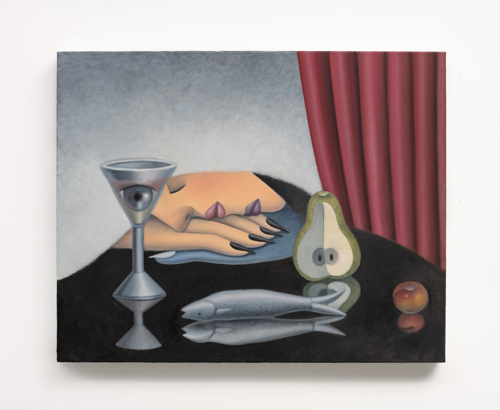
GaHee Park, Room for Reflection, 2025; Oil on Linen, 51 x 64 cm. Courtesy of the Artist and Perrotin. Photographer: Paul Litherland
Margherita Artoni (MA): The women in your paintings often appear suspended between presence and withdrawal. Their expressions, gestures and bodily positions can suggest several psychological states at once, while divided or interrupted faces reinforce this sense of inner complexity.
How do you conceive your female protagonists? What interests you about the tension between exposure and self-possession, desire and agency? And how does your position as a woman artist inform the way you construct and represent female subjectivity?
GaHee Park (GP): I feel like my female figures were formed and developed naturally as I continued to paint them over the years. When I paint, I treat the figures the same way as other subject matter, it's almost all like a still life for me. I often think about my work as a never moving theatre, and so I have only one chance to put my subjects together in a way that makes sense as one image.
In the past I didn't consciously think about the figures as being me, or anyone specific, but recently I can see that I am making these women desirable-looking to my eyes. So I can say this might be my desired self in some way, but I feel the same about other things in the paintings, like peaches, fish, or flies.
MA: Hands, flowers, food, fruit, bottles and domestic objects recur throughout your paintings. They often seem to carry meanings beyond their immediate function, while the hand occupies a particularly charged position between gesture, touch and erotic suggestion.
How do you select the objects and motifs that enter a painting? Do they emerge from personal associations, art-historical references or intuitive choices? And what possibilities does the hand offer you for expressing intimacy and desire without relying on explicit representation?
GP: I think these elements come from all of the places you mention. They emerge from intuitive personal associations and also from a desire to express myself through a language from art history. When I moved to America in my early 20's to study, I was not really good at speaking English. Even if I could understand everything, I felt like I was talking like a child. So I had to use more gestures and use my hands a lot. Hands help communication, hands can mimic and represent. So I was naturally looking at hands in everyday life and then also in museums. Old masters use hands all the time, and I loved to observe how they use them. They can direct, hide, reveal, mimic, alienate...
MA: Your scenes often seem to capture a moment whose temporal boundaries remain uncertain. The viewer may sense that something has happened, is happening or is about to happen, while the event itself remains outside the image.
How important is temporal ellipsis to your work? Does withholding a narrative event create a particular space for the viewer’s imagination? And how does this suspended time contribute to the erotic or emotional tension of a scene?
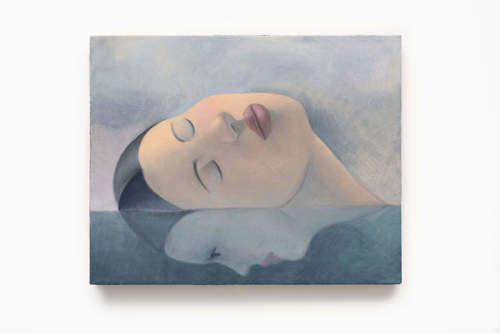
GaHee Park, Woman with Two Faces, 2026; Oil on Linen, 41 x 51 cm. Courtesy of the artist and Perrotin. Photographer: Paul Litherland.
GP: I guess I am always struggling in between parts of myself - as a painter who sees and is being seen. Part of me feels like I want to reveal everything to be recognized and part of me wants to hide everything I do and disappear. I guess what the viewers see is the consequence of this struggle. The space of the paintings is kind of negotiated from these two opposite poles.
So I think even if the actual scene of a painting appears calm at first glance, there are always tensions underneath the surface that remain alive and are never resolved. I am not interested in clear narratives in general. I like my images to be fluid so they go in multiple narrative directions or hold different narrative meanings - which has to do with the unstable sense of time in the paintings. And this fluidity can also take me beyond the painting I'm working and into thinking about the next painting.
MA: Your highly stylized compositions combine symmetry and order with divided faces, doubling, distortion and subtle disruptions. The result can move from the grotesque to the refined, or from the uncanny to the sensuous, while retaining a strong formal coherence.
There is a sense of controlled Romanticism in this relationship between structure and emotional intensity. How do you use symmetry, division and stylization to construct your figures and spaces? How do colour, texture and pattern shape the emotional atmosphere of a painting? Which artists, images or traditions have been important to the development of your visual language? Are there particular painters or works that have influenced your understanding of the figure, domestic space, stylization or desire? How do these references become transformed through your own practice?
GP: I grew up in a strict Catholic family. When I was young, I hated being Catholic and I never wanted to engage with religious art at all. Then in college, I learned about Caravaggio who speaks a strong unique language, in his works there seems to be a layer beneath the image depicted and through that he invites the viewers to explore subversiveness and sexuality within this religious imagery. After that I became excited to explore the Italian masters of the Renaissance. I was fortunate to visit Venice and Padova multiple times and Tintoretto, Veronese, and Giotto became big influences. I love that kind of work for the intricate, precise, and playful compositions, the story and psychology behind gestures and figures, how the animals are depicted, and the abstract qualities of those paintings.
I draw from many artists, eras, and movements... I could say so many different people but to name a few: Cezanne, Rousseau, Renoir, Cubism, Fauvism, Surrealism, Joan Jonas, Ana Mendieta, Dora Maar, Maya Deren, Magritte, Man Ray, Louis Bourgeouis, Cy Twombly, as well artists in other mediums, writers, filmmakers, performance, dance, comic book artists.
I try to understand the historical context of the works, but I also let myself use whatever elements spark some personal associations or ideas. I'm interested in looking at and learning about all forms of painting and art. Certain things might speak to me at a certain moment, or might fit into what I'm already thinking about - and then maybe those end up as elements I explore in my own work. Other things might not seem to be directly related to what I'm doing, but I like to see these too and maybe I'll remember them at some point.
When I lived in Philadelphia, Dona Nelson and Odili Odita were my undergrad professors at Tyler School of the Arts. They taught me a lot about how to see art with an abstract vision. I wanted to be an abstract painter for a while, but I didn't have that particular talent or orientation. But studying with these abstract masters made me understand the abstract qualities in art. Dona took us to museums a lot, and she would get really excited about every piece of great art in front of us, and that was a great experience. I always want to find that kind of exciting moment in my own work and in the work of others, and that provokes me a lot.
MA: Woodgrain, brocade, mirrors, windows, framed images and curtains repeatedly complicate the construction of space in your paintings. Surface can become almost architectural, while reflections and thresholds introduce different levels of reality within the same composition.
Curtains are particularly evocative: they can divide a room, conceal a figure or suggest something beyond the frame. Do you think of them as thresholds between different psychological or pictorial spaces? What attracts you to the tension between revealing and concealing?
This also raises a philosophical question about representation. Your paintings seem to suggest that what appears before us can never completely account for what is present. Could painting, for you, give form to an experience that remains partly unknowable? Is ambiguity itself a form of knowledge?
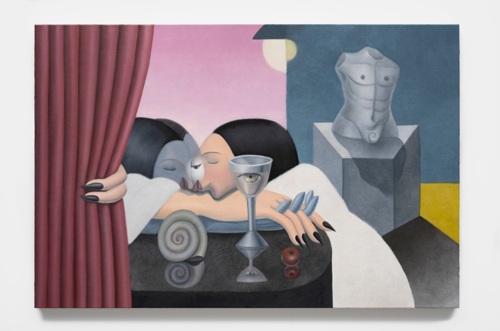
GaHee Park, Seafood Heaven, 2026; Oil on Linen, 115 x 152 cm. Courtesy of the artist and Perrotin. Photographer: Paul Litherland.
GP: Yes I do think the curtains and also the windows, the mirrors, the reflections, the paintings-within-the-paintings, etc function as pictorial and psychological thresholds in the way you describe. I think I consistently like to flatten the pictorial space... it's some instinct I have to want to bring multiple elements into focus at the same time even if that creates an image that goes against a naturalistic perspective and creates something more like a kind of psychological or interior perspective.
So there's a sense of depth and space that feels unexpected or uncertain, and then I think maybe I include these elements like windows, curtains, mirrors as something that feels more familiar and seems to create a space that you understand - there's an inside and an outside, there's one room and another. And I try to use this seemingly familiar sense of space as an anchor that can help to hold together all the other elements in a painting. But in the end there's always a sense of ambiguity and uncertainty that pushes against this familiarity and creates some kind of tension and alienation.
MA: Your work suggests a sustained process of observation and introspection. What happens within your mental landscape while you paint? Is the studio a space of solitude, reflection or investigation, and to what extent do your paintings become a way of understanding your own experiences? How much of yourself do you recognize in a finished painting once it has become an autonomous image? And after it leaves the studio, how do you relate to its independent existence through exhibitions, collections and encounters with viewers?
Finally, in a culture defined by the accelerated production and circulation of images, what can painting still make possible through duration, materiality and sustained attention? What remains unexplored within the medium?
GP: My painting process has changed quite a bit in the past couple years. I used to make many drawings, which were collections of memories of objects or landscapes, sometimes with some narrative elements... From these drawings I'd work out a composition that I'd then use as the basis for a painting. I've never painted from real models (people or objects) because it always loses some aura for me and becomes not interesting anymore.
These days I don't really draw anymore, and I try not to think about what to paint until I start painting. I try to remember what I did with my last paintings, and I start to paint similar things, and then I improvise from there and slowly find new ideas and images that lead me
somewhere else. Sometimes it almost becomes like I am painting a still life of my own old work in my memory. In my studio, I paint 10 or more paintings at once. They are usually all at different stages, but they sort of interact with each other as I'm working. Some paintings can take 2 years or more and never feel finished, but then others can be done in as short as a week or two.
When I'm working a lot I try to live in a way that lets me stay in this kind of zone where I'm in tune with all the paintings I'm working on. I don't go out too much or see many people except for my husband who participates in this process and makes suggestions and also engages with it through film, music, and literature.
We have a regular daily routine that helps me work in this way. When I finish a body of work, I just try to move on to the next paintings and let the finished works live in the world. Since I was quite young painting has been my primary interest and what consumes my energy... I feel like I live in my micro-world of painting and it takes up all my time and focus.
Main Image: GaHee Park, Love Investigations, 2025; Oil on Linen, 183 x 173 cm. Courtesy of the artist and Perrotin. Photographer: Paul Litherland.