
Frida Kahlo: The Commodification of Rebellion
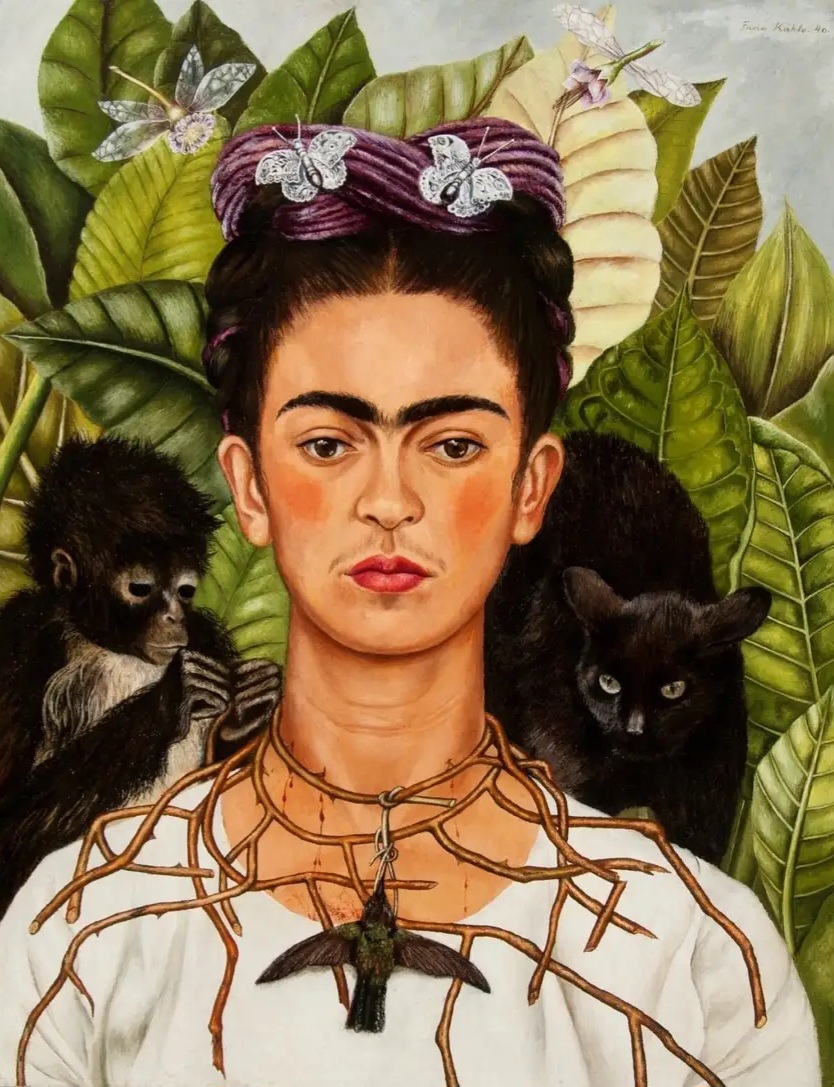
At Tate Modern, Frida: The Making of an Icon (25 June 2026–3 January 2027) explores a
defining contradiction of contemporary visual culture: how an artist who challenged
conventions of identity, gender and representation became one of the world’s most
commercially reproduced figures.
Developed with the Museum of Fine Arts, Houston, the exhibition traces Kahlo’s transformation from a relatively little-known painter into a global phenomenon. At its core lies a question: what becomes of dissent when it enters the marketplace?
Kahlo’s radicalism is rooted in the body. Her self-portraits confront pain, disability, desire
and cultural identity, unsettling conventional ideals of femininity. In Self-Portrait (With
Velvet Dress) (1926), self-fashioning asserts presence and control; in Memory (The Heart)
(1937), emotional suffering takes an uncompromising visual form. Through these works,
representation becomes an act of self-construction, challenging the frameworks through
which identity is understood.
In The Frame (1938), Kahlo’s image is enclosed within painted glass. Its presence
resonates within an exhibition about icon-making: the self-image becomes available for
framing, circulation and reinterpretation. The work also foregrounds a question shaping
Kahlo’s afterlife: who determines the meaning of her art as it moves through popular
culture and the global market?
Walter Benjamin’s account of mechanical reproduction offers a useful point of departure. In The Work of Art in the Age of Mechanical Reproduction (1935–36), he examines how
reproducibility transforms art’s authority and aura. Kahlo’s ubiquity appears to embody this
shift, yet her expanding reach also fosters identification, political affiliation and cultural
belonging. Reproduction multiplies access, leaving meaning open to contest.
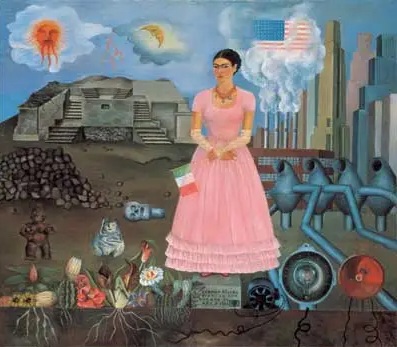
Frida Kahlo Self-Portrait on the Borderline Between Mexico and the United States 1932
© Banco de México and INBAL Mexico, 2005
Fridamania crystallises the paradox: rebellion itself becomes a marketable asset. Kahlo’s
defiance fuels her commercial appeal; her likeness promises difference, autonomy and
resistance. The marketplace repackages these associations as expressions of personal
style and identity. Dissent acquires exchange value even as its oppositional charge
remains part of the product’s appeal.
Guy Debord’s The Society of the Spectacle (1967) deepens this reading. Debord
describes the spectacle as social relations mediated by images. Fridamania operates in
this register: Kahlo’s likeness becomes a cultural reference through which audiences
express affiliation, construct identity and participate in consumption. The icon functions
simultaneously as a symbol of resistance and a commodity.
Kahlo’s reception among Chicana/o artists, feminists and contemporary practitioners
complicates any simple account of appropriation. Since the late 1960s, she has served as
a figure of cultural pride and political resistance for Mexican American communities. Her
legacy also resonates in the practices of Ana Mendieta, Judy Chicago, Kiki Smith,
Yasumasa Morimura, Martine Gutierrez and Berenice Olmedo, whose work engages
embodiment, gender and representation. These encounters reveal a legacy continually
reworked across distinct histories and contexts.
Bell hooks’s concept of the oppositional gaze, developed in Black Looks: Race and
Representation (1992), offers a further lens. Looking can become an act of resistance,challenging dominant systems of visibility. Kahlo’s afterlife therefore raises questions of agency: who can reinterpret her likeness, whose readings gain visibility, and how far can critical meanings travel within commercial systems?
The final room, devoted to “Fridamania” and featuring more than 200 objects, brings the
exhibition’s tensions into focus. Clothing, dolls, perfumes and consumer products chart
Kahlo’s cultural reach while exposing the ambiguity of her commercial afterlife. What
drives their appeal: the art, the biography, the defiance, or their fusion into a recognisable
global brand?
Tate itself is implicated. By placing Kahlo’s work alongside its cultural and commercial
afterlife, the museum participates in producing the icon it examines. Its curatorial ambition
carries an institutional risk: exposing the machinery of commodification may also turn that
machinery into a spectacle. The presentation of Kahlo as a figure of universal inspiration
raises a related concern: which specific histories of struggle recede as her image travels?
Fridamania remains a contested cultural formation where resistance and consumption
intersect. Kahlo’s influence persists through the competing interpretations attached to her
work, even as commercial circulation narrows the terms of engagement.
A critical encounter with Kahlo requires looking beyond the familiarity of the brand and
attending to the historical, political and artistic complexities that mass circulation can
flatten. Her work retains a force exceeding its commercial afterlife: intimate, unsettling and
resistant to easy consumption. The encounter begins where the brand falls short.
Main Image: Frida Kahlo (Mexican, 1907–1954), Untitled [Self-portrait with thorn necklace and hummingbird], 1940. Oil on canvas mounted to board. Nickolas Muray Collection of Mexican Art, 66.6. Harry Ransom Center.