
Eunnam Hong: The Unfinished Self and the Theatre of Becoming
In Eunnam Hong's paintings, identity emerges as an unstable construction. Faces recur,
bodies assume different roles, and familiar situations acquire unexpected meanings.
Her figures inhabit an ambiguous space where individuality and repetition, recognition and transformation intertwine. Presented at Mendes Wood DM, the exhibition Coming-of-Age Stories (成長物, 성장물) approaches identity as an ongoing process, shaped by the forms through which the self is represented and recognised.
The exhibition's title brings together two meanings: the coming-of-age narrative and economic growth. Their convergence establishes a tension between personal development and the historical, social, and economic structures that shape it. Growing means discovering one's possibilities, but also adapting to the expectations through which society recognises the individual. The promise of self-realisation is thus accompanied by the imperative of constant reinvention. Hong's figures inhabit this contradiction, moving through successive incarnations without reaching a definitive form.
A central element in this process is the recurring curly blonde wig, worn by the different figures throughout Hong's paintings. Its repetition introduces a principle of continuity into a plurality of seemingly distinct characters. Rather than functioning simply as an accessory or disguise, the wig appears to represent a shared self, an invariant presence manifesting itself through different identities, behaviours, and roles. Costumes and accessories shape these configurations, making visible the relationship between subjectivity and representation. This conception finds a parallel in Judith Butler's reflections on in Gender Trouble (1990): “There is no gender identity behind the expressions of gender; that identity is performatively constituted by the very ‘expressions’ that are said to be its results.” Although Butler's argument specifically concerns gender, it offers a useful perspective on Hong's broader investigation of identity. The wig embodies an ambivalence: it remains the sign of an underlying continuity of the self, while the figures who wear it multiply its possibilities of expression.
As Barry Schwabsky observes in the essay accompanying the exhibition, Hong thinks through novels and, above all, cinema. Her compositions reveal the deliberate construction of cinematic scenes: interiors resemble sets, garments possess the precision of theatrical costumes, and gestures suggest narratives whose circumstances remain partially concealed. Hong translates cinema's temporal organisation into the simultaneous space of painting. Different roles, points of view, and possible moments coexist on the same surface, compressing what film would develop through a succession of frames into fragments of an unfinished narrative.
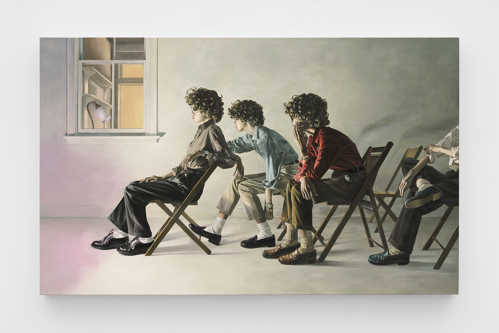
Eunnam Hong, Inside Out, 2026 Oil on Linen. Courtesy of the artist and Mendes Wood DM, São Paulo, Brussels, Paris, New York
Her practice belongs to a broader history of identity construction and theatrical figuration. Cindy Sherman's exploration of performative identities provides a reference for understanding the role of costume in the formation of the subject. The psychologically suspended interiors of Mamma Andersson and the enigmatic theatricality of Michaël Borremans offer further parallels, while Elizabeth Peyton provides a more indirect comparison through her approach to portraiture and the emotional charge of the painted figure. Hong's distinctive approach lies in the dispersal of identity across recurring bodies, altered appearances, and overlapping temporalities. The wig holds this plurality together: the figures become successive, sometimes simultaneous, possibilities of the same self.
In Snakes (2026), five figures occupy a single room, arranged in two distinct yet visually connected groups. Three stand beyond a large opening in a partition wall, while two occupy the foreground. This spatial arrangement separates the figures without necessarily implying differences in age or temporality. Their resemblance, reinforced by the recurring blonde wig, instead suggests a multiplication of identity. They can be understood as different manifestations of a single self, expressed through distinct postures, clothing, and positions within the scene. The opening in the wall brings these configurations into relation rather than separating different stages of life. The title refers to the Sansevieria visible in the background, commonly known as a snake plant, confirming Hong's attention to the visual language of cinematic set design. What appears to be a plurality of characters may, in fact, represent a single identity manifesting itself in multiple forms.
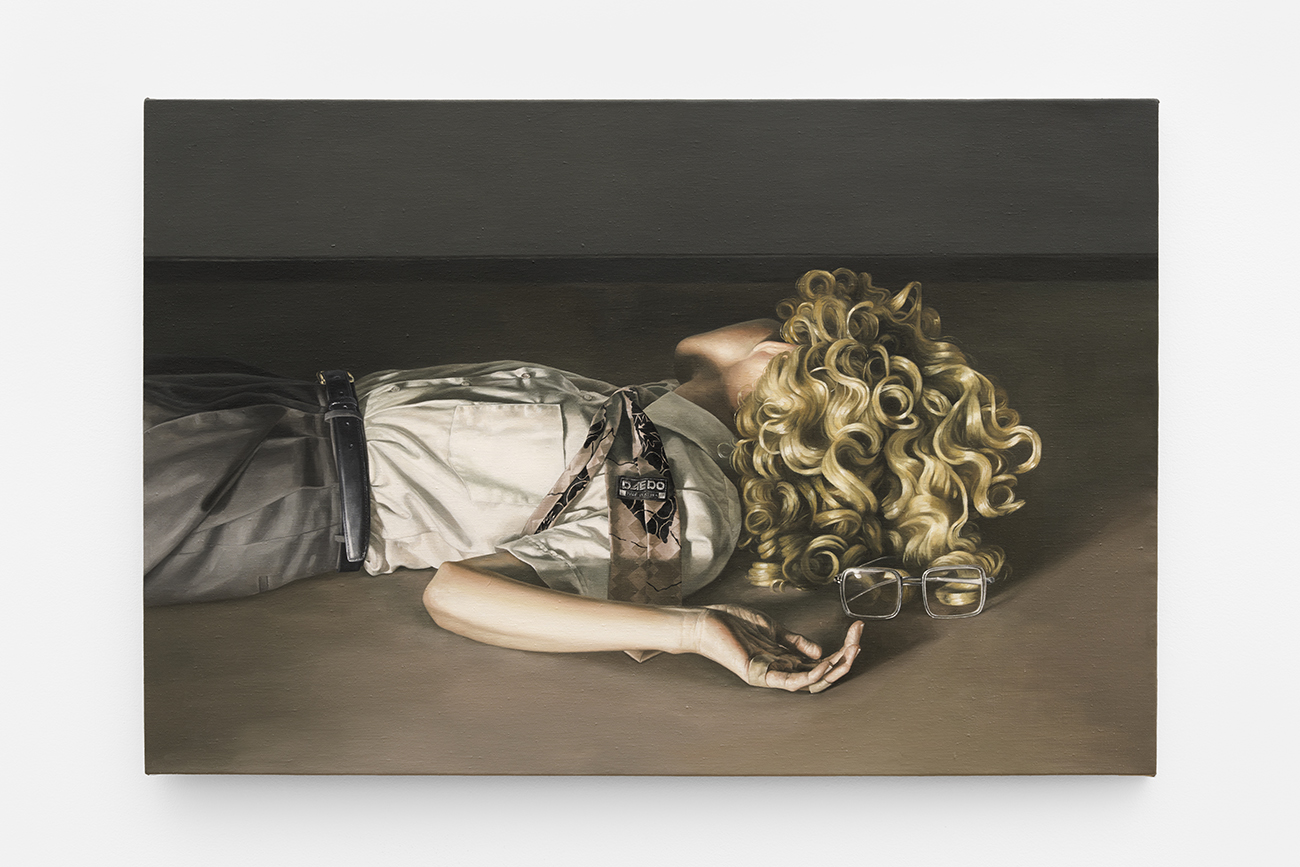
A different form of disappearance emerges in The Great Thief (2026). A female figure lies on the floor, her long blonde hair spread around her head. A pair of glasses rests beside the back of her head, near the nape of her neck, as her face is turned away. Her concealed features and vulnerable position suggest a loss of control, although it remains impossible to determine whether she has fainted or lost consciousness. The glasses introduce a suggestive detail: an object associated with vision lies beside the figure, while the face of the person who might wear them remains inaccessible. The recurring blonde wig connects her to the shared identity matrix running throughout Hong's paintings. The title intensifies the uncertainty: what has been taken, and from whom? The painting seems to stage an act of dispossession, presenting a physically present body deprived of the features through which a person becomes recognisable.
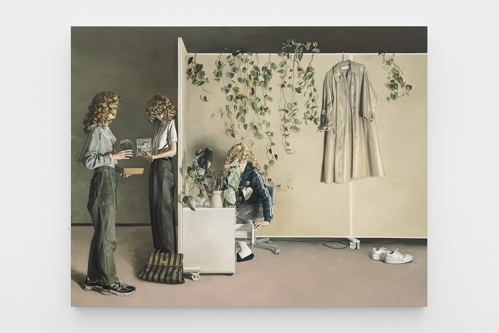
Eunnam Hong, Devil’s Ivy, 2026. Oil on Linen Courtesy of the artist and Mendes Wood DM, São Paulo, Brussels, Paris, New York
The recurrence of figures and the slippage of identities evoke a form of dissociation, understood here as an aesthetic and existential discontinuity rather than a clinical diagnosis. The body persists while the self seems to multiply. This condition approaches Freud's notion of the uncanny: the unsettling return of something familiar in an altered form. In his 1919 essay The Uncanny, Freud describes it as “that class of the frightening which leads back to what is known of old and long familiar”. A repeated figure or familiar appearance acquires an unsettling quality through its recurrence. The double disturbs because it occupies an ambiguous position between the self and the other. In Hong's paintings, repetition destabilises the very notion of continuity: the figures appear to be different people, yet may be distinct manifestations of a single subject.
The exhibition's historical dimension further develops this reading. Its accompanying text connects Hong's imagery to her experiences between Korea and the United States and, in particular, to the memory of the 1997 South Korean financial crisis. Individual transformations do not take place in isolation but are shaped by economic structures, social expectations, and cultural models. The title's double meaning of growth thus acquires a broader significance: the imperative to develop and reinvent oneself also entails adapting to structures beyond individual control. Hong's figures inhabit this tension, sharing a common visual identity while assuming different roles and behaviours.
In Shiitake Mushroom (2025), two women prepare mushrooms around a table. An everyday activity takes on an unexpected theatrical quality through their elaborate clothing and striking hairstyles. Their resemblance suggests a connection that the painting leaves undefined: they could be distinct individuals, doubles, or variations of the same person. This last possibility offers a key to understanding Hong's practice as a whole. The recurring blonde wig suggests a common identity manifesting itself through different bodies and behaviours. It becomes a visual matrix of the self, a constant element persisting through different incarnations. The figures may therefore represent different versions of the same person, simultaneous and autonomous, engaged in distinct actions.
The material precision of the painting provides a counterpoint to this narrative ambiguity. The textures of the garments, the arrangement of objects, and particularly the transparency of the tablecloth reveal Hong's sensitivity to light and surface. As Schwabsky observes, the visibility of the women's knees through the translucent fabric demonstrates the sophistication of her painterly technique.
This tension defines the relationship between cinematic imagination and painterly specificity in Hong's practice. Carefully modulated light, the weight of fabrics, and translucent surfaces lend the scenes physical and emotional authority. The recurring blonde wig establishes continuity within compositions populated by seemingly distinct figures. The self remains recognisable in its underlying matrix while unfolding into multiple forms, roles, and behaviours. The multiplication of figures does not necessarily imply a multiplication of identities: what we see may always be the same subject, represented through its many possibilities of existence.
The promise of growth contained in the exhibition's title ultimately remains open-ended. Becoming unfolds as a multiplication of the possibilities of the self, expressed through different roles, behaviours, and appearances. The blonde wig becomes the sign of a continuity persisting beneath these transformations: a recognisable identity distributed across multiple versions of itself. The double calls into question the existence of an original, while repetition destabilises the boundary between the individual and their representation. Hong suggests that identity is not necessarily a singular form to be preserved or an essence to be discovered, but a constellation of possibilities that coexist and transform. In a world that demands perpetual reinvention, the question is no longer simply which mask we wear, but whether the different versions through which we manifest ourselves are truly other than us, or whether, taken together, they constitute our very self.
Main Image: Eunnam Hong, The great thief, 2026. Oil on Linen Courtesy of the artist and Mendes Wood DM, São Paulo, Brussels, Paris, New York