
David Salle: The Venice Paintings — Reprogramming the Image
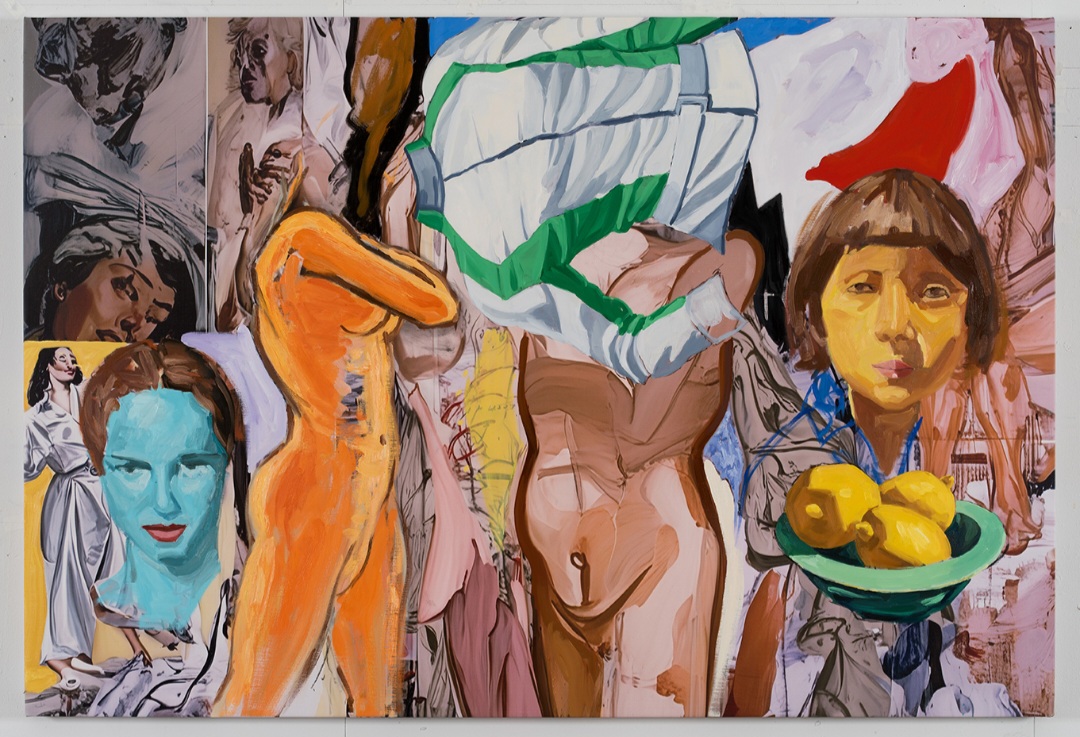
“One way to subvert a hegemonic technology is to co-opt it,” David Salle declares. At
Thaddaeus Ropac Paris Pantin, The Venice Paintings explores the encounter between
artificial intelligence and the material intelligence of painting.
Bringing together works previously presented at the Palazzo Cini in Venice, the exhibition examines how algorithmic intervention can unsettle an artist’s established language. For Salle, this experiment offers a means of testing the boundaries of authorship and the capacity of painting to absorb technological change.
The series revisits the Tapestry Paintings (1989–91), inspired by eighteenth-century
Imperial Russian tapestries interpreting sixteenth- and seventeenth-century Italian
paintings. These compositions had already undergone successive translations, from oil
painting to woven textile and back to canvas. Salle introduces another stage of mediation
through a personalised AI model, developed from 2022 and trained primarily on his own
oeuvre. The resulting compositions are fragmented and recombined, then printed onto
linen and reworked with oil, acrylic, Flashe and charcoal. Historical references, algorithmic
operations and manual interventions converge within a layered pictorial structure.
The project extends questions associated with the Pictures Generation, with which Salle
emerged in the 1980s. In his seminal essay Pictures (1977), Douglas Crimp examined
how appropriation unsettles conventional assumptions about representation and originality.
Salle brings this inquiry into an era of algorithmic image production, where existing
material can be reorganised at scale. His historical sources acquire new configurations
through successive acts of mediation, revealing how meaning changes as images migrate
across periods and artistic media.
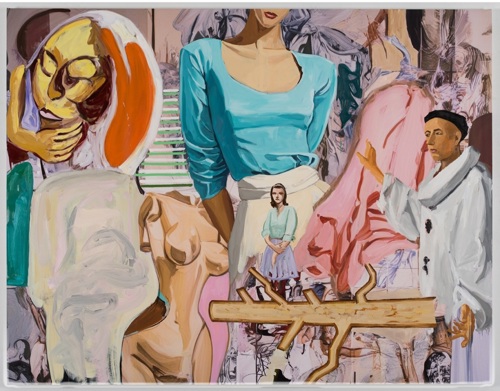
David Salle Mime, 2026 © David Salle / Adagp, Paris, 2026. Photos: John Berens Courtesy Thaddaeus Ropac gallery, London · Paris · Salzburg · Milan · Seoul
In Mime (2026), overlapping figures and objects create a densely populated surface
without an obvious centre. The eye moves between competing passages, encountering a
composition whose internal relationships resist narrative continuity. This simultaneity has
long characterised Salle’s practice; the AI intervention intensifies it by loosening the
structures that previously connected the source material. The resulting instability becomes
a formal principle in its own right.
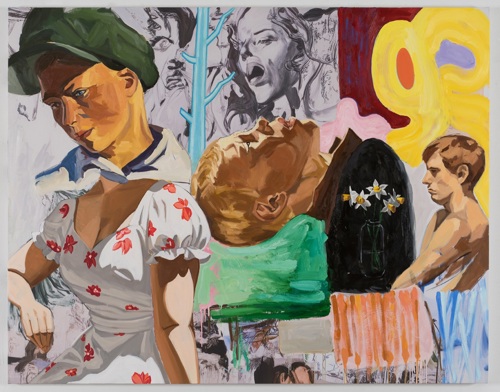
David Salle The Green Cap, 2025 © David Salle / Adagp, Paris, 2026. Photos: John Berens Courtesy Thaddaeus Ropac gallery, London · Paris · Salzburg · Milan · Seoul
The Green Cap (2025) offers a different point of entry. Saturated colour and recognisable
figurative elements establish moments of orientation within a composition that resists a
definitive reading. The titular detail provides a visual anchor, while the surrounding
fragments complicate the coherence of the scene. The juxtaposition recalls Robert
Rauschenberg’s incorporation of found imagery into painting, although Salle’s
arrangements remain governed by the rhythms and tensions of his own pictorial language.
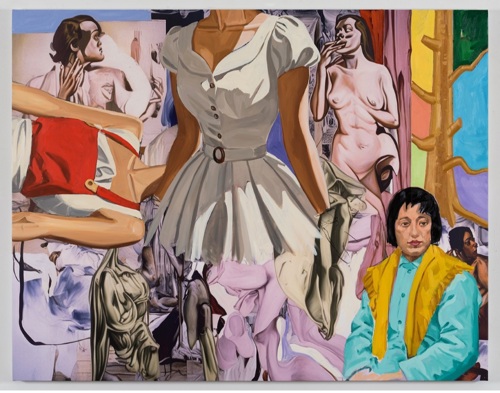
David Salle, Yellow Shawl, 2025-2026 © David Salle / Adagp, Paris, 2026. Photos: John Berens Courtesy Thaddaeus Ropac gallery, London · Paris · Salzburg · Milan · Seoul
In Yellow Shawl (2025–26), the draped garment introduces a more concentrated visual
motif. Its presence directs attention towards the relationship between the represented
figure and the surrounding forms, where shifts in colour disrupt spatial continuity. The
shawl momentarily anchors the composition as it moves between figuration and
abstraction. Recognition becomes provisional, shaped by the viewer’s movement across a
surface that continually redirects attention.
The distinction between machine and artist remains central to Salle’s method. He has
described his intervention as sending the machine to art school, teaching it to recognise
pictorial values such as contours, edges and tonal relationships. The formulation places
the accumulated knowledge of painting at the heart of technological experimentation. The
model generates compositional disruptions; Salle evaluates its output and respondsthrough colour, brushwork and gesture. Each intervention alters the conditions established by the preceding stage.
This approach intersects with Wade Guyton’s investigation of digital printing and the
material conditions of painting. Both artists incorporate technological operations into the
construction of the work, making the medium’s production visible. Salle, however, places
particular emphasis on the encounter between synthetic imagery and expressive gesture.
The printed surface retains traces of its mechanical origins as the artist redirects its
compositional logic.
A fundamental tension emerges from the model’s dependence on Salle’s own archive. Its
capacity to generate unexpected configurations remains conditioned by the visual
language it has absorbed. The artist’s desire to escape his established habits therefore
encounters a paradox: the system introduces unpredictability through the very material
that sustains his identity. Authorship shifts towards the selection, interpretation and
transformation of generated compositions, while Salle’s stylistic vocabulary persists
beneath their distortions.
The exhibition situates AI within painting’s longer history of translation and appropriation.
Historical imagery acquires new meanings as it passes between media, contexts and
successive acts of interpretation. Salle makes these transformations tangible, exposing the friction between algorithmic recombination and the painter’s embodied judgement. The technology expands the possibilities of rearrangement; the artist determines their pictorial consequences. Painting emerges as a critical practice through which technological change can be tested, absorbed and given form.
Main Image: David Salle, Faster, 2025 © David Salle / Adagp, Paris, 2026. Photos: John Berens Courtesy Thaddaeus Ropac gallery, London · Paris · Salzburg · Milan · Seoul