
Daisy Parris: The Language of Feeling
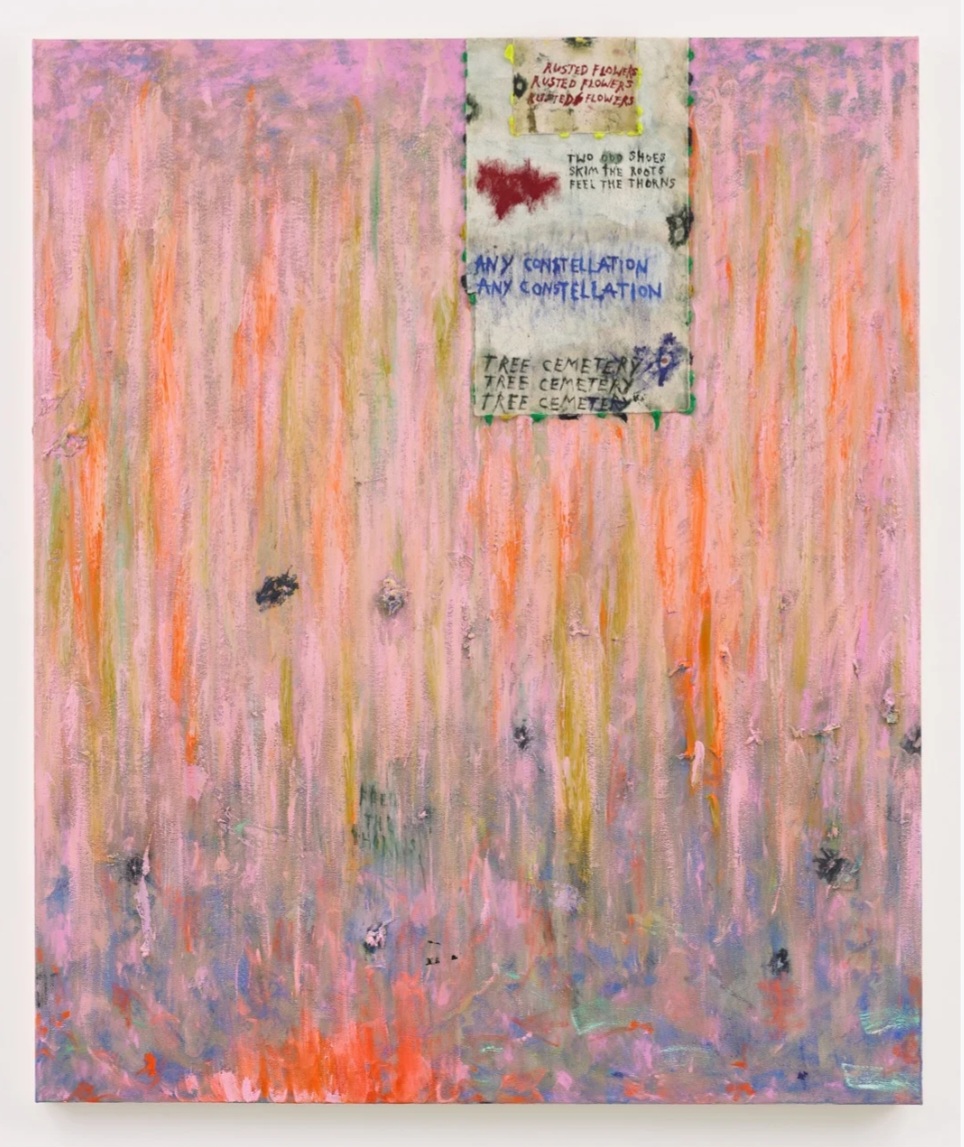
Daisy Parris’s paintings emerge from a tension between language and abstraction,
immediacy and reflection, gesture and structure. Colour, fragments of text, collage and vigorous painterly marks coexist on the canvas, creating images whose emotional intensity resists a single interpretation. Words enter the paintings as traces of memory, thought and lived experience, while colour acquires a psychological force that exceeds any fixed vocabulary of emotions.
This evolving language is at the centre of Fist Full of Dreams, Parris’s current solo
exhibition at Wolterton Hall in Norfolk, curated by Simon Oldfield with guest curator Gemma Rolls-Bentley. Running from May 20 to October 31, 2026, the exhibition brings together new oil paintings shaped by the history and landscape of the estate, alongside Kiss the Storm, the artist’s first monumental textile installation, rising five metres in height (width). The work extends Parris’s painterly vocabulary into a different material and spatial register, opening new possibilities around scale and tactility.
Across these works, vulnerability acquires a physical presence. Feelings take form through colour, rhythm, surface and language, allowing deeply personal experiences to become open to interpretation. The paintings hold the urgency of experience alongside the slower process through which experience becomes an image.
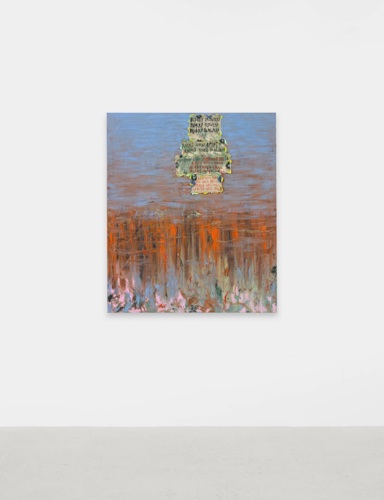
Margherita Artoni (MA): Colour appears to be one of the primary forces within your paintings. It can establish an atmosphere before an image has been identified or a text understood, and its emotional charge shifts according to its position within the composition.
Do you experience colour intuitively, before you know what a painting will become?
Daisy Parris (DP): Colour is always my way into starting a painting. It is feels instinctive
and tends to happen naturally. I tend to take note of colour combinations everywhere I go and store them away to bring into paintings later on. It feels like I’ve been researching colour for years, just by observing how to operates in the world, and I now have a repertoire to dip into. Sometimes it’s as simple as knowing that I need a contrasting colour to make another colour sing. Other times I use up leftover paint to start new canvases and I love how that kind of takes the decision making out of it.
MA: How do you navigate the distance between the associations we bring to colour and the meanings that emerge within your work?
DP: I used to live in London, surrounded by concrete so I had to turn to paint to get my dose of colour and that really helped me figure out how to express my emotions and memories through colour. I had no where else to turn apart from to devoting myself to colour and painting.
Now I live in the countryside and I see colour changing by the minute. I see how tender or ferocious the weather can be. I think keeping colours open and free and not bound by generic associations of emotions is really important. Some colours may be so strong and sure of what they conjure up, and others associations may still change, but either way, it takes a lot of looking to build an encyclopedia of colours that you can dip in to.
MA: Can a colour ever surprise you during the process of painting?
DP: Colour surprises me constantly. Whenever I’m stuck and don’t know how to move forward with a painting, I challenge myself and use a colour I haven’t used before or in a
long time. I try to make the ugliest colour combinations, but sometimes they end up being the most nuanced, complex combinations. I love it when colours reveal themselves by chance.
I don’t have the best lighting in my studio at the moment, but I love when I frantically paint at night thinking I’m painting a certain colour, and then when I return to have a look in the daylight the next day, it reveals itself as a slightly different shade or saturation. That might be one of the reasons I tend to work in dingy spaces; I love the surprise of seeing my work in a properly lit space for the first time.
MA: Across your paintings, there is a remarkable sense of coherence. Individual works
can stand on their own, while repeated gestures, words, forms and compositional structures become increasingly apparent when the paintings are encountered together. Repetition creates a sense of continuity across the body of work, allowing certain elements to evolve from one canvas to another.
How important is iteration to your practice?
DP: Iteration and repetition is very important to me because it helps me get to the core of things and understand them. I hear and see rhythm in everything. It’s constantly going round in my head and I can’t shut it off, so naturally it all ends up in my paintings.
The more you repeat something, the harder you press with the pen on the paper with the word you’re writing over and over again, the more you feel it, the more you understand it. Repeating helps me process. I like the contradiction that things can become clear and more meaningful with repetition, or they can become hollow and you question the importance of them.
MA: When you return to similar forms, colours or gestures, what are you looking for?
DP: I suppose I’m trying to communicate through colours and gestures things that I never could in words. So when I return to them, I’m just speaking the language I’ve developed to express myself over the years. I also have a fear of certain forms spreading and taking over so I am really exploring that fear in my paintings at the moment. I’m asking myself what would happen if a gesture did take over, or what would the point of that be, and do I need to push it that far? Painting is great place to confront fears because you can just paint over it if it gets too much.
MA: And how does a gesture change when it reappears within another painting, sequence or installation?
DP: In my head I am trying to recreate the exact gesture at it’s most perfect and honest; which was probably the first time it was subconsciously painted into existence, but of course the more you paint it, it loses the originality. I have quite the inner turmoil and I have to consider whether the gesture is good enough for the painting.
Is it necessary, honest or expressive enough, or is it just a copy of a copy of what’s come before? It’s funny how the gestures change slightly each time you paint them, even though you think you’re painting them the exact same way. The more they’re repeated in multiple works and across different medias, the more they feel like I’m building a recognisable language and the more the works support each other.
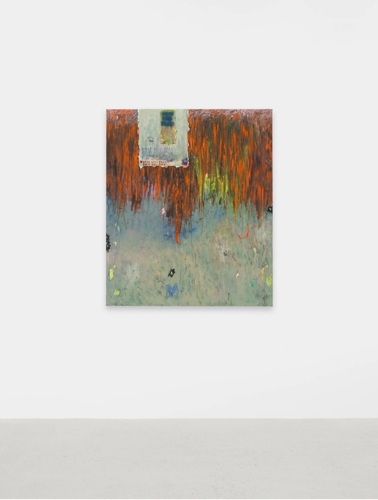
MA: Music and language occupy an important place within your visual vocabulary, and
your paintings often suggest an imaginative world extending beyond the physical limits of the canvas. I wonder about the environment from which that world emerges: the sounds, images, memories and associations that accompany you before and during the act of painting.
When you are in the studio, do you listen to music or surround yourself with particular sounds, images or other forms of stimulation?
DP: Sometimes I listen to music, lots of times I listen to nothing and just have the doors open to hear the countryside. When I’m on a deadline, the only thing that keeps me working is true crime podcasts. I like the rhythm of them and being hooked on finding out what happens and the fact you may never know what happened keeps you in this state
where you’re always asking questions and I think that’s really useful for painting.
Sometimes elements of painting are so mundane and laborious that I just need something really gritty to get through it. I tend to have pictures of paintings of mine on hand for reference because it feels like I forget how to paint quite often and it’s good to remind myself of times when I felt totally free in painting, even though at the time it may not have felt successful.
MA: Do you consciously construct a private imaginative environment in which to work?
DP: I actually don’t. I work from home in a tiny studio at the moment and there’s so many disruptions, it’s almost like I’ve had to take the preciousness out of the studio for a bit and just get on with it. It’s not a studio that you can hang around and dream in, it’s in or out and get on with it or nothing. As soon as you step out of the door, you’re back in a domestic environment.
The only way I can move forward is to think about what decisions I want to make in the studio the next time I go back in. I long for that idyllic studio environment where I hang out in it all day and get excited to go back the next day.
MA: And when words or phrases appear on the canvas—sometimes clearly legible, sometimes fragmented or partially concealed—how do they move from that inner world into the shared space of the painting?
They usually go from being written on my phone or journal, to being written on sheets of paper that are laying about the studio, then onto scraps of canvas. The words get erased and repainted a lot so that they too have a history and have lived a life. The words float
around the studio for a long time before they ever get put into a painting. I try to get to the core of them and see if the painting really needs them or if I’m just being indulgent or decorative.
MA: Your surfaces often seem to register the passage of time. Layers of paint, erasures,
interruptions and revisions remain visible, giving each work a sense of duration and
accumulated experience. The physical process itself becomes part of how the image is read.
Do you think of the surface as a record of time?
DP: I’ve always wanted to make work that seemed like it had lived a life and I’ve realised you can’t fake that. The only way you can make a painting that is emotionally and texturally dense is to put the time in. The work I’m making at the moment has so many layers, it can’t help but be a record of time, especially when I carve back into the surface and reveal all the layers of paint underneath.
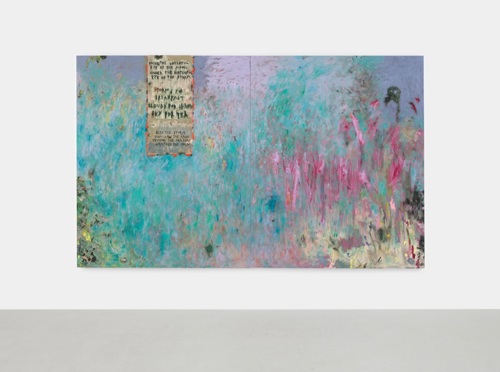
MA: What role do erasure and revision play in developing a painting?
DP: When I look back at some of my older paintings, they are just bare bones only concerned with cherishing the first marks made on the canvas. My work now is so laboriously layered and complex. The work has to take a beating and it has to survive it.
I’m always trying to prematurely finish paintings but they won’t let you if they haven’t lived enough. It’s agony but if they’re not ready then you have to push further, they need more time. Paint needs to go on and be scraped off, over and over. It’s the only way paintings can be fleshed out and reveal themselves. I’ve learned that I have to let go of everything I’m being precious about in a painting because it holds the painting back. It hurts at first but one of the best things you can do for a painting is get rid of the parts you like about it.
MA: Can the traces of its making communicate something that remains beyond the reach of its subject matter?
DP: I suppose it communications friction, time, frustration. It shows you that nothing is wasted even though it feels like it at the time when you’re wiping off all this paint that you’ve just put on. When you dig into paint and scrape it off, it shows you some of those bizarre colour combinations that were occurring in the early stages and it reveals some colours combinations that have happened by chance. I think that’s so beautiful, it’s like
unearthing something.
There is an intimacy in your work that can feel almost confessional. Personal experience is transformed through colour, gesture and language, creating an encounter in which the viewer can recognise something of their own emotional life. In a culture increasingly accustomed to translating complex feelings into immediate, legible images, your paintings retain a degree of opacity.
MA: How do you decide what enters the work and what remains private?
DP: A few years ago I feel like I was more directly confessional in my work. It was like I had finally found my voice and just had to get everything out as it was because that was better than having no words. Now I feel as though I have collected more ways to say everything I need it to say, but in a way that doesn’t necessarily give everything away; in a way that gestures or nods towards a feeling, experience or observation.
I’m learning that there are ways to write about heavy subjects like grief and loss, but in lighter ways. I’m not trying to sidestep the darkness, and I still stand by giving everything to painting, but I think I have matured in the ways I express my emotions, my writing skills and my ability to edit have developed. It goes back to asking myself if adding elements to the work is indulgent or it’s necessary to further the painting.
MA: Can opacity preserve a complexity that direct disclosure might diminish?
DP: I suppose it’s about getting the balance right. I want to find a way to invite people in, but not illustrate or explain. I want to keep some magic and for people to keep asking questions when they look at my work. I try to do this by keeping bits of the painting unresolved. It might not give you everything you need when you look at it, but that means I trust the viewer to take what they need from the work.
MA: And what happens when an experience that began as deeply personal acquires a meaning shaped by someone else’s encounter with the painting?
DP: I really encourage this. Hopefully I’ve got to a point where what I title or write in a
painting doesn’t close it down entirely, but opens it up for people to relate to it in difference ways. I think that’s why I like weathering the text so that it’s not always completely legible; you can read it if you want or you don’t have to; it can become another painterly gesture along with all my other brush strokes. Once you put something in a painting and show it to the world, it’s not yours anymore.
MA: Kiss the Storm marks an important expansion of your practice: a monumental textile installation that translates elements of your painterly language into another material and establishes a different relationship between touch, scale, repetition and space.
What did working with textile reveal to you about your own language as a painter?
DP: I used to paint large surface areas with small brushes because I loved the friction it created, but it was such a slow process. Stitching was quite similar to that. Filling in one area of colour, one stitch at a time. The labour of doing it on such a large scale was shocking at first. Threads are set in stone once they’re stitched, they’re not fluid like paint. But all the time I’d spent layering and building up surface texture in painting translated really well into textile. I could see the bigger picture and what areas needed to be built up with different thicknesses of thread. It revealed that I love challenging the surface, seeing how much something can take, pushing it to the extreme whilst also adding the most gentle gestures.
MA: Has the experience altered your understanding of the canvas as a physical and conceptual space?
DP: I’ve carried the layering and carving in the surface forward in painting in a more intense way. A brush stroke doesn’t always bring immediate texture like a thread does. The fact that a stitch actually goes through the surface of the textile is something that I really love and I’m try to bring that same energy to the paintings - that everything is built up and part of the same thing, not that elements are just put on top. It’s also made me really appreciate how immediate painting can be - how quickly you can build up colour and get it down on the surface and how you can take it off.
MA: And when you think about the future of your practice, where do you see the greatest possibilities for discovery?
DP: I think the greatest possibilities for discovery lie in playing. I need to remember that part of my practice should always be dedicated to playing with materials and failing. It’s really hard to make time for playing when there’s so much pressure to create finished work constantly. My goal is to maintain an element of playfulness, and realise that it’s okay to make paintings that aren’t always successful.
Main Image: Daisy Parris, If It's Any Constellation, 2026 oil and collaged canvas on canvas Courtesy of Sim Smith. © Daisy Parris