
Christine Safa’s Noces: The Imaginary as a Space of Tenderness
At Bortolami, New York, Christine Safa’s Noces (9 September–24 October 2026) examines how experience inhabits the inner world. Sensations, memories and intimacies converge in paintings where perception acquires the fluidity of recollection. Safa approaches painting as an act of attention, translating the encountered world into images shaped by inward experience.
The title, Noces—nuptials, or a joining—evokes a form of togetherness sustained across
difference. Throughout the exhibition, bodies, landscapes and fragments of memory enter
delicate relations, held together through the rhythms of perception. The imaginary
becomes a space in which experience can be revisited and transformed, gaining renewed
emotional resonance.
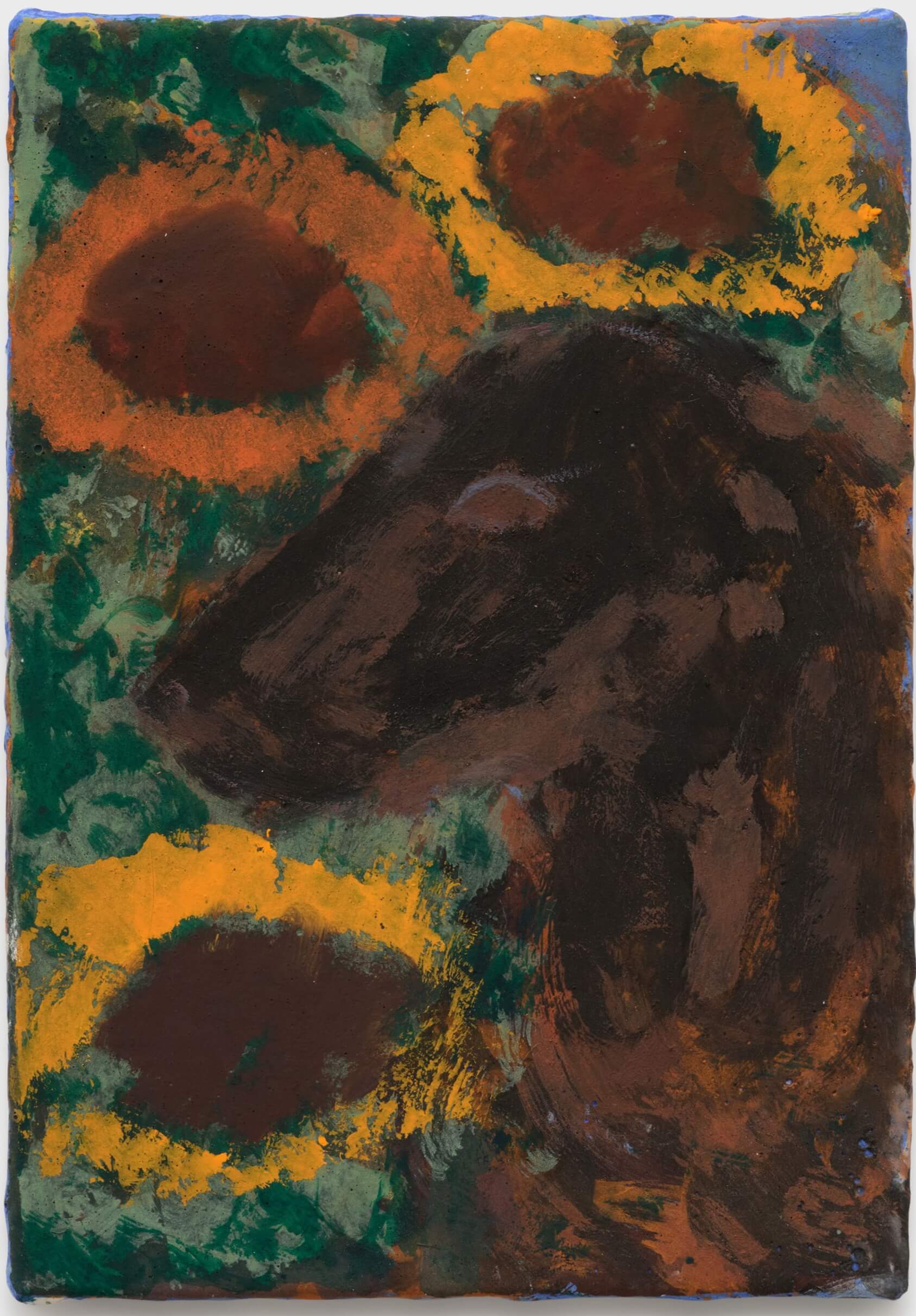
In Vigne aux tournesols (2026), three sunflowers frame the face of a dog. Vegetal forms
and animal intimacy converge within a shared field of attention. The flowers establish a
setting for the face, bringing subject and surroundings into close relation. The dog retains
its singularity while belonging to a larger living environment. Tenderness emerges through
this act of looking, allowing an ordinary encounter to acquire a quiet intensity.
In Là où j’étais, quand le ciel s’est déplacé I (2026), a man bathes at night. The title
evokes displacement, suggesting a shift in the experience of place. Immersion brings the
body into a condition of simultaneous exposure and shelter. Darkness unsettles the limits
of visibility; water surrounds the figure, holding him within a suspended interval. The scene
conveys the vulnerability of inhabiting a world beyond one’s control. Its intimacy resides in
the provisional nature of this encounter, where presence is experienced without certainty.
The dove in Colombe (2026) extends this exploration of fragile presence. Against the
night, the bird carries associations of peace while retaining the uncertainty of a living form.
Its appearance offers no definitive resolution; instead, it sustains a moment of attention
within darkness. The image suggests that tenderness can endure alongside uncertainty,
affirming life through the simple persistence of what remains perceptible.
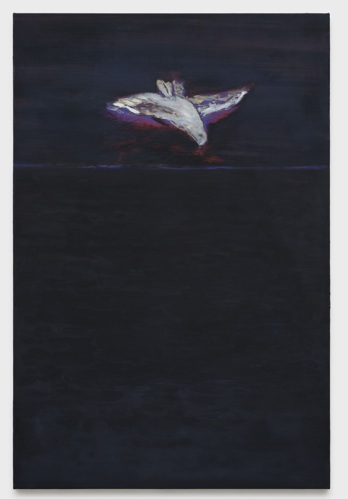
Christine Safa, Colombe, 2026 Courtesy The Artists and Bortolami Gallery
These works move from companionship to exposure and, finally, to persistence. Their
intimacy arises from the coexistence of vulnerability and care. Safa gives uncertainty an
emotional form, allowing connection to emerge without imposing closure. Tenderness
becomes an ethic of attention: a way of approaching the living while respecting its fragility.
Gaston Bachelard’s The Poetics of Space provides a framework for considering Safa’s
inward landscapes. His reflections on intimate space and reverie illuminate how memory
transforms the experience of place. In Safa’s paintings, space unfolds through perception,
carrying the traces of lived experience. Maurice Merleau-Ponty’s Eye and Mind offers a
complementary perspective through its account of embodied vision. Seeing, in this
context, is a bodily engagement with the visible, shaped by proximity, distance and
exposure.
A conversation with Etel Adnan and Pierre Bonnard further situates Safa’s approach to
painting. Adnan transforms lived geography into intensely personal fields of colour;
Bonnard reconfigures familiar surroundings through memory and sustained looking. Their
relevance lies in a shared understanding of painting as an inward transformation of experience. In Safa’s work, the image holds the duration of perception, allowing the visible to carry an intimate charge.
Safa has described painting as an attempt to find an anchor, allowing things to coexist and
accumulate in layers. This aspiration resonates throughout Noces. Her account of planes
becoming birds, rooftops turning into mountains, and treetops opening onto a horizon
reveals an imagination attentive to the transformations latent in everyday life. Such shifts
renew the experience of reality, revealing its capacity to exceed the immediately visible.
Ultimately, Noces considers connection as a fragile, ongoing practice. Through images
shaped by intimacy and uncertainty, Safa constructs an imaginary in which experience can be held and transformed. The inner world becomes a site of renewed encounter, where tenderness sustains attention to life and allows its vulnerable forms to endure.
Main Image: Christine Safa, Vigne aux tournesols, Courtesy The Artists and Bortolami Gallery