
Cassi Namoda: Myth, Memory and Invention
Cassi Namoda (b. 1988, Maputo, Mozambique) is a painter and performance artist whose work interweaves personal memory, cultural history and invention.
Born to a Mozambican mother and an American father, and having lived across different geographical and cultural contexts, Namoda explores identity, belonging and historical memory through vivid scenes that bring together the intimate and the collective, the quotidian and the cosmic, the joyous and the macabre.
Originally trained in cinema, Namoda approaches painting through narrative construction. Film stills, archival images, personal memories, literature, mythology and art-historical references become points of departure for paintings in which imagined characters and situations inhabit an ambiguous space between experience and invention.
Washed colours, flattened perspectives and recurring motifs contribute to an atmosphere of magical realism, allowing the familiar to acquire symbolic and dreamlike dimensions. Her practice engages deeply with the histories of Mozambique and the wider Lusophone world, exploring the intersections between vernacular traditions, spiritual imaginaries, colonial histories and contemporary forms of cultural exchange.
Her relationship with the history of painting is equally complex: European modernism, expressionism and surrealism become languages through which the canon can be examined, transformed and reclaimed.
In 2026, Namoda’s work enters several significant institutional contexts. Life Is the Seamstress of Dreams, opening at the Institute for Contemporary Art at Virginia Commonwealth University in Richmond in September 2026, will be her first major museum solo exhibition in the United States, bringing together new paintings, works on loan and film. Her work will also be presented in institutional group exhibitions including Flight Paths at the American Academy in Rome and an exhibition at Kettle’s Yard in Cambridge.
This conversation begins with Namoda’s most recent paintings, including the works that will be on view at the Institute for Contemporary Art at Virginia Commonwealth University, curated by Jessica Bell Brown. It considers painting as a space where memory becomes invention, history becomes personal, and everyday experience opens onto myth, emotion and the imagination.
Margherita Artoni (MA): The recent paintings that will be presented at ICA VCU continue your interest in scenes that seem to belong to a larger story. A gesture, a character or an encounter suggests a narrative without fully revealing it. This exhibition will also be your first major museum solo exhibition in the United States. The following year, in September 2027, you’ll have an exhibition at Pavilhão Julião Sarmento in Lisbon, curated by its director, Isabel Carlos, which will be your first solo institutional exhibition in Europe. Then, in August 2028, you will have your first solo institutional exhibition in the UK, at Kettle’s Yard in Cambridge. There are therefore a few significant “firsts” across each continent within this timeline, which is pretty incredible and worth noting.You have a background in cinema, and film stills have often served as points of departure for your paintings. What is it about the film still that continues to interest you as a painter? How does the transition from cinema to painting alter the relationship between image and narrative? When imagined characters or situations enter your paintings, how do you determine what should remain unstated?
Cassi Namoda (CN): I think what continues to interest me about the film still is the power of imagination, but also the possibility of communicating a kind of global lived experience -a human experience. Film has this extraordinary capacity to create moving depictions that people across different cultures can access and recognize, even when the histories or circumstances being depicted are not their own. An image can enter you almost instantly and influence something subconsciously.
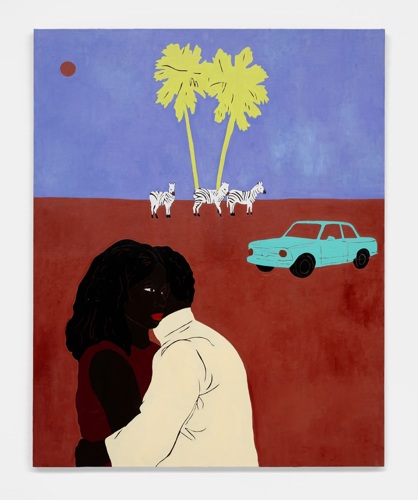
That is part of the power of cinema. When that language is translated into painting, however, I think something shifts. The image becomes more subjective because it is no longer moving toward another image or toward the resolution of a narrative. Everything has to exist simultaneously on one surface. Composition, color, gesture, scale, atmosphere, all of these things become ways of constructing a narrative without necessarily explaining it. In that sense, painting allows me to hold back information. I can suggest that something has happened, or is about to happen, without determining exactly what that event is.
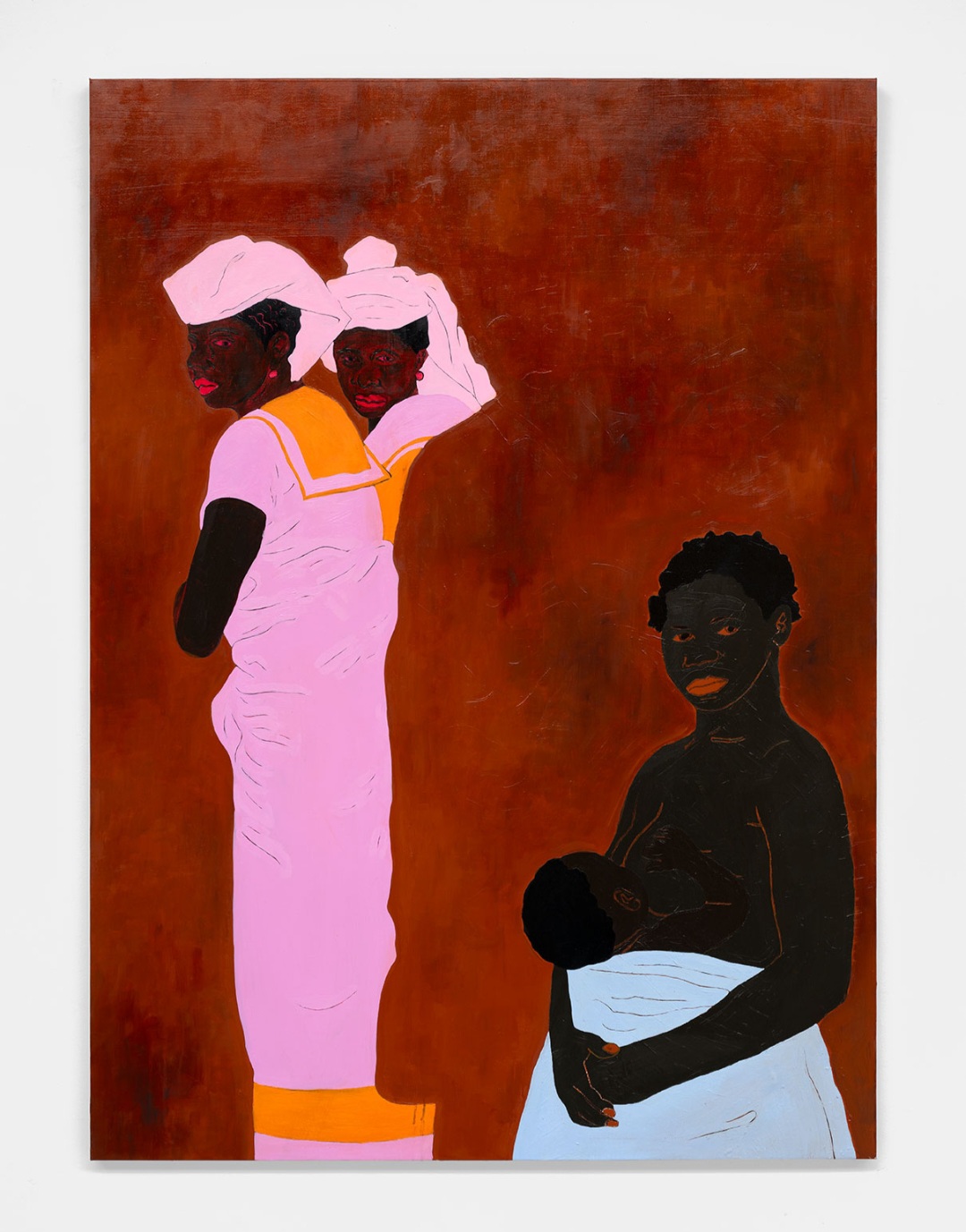
In Sasha and Zamani, for instance, flattened forms, restrained gestures, and direct gazes become ways of thinking about how colonial histories continue to inhabit the present, shaping bodily experience, identity, and communal memory. The conjoined figure evokes the psychological and historical entanglement of colonial pasts with contemporary life- histories that cannot be cleanly separated from the present conditions of social fragmentation and economic hardship.
In contrast, the mother and child suggest both continuity and rupture: a future carried forward through care and survival, even amid the erosion of communal structures and material stability.
This is also where the imagined enters the work. I’m not necessarily interested in resolving these figures into characters with fixed biographies or giving the viewer a complete narrative. I want them to remain somewhere between the specific and the imagined, because that ambiguity creates space for another kind of recognition. The viewer encounters a gesture, a relationship, a gaze, and has to negotiate what it might mean.
MA: Your paintings bring together personal memories, archival references and images drawn from different sources. The resulting scenes occupy an uncertain space between what has been experienced, remembered and imagined. How do you negotiate these different forms of memory? What happens when a personal recollection encounters an archival image? Can painting transform memory into something that exists beyond recollection? At what point does invention become part of the act of remembering?
CN: Well, essentially, I’m interested in a context that is negotiated around the ways African stories have been told to me,where storytelling is a kind of dream-building, but also world-building, and where dream life is not necessarily separated from waking life. I’m interested in that realm where discernment itself becomes a form of abstraction: where memory, imagination, history, and lived experience don’t necessarily need to be distinguished from one another in order to produce meaning.
For me, painting offers a particularly interesting space in which to explore this. We’ve seen these kinds of temporal and imaginative collisions happen in film, but I feel there is still a gap within painting, and that gap has increasingly become a focal point in my practice. I’m trying to negotiate composition in a way that can reveal this realm l, one in which the archival, the imagined, the remembered, and the lived are able to coexist and almost dance together on a single surface.
So invention, for me, isn’t necessarily opposed to remembering. It can be part of how memory is constructed and carried forward. Painting becomes a way of giving that unstable space a material form, allowing memory to move beyond recollection and become something that can be encountered in the present.
MA: Your paintings bring together the quotidian and the cosmic, drawing on mythology, vernacular traditions, indigenous forms of storytelling and spiritual imaginaries. Recurring figures and motifs—such as conjoined twins or powerful suns—return across your work, often in altered contexts and configurations. Their recurrence can feel almost ritualistic: something is repeated, yet each repetition seems to reactivate rather than simply reproduce the previous image. What draws you to myth and folklore as sources for painting? How do inherited stories enter your images while retaining their ambiguity and cultural specificity? Do recurring figures and motifs function as a way of activating collective memory? Can repetition transform meaning through variation, allowing an image to return without ever being quite the same?
CN: I think part of the beauty of living is being able to tap into the unknown. Not everything has to be absolute or fully understood. There is something important about being able to revel in things unbeknownst to us, whether they belong to the realm of dreams, the past, myth, folklore, or spirituality. I feel very content living within societies where these different realities are allowed to exist alongside one another. Life somehow becomes richer- or maybe simply less boring- when the visible world isn’t understood as the only world available to us.
For me, that is one of the beauties of African life and African societies. There is an incredible capacity to absorb these different registers of experience- the historical, spiritual, mythical, quotidian and allow them to coexist within storytelling. I think it is part of why the continent has produced such powerful authors and filmmakers. They are able to move between these realms without necessarily having to explain or separate them. In painting, I’m simply attempting something similar.
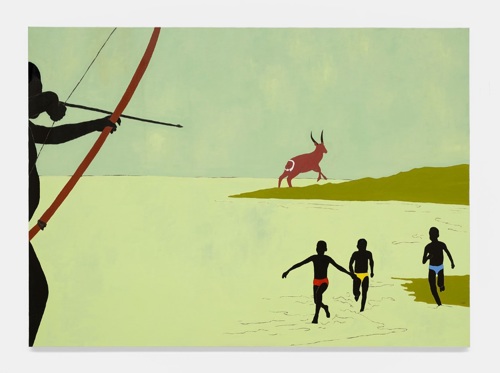
The recurrence of figures and motifs in my work is connected to this. I’ve been particularly interested in John Mbiti’s ideas around African conceptions of time and the relationship between the Sasa and the Zamani. In Mbiti’s thinking, the continued presence of a person through memory and the recurrence of names can keep them within the present, before they eventually recede into the deeper, collective realm of the Zamani.
That idea that recurrence can become a way of maintaining presence has become very important to how I think about painting. When a figure returns in my work, then, I don’t necessarily see it as repetition. I think there is still more life within that figure, or more of its story to tell than I was able to convey before. Perhaps through reflection, or simply through a different understanding of the world at another moment in my life, I become curious about what transformations are possible. The figure returns, but the conditions around it have changed, and therefore its meaning has changed as well.
I think that is one of the strongest aspects of the figurative language I’m trying to build: it operates through a kind of circularity. A figure doesn’t necessarily begin in one painting and end there. It can disappear, return, transform, and carry traces of its previous existence into another image. So repetition becomes less about reproducing something and more about reactivating it. In that sense, these recurring figures can hold a kind of collective memory they allow the past to remain active in the present while still leaving open the possibility that each return might reveal something we hadn’t seen before.
MA: Your paintings engage with modern art history through expressionism, surrealism and other established pictorial languages. You have described this relationship as 'one that both challenges and venerates the canon'. Expressionist distortion, dissonant colour and magical realism become ways of reactivating historical languages within your own visual world. Can you explain what it means for you to work within the history of painting while questioning its inherited hierarchies? When a historical pictorial language enters your work, how is its meaning altered through your own cultural and visual context? Can painting become a form of revision through which the canon is encountered from another position?
CN: There’s a quote by Robert Motherwell that has always resonated with me: “Every intelligent painter carries the whole culture of modern painting in his head. It is his real subject, of which everything he paints is both an homage and a critique, and everything he says a gloss.”
What resonates so deeply for me is this idea that the history of painting itself inevitably becomes part of the painter’s subject. A new painting doesn’t exist independently of what came before it. It inherits a language, a history, a set of conventions and contradictions. So every time you make a painting, you are in some way paying homage to that history, arguing with it, questioning it, and hopefully attempting to push it somewhere else.
For me, questioning the canon doesn’t necessarily mean rejecting it. I’m interested in what happens when you enter that history from another cultural and experiential position. And I think my own position as a woman of color from the African continent, but also as someone with a mixed cultural identity—gives me a particular kind of agency within that conversation. To have a seat at the table of painting, so to speak, means that I can participate in this history while also proposing revisions to it. I can ask who has traditionally been permitted to look, who has been looked at, and how those relationships might be reconfigured.
This becomes particularly important when I think about the masculine gaze and the long history of the female body within painting. When I return to something like the reclining feminine figure, or the mother and child, I’m very conscious that these images carry an enormous history.
There is an old-world knowledge embedded within those compositions, particularly through religious imagery and the traditions of the nude, and generations of painters have continued to reinterpret and expand upon those forms. But my relationship to those images is inevitably different. I am simultaneously the painter, the woman looking, and
someone whose body and cultural identity have historically been positioned differently within that canon. That gives me the agency to revisit those forms and ask what happens when the gaze originates from somewhere else.
But this inheritance isn’t only about pictorial language, subject matter, or the compositions I’m revisiting. It’s also embedded in the treatment of the brush and the paint itself. There is an old-world knowledge in the material construction of a painting, in how paint can model a form, create atmosphere, or complicate the distinction between foreground and background.
When I make these more modeled paintings, where figures seem to emerge from and recede back into the space around them, I’m consciously bringing that knowledge into the work. Sometimes the historical reference isn’t located in the structural making of a figure at all. It might exist in the atmospheric tension of the brush- in a passage of paint, in the handling of light, or in the way depth is suggested and then suddenly flattened. So the history of painting can enter the work through sensation and materiality just as much as it can through an identifiable image or composition.
You can trace these pictorial and material conversations from Giotto through Gauguin, for instance, and then someone like Bob Thompson enters that history and transforms its vocabulary again. And then there is painting today. None of us are beginning from zero. We inherit these images, but we also inherit this material intelligence- centuries of accumulated knowledge about what a brush, pigment, surface, atmosphere, and illusionistic space can do. We inherit the language, but we also inherit the possibility of changing what that language can mean.
That is why Tropical Depression, with Xavier Hufkens, was such an important and crucial moment in my career. It allowed me to think more deliberately about my own agency within these histories: how I could occupy established pictorial structures while simultaneously destabilizing some of the assumptions embedded within them, particularly around femininity, desire, race, and who controls the act of looking. It became an important moment of recognizing that revision could itself be a form of authorship.
So when historical languages enter my paintings, they inevitably become altered by the world that I bring to them; by African histories and forms of storytelling, by cinema, folklore, lived experience, memory, femininity, and my own culturally mixed position. A mother and child may carry the residue of a religious or canonical composition, but once those figures enter my world, they can begin to speak about something else: ancestry, migration, survival, intimacy, colonial history, or the continuation of life across generations. And similarly, a particular treatment of paint might carry the memory of an older painting tradition without having to quote a specific painting at all.
That is where I think painting can become a form of revision. Revision doesn’t have to mean erasure. It can mean returning to an existing language and asking what else it is capable of saying, who else has the authority to speak through it, and what happens when that language passes through a different body, history, and cultural experience.
In that sense, I’m interested in both venerating and challenging the canon. I want to acknowledge the extraordinary things painting has already done while recognizing the histories, bodies, and ways of seeing that have existed outside its dominant narratives. I’m not only borrowing images from the history of painting and changing who occupies them. I’m inheriting painting as a material intelligence and allowing that knowledge to encounter my own visual and cultural language.
Ultimately, I think we’re expanding the vocabulary of what painting can do. The language is inherited, but it isn’t fixed. Each generation encounters it from another position, adds something to it, distorts it, contradicts it, and passes it forward. For me, having the agency to participate in that process- to take a language that I inherited and make it answer to my own position -is one of the most powerful possibilities of painting. Sometimes history is present in the subject, and sometimes it is simply present in the brush.
MA: Your paintings bring together different symbolic, narrative and visual registers while maintaining a strong internal coherence. How do you establish relationships between such varied elements within a single image? Is there a connection between your chromatic decisions and the symbolic structures of your paintings? Do colour, gesture and recurring signs operate as a visual grammar through which different worlds can coexist?
CN: Definitely. Ultimately, I’m interested in what painting can do, and I think a large part of my practice is an attempt to create my own visual vocabulary a language through which color, space, gesture, figures, and recurring signs can begin to communicate with one another.
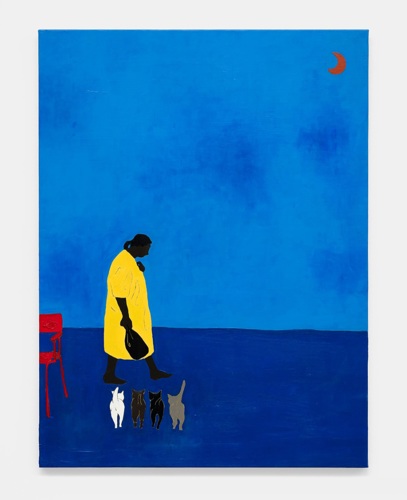
At times, I reflect very deeply on space and time, and those paintings tend to acknowledge a certain fullness and spaciousness. There can be a chromatic harmony that holds the image together and allows very different elements to occupy the same world. Color becomes a way of creating atmosphere, but also of establishing a kind of internal logic. It can tell you something about the emotional or psychological temperature of the painting without necessarily having to symbolize something in a fixed way.
But then there are paintings that deliberately deflect that harmony. In those works, I become much more interested in the uncanny in how elements can fall into place in ways that initially seem unlikely or even completely unrelated. A figure might operate at a strange scale, a color might interrupt rather than harmonize, or an object or gesture might appear without an obvious narrative explanation. And somehow, through painting, those things can begin to belong to one another.
I think that is where the visual vocabulary becomes important. I’m not necessarily interested in creating a fixed semiotic system where one color or one recurring motif always means the same thing. It’s more fluid than that. A sun, a body, a particular gesture, or a certain color can return from painting to painting, but its meaning changes according to what surrounds it. In that sense, the vocabulary is relational. The elements are constantly influencing and transforming one another.
Color is particularly powerful for me because it can create relationships before we even understand what we are looking at. It can collapse distance between things, separate them, create tension, or make completely different registers of an image feel as though they exist within the same atmosphere. Sometimes chromatic harmony creates coherence; at other times, chromatic dissonance is exactly what the painting needs.
I think different worlds can coexist because they don’t necessarily have to be reconciled through narrative. Painting can hold contradiction. The quotidian can sit beside the cosmic, the historical beside the imagined, and something deeply familiar beside something completely uncanny. What interests me is finding the internal logic that allows those things to coexist on one surface.
That logic changes from painting to painting. Sometimes it comes through color, sometimes through gesture, composition, repetition, or atmosphere. And sometimes it comes from allowing something to remain unresolved. For me, that is part of developing a visual language: not establishing a set of rules, but understanding how far those rules can be stretched while the painting still somehow holds together.
MA: Your paintings invite the viewer into scenes whose meanings remain partly unresolved. What kind of experience do you hope the viewer carries away from the painting? What would you like an image to continue doing in the mind after it has been seen?
CN: I don’t think anyone leaves this world with all of their questions about life resolved. Even if you have lived a deeply religious life, completely devoted to a particular set of beliefs, if you are genuinely engaged with intellect and curiosity, there will always be questions that remain unanswered. I think that is part of a universal truth about being human.
So in my paintings, I don’t think I’m ever attempting to provide answers. In fact, I often find paintings that give me all the answers less inspiring. I’m much more interested in finding that genuine quality of curiosity, where something can be proposed, attempted, felt, and still remain unresolved. In my practice, sometimes the unresolved notion is actually the resolution.
It also keeps the painting alive for me. And I think painting should feel alive. It should have some connection to humanity that extends beyond the particular moment in which it was made. I want an image to remain active in the mind, to leave behind a question, a feeling, a strange recognition, or perhaps simply something that you cannot completely explain. If everything is resolved within the first encounter, there is very little reason to return to it.
When I’m painting, I sometimes think about those extraordinary depictions made for churches centuries ago, and about the people whose labor went into creating them. So much of that work was made in the name of God, in service of something beyond the individual maker. Through those images and religious stories, people could feel closer to something they couldn’t necessarily see or fully understand. There is something about that relationship to painting that moves me very deeply.
I think there is a kind of human servitude within the act of making an image not servitude in the sense of submission, but in the sense of service. You give your time, your labor, your intellect, and your imagination to making something that might exist beyond you.
Perhaps, in practical terms, that is one of the reasons we paint: to leave something beautiful, and maybe meaningful, in this world. And I like when things relish. I like when an image is allowed to linger, when it doesn’t exhaust itself immediately. I want the painting to continue living after you have walked away from it to become entangled with your own memories, questions, beliefs, or experiences. I don’t necessarily need the viewer to arrive at the same place that I did. What matters to me is that something remains active.
Maybe that is what I ultimately hope an image can do: not resolve the world, but keep our curiosity about it alive.
All Images: Cassi Namado Photo credit: Thomas Merle, courtesy of the artist and Xavier Hufkens, Brussels