
BEFORE THE IMAGE Conversations on Painting in the Making - Yuri Yuan
Yuri Yuan (b. 1996, Harbin, China; raised in Singapore), a New York-based painter whose figurative practice explores the subtle tensions between the familiar and the uncanny.
Drawing on everyday situations, memories and fragments of lived experience, she creates enigmatic scenes in which solitary female figures inhabit domestic interiors, urban spaces and open landscapes. Through delicate tonal variations, carefully balanced compositions and a distinctive use of colour, her paintings evoke states of loneliness, displacement and longing, while leaving room for the inexplicable and unresolved.
In 2026, Yuan presented Wanderlust, her first European solo exhibition, at Haverkampf
Leistenschneider in Berlin, exploring questions of distance, belonging and the meaning of home. More recently, her work was included in Tête-bêche, a group exhibition at Make Room in Los Angeles (September 12–October 10, 2026). Her paintings reveal how external environments can become projections of inner states, and how ordinary moments can open onto more elusive psychological territories.
In this conversation, we explore her choice of subjects, her painterly process, the emotional language of colour, and the relationship between solitude, emptiness and the contemporary human condition.
Margherita Artoni (MA): Your paintings often begin with ordinary situations, familiar places or seemingly insignificant moments, which gradually acquire an enigmatic quality. What draws your attention to a particular subject, and when do you recognise that a moment or an image has the potential to become a painting?
Yuri Yuan (YY): I am interested in liminal spaces that often get overlooked, especially with our attention becoming increasingly sporadic. Places where main events don't seem to happen. Subjects that aren't the main character. Moments that feel in between reality and imagination, like when you close your eyes, getting ready to sleep, but your mind starts wandering and conjuring up images and narratives, or when you space out just looking at a candle or a chair, or when a smell reminds you of that time you were in Barcelona chatting with an interesting character (in the Proustian way).
After years of making art, I sort of developed an instinct that allows me to recognise the visual or narrative potential of that moment. For example, once in my dream, I saw waves and clouds that were intense red and pink colors. In that moment, I recognised it was a dream but told myself, "Gotta remember the intensity of this color. Gonna paint it later."
MA: How do you select and transform your visual references? What roles do photographs, memories and direct observation play in the development of your compositions?
YY: These moments that I just mentioned give me a vague mental image. Sometimes, in the moment, I take photos or make sketches. In the sketches, observational or from
memory, I often label the colors (a habit that I learned from Hopper's sketches). For photos, I usually draw from them or convert them into black-and-white images and then
paint from them. I usually don't work directly from a photo, it limits my imagination. Whether it's memories or drawings, they function as a filter between me and the image that allows me to alter and create the composition or palette that will work best for the story I have in mind.
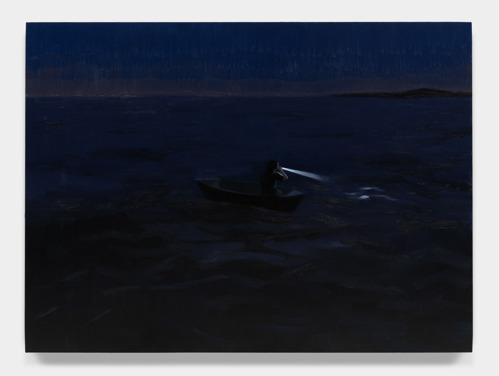
Yuri Yuan,You Will Be Found, 2024
MA: Your scenes often seem to emerge from fragments of everyday life, yet they suggest something beyond what is immediately visible. How important is intuition in choosing what to paint, and how much do you allow the unexpected to enter the process?
YY: While I do have an intuition about what I choose to paint, I'll be honest, there are many moments that I thought had potential but didn't work out on the canvas, at least at the time.
Whenever I have an idea, I just pursue it. Sometimes I can be stuck for weeks; the color
palette or composition is not eliciting the kind of emotion I was hoping for. The difficult part
is that even though sometimes I have a narrative in mind that I was very excited about, in
the end, I may have to let that go. The painting has to work as a painting. There's hardly
ever a complete overhaul from what I had in mind, but yeah, sometimes the paintings will
change during the process.
MA: Your work combines a recognisable figurative language with an atmosphere that often feels suspended between reality and imagination. Could you describe your painting process, from the first preparatory studies to the final image?
YY: Like I mentioned, I take photos and make sketches. I also make color studies using
watercolors and oil sticks, and charcoal drawings to experiment with the tonal values.
Usually, the larger the painting and the more complicated the image, the more studies I will make. The way I paint is pretty traditional.
The canvas is prepped with oil ground, then "stained" with a layer of color (often a light grey, sometimes pink or yellow, depending on the scene I''m painting). Then I draw on the canvas using raw umber (since this pigment dries really fast), use big brushes to block in the colors, then work out the details using a smaller brush.
MA: How do you approach composition, perspective and the relationship between the
figure and its surroundings?
YY: I approach the "figure-ground" relationship like a movie director. I'll ask myself, who is this figure? Is it a specific person? A generic figure? The answer will determine the level of specificity, what kind of clothes they are wearing, what posture or position they are in, and what expressions they have. Even though I often use my own body as a reference for the figure, I don't see them as self-portraits. I'll also ask myself, where is this place? What time of day, what season? What happened before and what will happen after? I think about all of these questions, and I think that's why my paintings sometimes give people a cinematic feel, since they imply a narrative of before and after.
MA: How do you work with paint, layering and tonal transitions to achieve the subtle, almost suspended quality of your scenes? Are there particular technical decisions that help you maintain a balance between precision and ambiguity?
YY: I think the ambiguity comes from a few formal decisions. First, the most obvious one, the composition, or the narrative implied by the composition, for example, the scale of the
figure in relation to its surroundings, like I just mentioned. Second is the colors. I often use a combination of chromatic grey and saturated colors. The color choice is not based on the representational world but on the emotional or narrative weight of the subject matter.
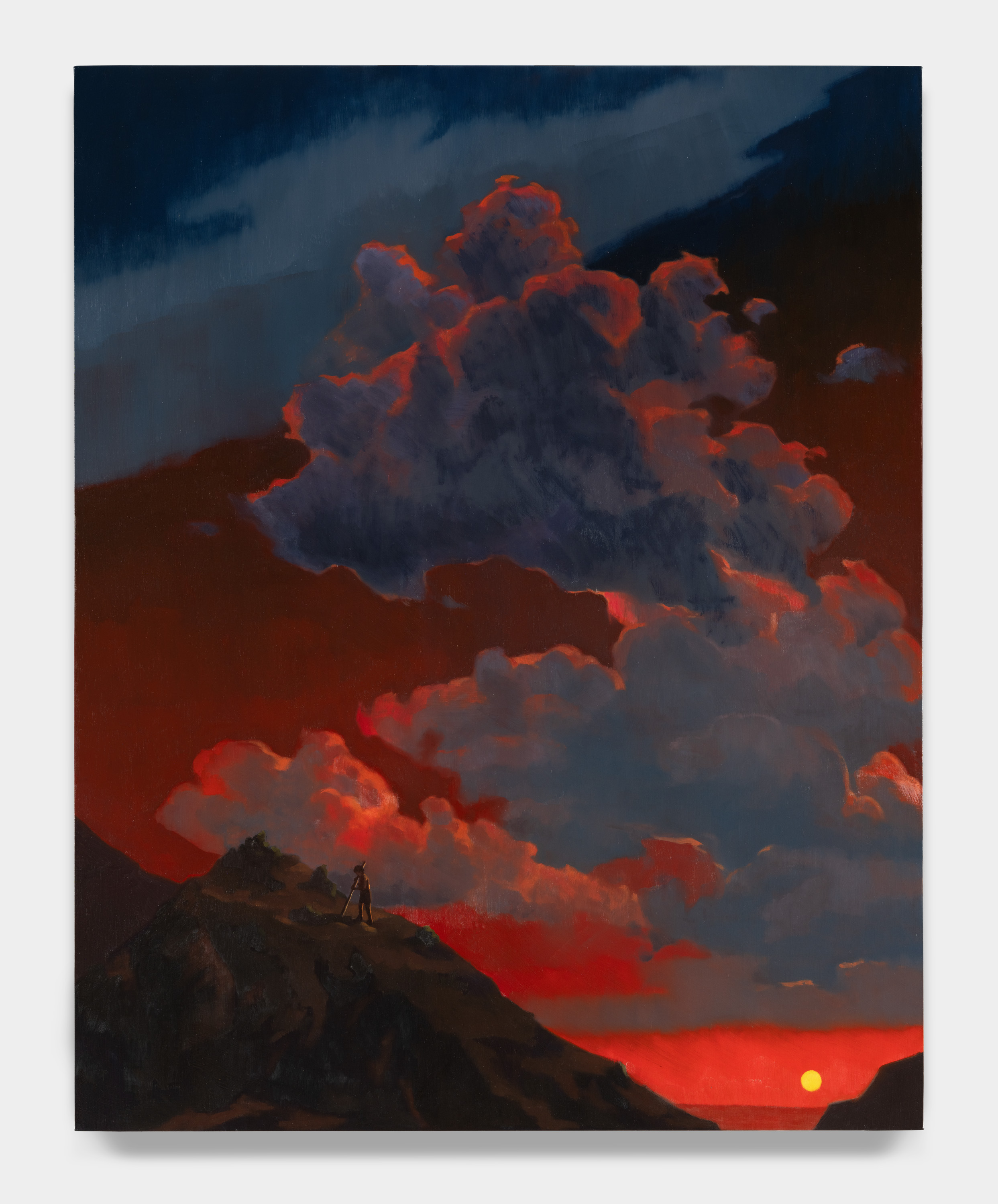
For example, in September, I want the viewer's eye to be immediately caught by the red
clouds, so the red was a very saturated cadmium red. And the figure is secondary; therefore, it is a brown-greyish color. The third choice is the brushstrokes. I use flat brushes instead of filberts (that is, brushes with straight, 90-degree tips, rather than
rounded tips), which create straight lines or rectangular blocks of color.
When you look closely at a detail, the painting starts looking pretty abstract. I hardly blend colors (think of someone like Da Vinci or Botticelli). Some people say they look pixelated and therefore imply a digital reference, but actually, I was mostly influenced by Vermeer. When you zoom in on his paintings, reality starts falling apart, and you realize you are looking at a blob of paint, not a pearl.
MA: Your paintings often transform familiar situations into scenes that seem almost
impossible or inexplicable. How do you construct this tension between the real and the surreal, and does the uncanny emerge during the painting process or is it something you consciously seek from the beginning?
YY: The impossibility of the scenes is very intentional. If a scene can be captured by photos, then what is the purpose of painting? At least to me, it's not fun anymore. It is important to me that the paintings are not just illustrations or illusions of spaces but emotional and psychological spaces. I like the suspense my paintings leave for the viewer.
Freud's "Uncanny" was a key text during my school years, and I continue to assign it to my students. In many ways, my work can be regarded an outlet for “the return of suppressed emotions.”
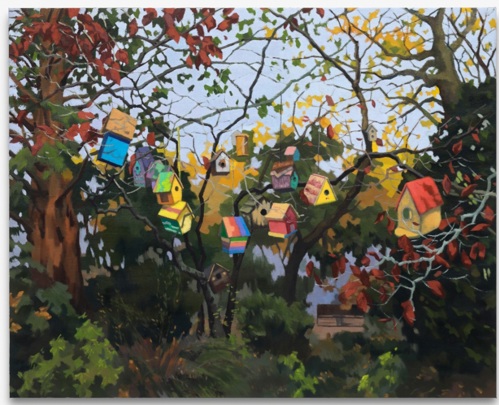
Yuri Yuan, Every Bird Has A Home, 2026
MA: Solitude is a recurring presence in your paintings. Your female figures often appear
isolated, even when surrounded by familiar environments, while the spaces they inhabit seem to convey a subtle sense of absence or emotional distance.
What does solitude mean to you, and why has it become such an important element of your visual language?
YY: Solitude is very different from loneliness. Loneliness implies a sense of yearning, whereas solitude is more neutral. No one enjoys loneliness, but one can enjoy solitude. My figures are in states of anticipation or absorption. They are aware of the gaze of the viewer, or maybe they do not care. I think subconsciously it reflects my state of being in the world. I have a sense of aloofness (maybe from being an Aquarius). I don't identify with the world, nor am I against it. I'm more like a witness. Therefore, a lot of my figures feel like they are in the world but not of the world.
MA: Your paintings often evoke a particular kind of emptiness: not simply the absence of people or things, but a psychological condition that seems to permeate both figures and surroundings.
How do you approach the representation of emptiness, and can it become a subject in itself, expressed through space, composition and silence?
YY: I think of certain spaces in my paintings as voids. It is more intense, more profound than emptiness. Emptiness implies that it can be easily fixed by adding things. But there is a sense of longing, longing for connection, and the impossibility of it, the paradox of
existence, in a void. Some people's loneliness can be fixed by a crowded party, but some can never be cured.
An example is my recent painting The Dream of a Dream. The background is full of trees, buildings, and gardens. The colors are bright: pink, yellow, green. But there is still a sense of melancholy, conveyed by the hidden expression of the figure and the headphones covering her ears. These are all visual devices that block the viewer from accessing her true emotions.
MA: You have explored aspects of contemporary life through a sense of emptiness that can persist even in apparently ordinary or surreal situations. Do you see this feeling as a reflection of the human condition today, and how much of your own experience enters into these paintings?
YY: I don't know if my painting is representative of the human condition today, but I think it
does reflect my own existence, hopefully that invites the audience to project and share their stories. I think in our current society, especially in the US, there's a lot of false dichotomy, a lot of either-or, a lot of for or against. In reality, what is personal can also be
universal.
An example is how much my paintings are influenced by my story as an immigrant. The stories of displacement shape the sense of alienation in my work. However, that does not mean that my paintings are about immigration. It doesn't mean that one has to be an immigrant to resonate with the anxiety and loneliness in my work, nor does it mean that just because someone is an immigrant, their experience will be the same as mine. My own experience is a lens through which I make my works but not the subject matter of my work.
MA: Having been born in Harbin, raised in Singapore and now living in New York, you have experienced different cultural and geographical environments. In your paintings, landscapes often seem to reflect emotional states as much as physical places.
How have your experiences of moving between places influenced your understanding of belonging and the way you represent landscape?
YY: Moving between places means that I have to constantly say goodbye and adjust to new environments. Sometimes that is a good thing. It exposes me to different cultures,
especially painting traditions, philosophies, political views, etc. My works are influenced by
Chinese ink paintings, Japanese literature, German/ Analytical philosophy, American films
etc. Sometimes it brings longing, regret, anxiety, fear… This experience isn't simply about
geography. Moving back or visiting a hometown doesn't fix the void it left in my heart. It is
also a longing for a different version of myself, a version that has not experienced the
turmoil of moving, a version that was perhaps more courageous and innocent.
Therefore, the landscapes in my work are not simply illustrations of places. Filtered by memory, they carry emotional weight. This complex feeling was explored in two of my previous solo shows at Make Room Gallery in LA. One titled The Great Swimmer (2022), which explored the rational vs. emotional self, and A Thousand Ships (2023), which explored the endless sense of anticipation and the fear of never having an arrival or closure.
MA: This relationship between geography and interiority is particularly evident in your 2026 Wanderlust exhibition in Berlin, which explored distance, belonging and the meaning of home.
How did these themes inform the works in the exhibition, and what does the idea of home mean to you today?
YY: For me, the symbol of a boat best represents the idea of home. Boats are traditionally
related to the history of immigration, the expression "fresh off the boat," for example. Like
a boat, I drift between places without a permanent home. Unlike a bridge that connects
two places, a boat can be a shelter, a home on its own. Therefore, you'll see a lot of my
paintings have a boat in them, such as Ashes of Dusk in Wanderlust (2026).
In this exhibition, Every Bird Has a Home is probably the most explicit example of an exploration of home. The painting is inspired by the park near my apartment where I usually walk my dog. There's a tree that has many birdhouses on it. I was moved by the gesture that we build human-shaped houses for birds. But at the same time, we are not able to extend the same gesture to fellow humans. I made this painting during the intense conflicts around immigration enforcement this year, which made me question who has the right to have a home, and who has to be displaced.
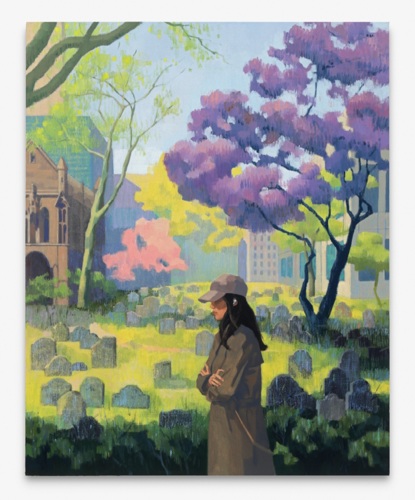
Yuri Yuan, The Dream of A Dream, 2025
MA: Your paintings often place solitary figures within open landscapes or unfamiliar
environments.
What determines the relationship between a figure and the space surrounding it, and can a landscape express emotions that the figure itself cannot reveal?
YY: I consider The Dream of a Dream an anchor piece in Wanderlust. The body embodies the question of physical vs. psychological space. Many audience members ask, "Where is this place?" when they first look at this painting. I'd tell them it is Trinity Church in Manhattan.
But soon one starts to question why the figure looks out of place. She seems alienated from the rest of the world. This effect is intentional. She's painted with sharp edges and
simple shapes (think Alex Katz), contrasting with the dry brushwork in the background, so
that she looks like a paper cutout pasted onto the background. This invites the viewer to
question whether she's out of this world or maybe this whole world is her imagination. The
flowers blossom and soon fall onto the cemetery ground. The cycle of life and death is
perhaps all that is on her mind. I am interested in how the internal world is reflected in the
external, and vice versa.
MA: One of the most distinctive aspects of your paintings is their delicate chromatic language. Subtle shifts in tone, muted colours and carefully calibrated contrasts create atmospheres that can feel serene, melancholic or quietly unsettling.
How do you develop the palette for each painting, and does colour emerge from the subject or from an emotional intuition?
YY: I make a few color studies before I start painting, testing out different palettes. And
sometimes in the middle of painting, I'l use an iPad to test colors as well. The color palette
usually follows a quote that isn't necessarily about the representation of the physical
world. This logic is often emotional or psychological. An example is Nickel Yellow, which I
sometimes use in skies to make them look uncanny or eerie. It is a cool-toned yellow, not
a warm yellow that feels inviting. You can see this yellow in works like Prelude, Elegy, and
Dancing Tears. Another example is The Dream of a Dream. The background is painted
with vibrant, bright colors to make it look "cheerful;" It is a red herring used to mask the
melancholic tone of the cemetery.
MA: How important are nuances, light and shadow in shaping the psychological dimension of your scenes?
YY: Light and shadow have significant symbolic meaning in my work. Whenever I make a
painting, I' m always thinking about where the light is shining from. Is it interior or exterior?
Is it top-down or from the side? Is the source natural sunlight or artificial? Is the figure lit
from above or behind? And what does it mean? An example is When You Are Found. A
person shines a flashlight at sea.
The flashlight is the only source of light. It is more than a light; it is a symbol of hope, of being rescued, being saved, being found (as the title suggests). Or Where the Light Ends, where the light functions as a spotlight highlighting the books, hiding the figure. Light then functions as a visual tool that symbolizes the intellectual priority. The message of the painting is that the works of an artist precede the identity of the artist.
MA: Do you think of colour primarily as a means of describing the visible world, or as an
autonomous language through which you can express sensations, memories and states of mind that cannot be conveyed through narrative alone?
YY: Like I just mentioned, I think of colors, light, and shadow as having symbolic meaning
beyond physical description. In the most ideal scenario, the formal aspects of the work and the narrative should work together to tell the same story, and if they work against each other, there should also be a reason why. A good way to think about it is whether the world on the canvas is possible vs. whether the world is believable. While the narrative tells a story that seems impossible, the formal aspects can work together to make it believable, and vice versa.
MA: Your paintings often seem to capture moments suspended between what has already happened and what is about to happen. They suggest possible narratives without fully revealing them, leaving the viewer with the feeling of having entered a story whose beginning and ending remain unknown.
How do you approach this temporal dimension, and what interests you about the narrative possibilities of a single image?
YY: I'm interested in images that can embody a sense of time or duration. It might have to do with my interest in philosophy and how I interpret time as non-linear. It's more interesting to think of time as a web, a circle, even a spiral, and therefore stories may not always have the same ending. I think current society has shaped our brains to believe in logical deduction. As a result, we have made great advances in science and technology.
We also lose our creativity and imagination. Therefore, I'm interested in the impossible, the paradox, the open-ended questions.
MA: Your works leave many elements unexplained, allowing viewers to bring their own
memories and emotions into the scene. How important is it for you to preserve this
ambiguity, and do you think a painting can communicate something precisely by refusing to offer a definitive answer?
YY: At the end of the day, it is up to the viewer to freely interpret the narrative. If I have a
message I really want to get across, I'd write an essay. In painting, I control the degree of ambiguity, and it's always intentional. I don' like telling people what to think. We have too
much of that already in our society, everyone screaming at the top of their lungs but no
one is listening. I hope my paintings can be a space for people to tune in to each other. I
don't prescribe any pre-existing meaning or interpretation.
MA: Looking ahead, are there new subjects, techniques or emotional territories you would like to explore? Are there aspects of the human experience or of your own inner world that you feel you have not yet found a way to translate into painting?
YY: For the past year, I've been exploring different media such as ceramics, installation, and printmaking. Not that I want to start making ceramics as work work, but to explore different ways of image-making through these new media and gain inspiration through these explorations. A new way of storytelling, and a different visual language. I am increasingly suspicious of "pretty and inoffensive" pictures as the world swings more to the conservative. Our aesthetics, too, are becoming "mellow".
I am interested in introducing more antagonistic colors and narratives. The human experience is an inexhaustible source of inspiration, the world changes and we change. What I thought 10 years ago is very different from what I think today so I’m sure there are many aspects I will cover in the future.
Main Image: Yuri Yuan, September, 2024