
BEFORE THE IMAGE Conversations on Painting in the Making - Vanessa Liem
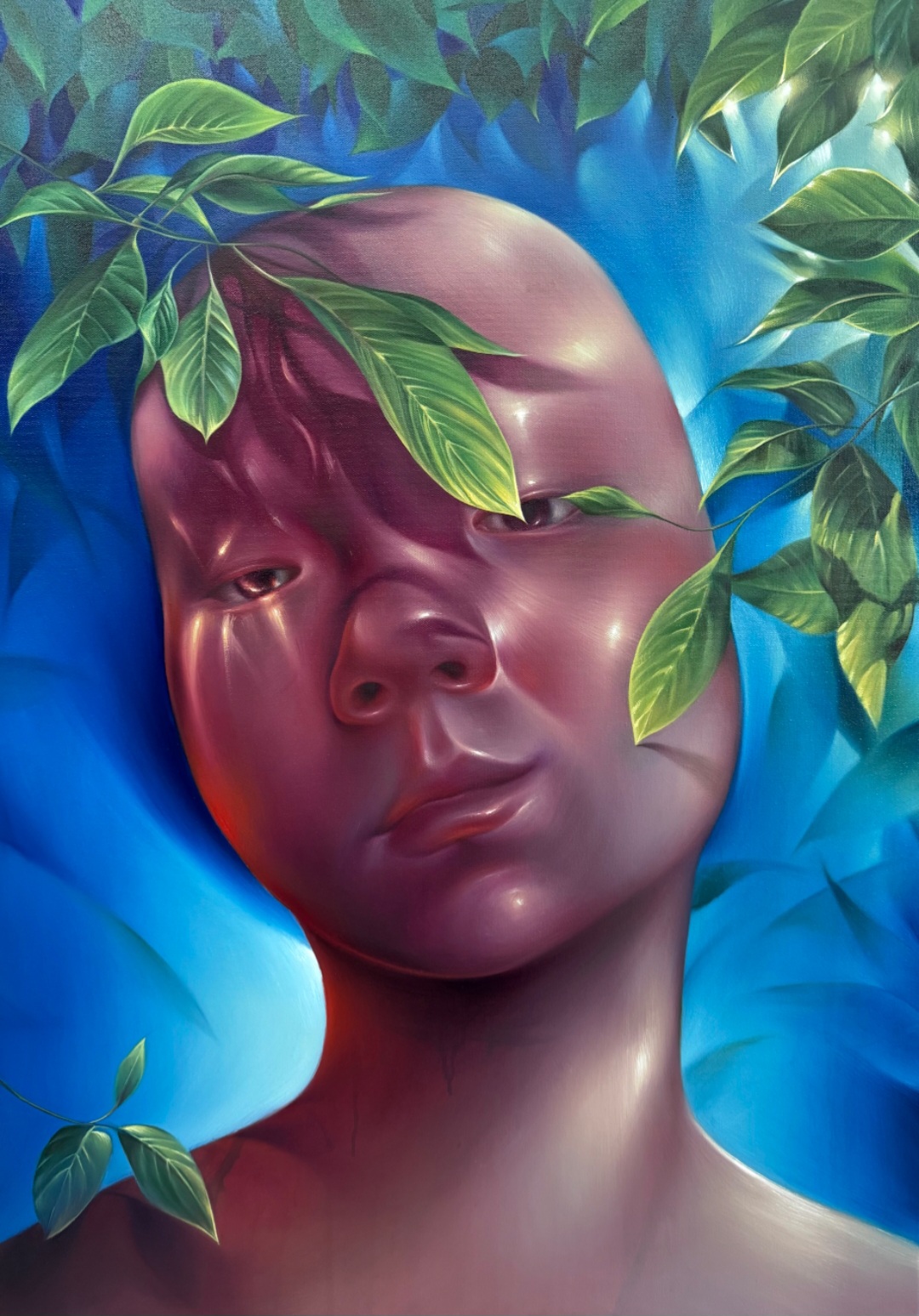
Vanessa Liem (b. 2002, Singapore) is an artist whose paintings inhabit an ethereal universe where surreal figures and recognisable environments converge.
Through airbrushed surfaces, altered bodies and dreamlike settings, she transforms familiar scenes into psychological landscapes suspended between reality and imagination.
Drawing on personal experience and theories of visual perception, Liem investigates how the act of observing influences bodily awareness, vulnerability and individual agency. Her paintings explore the tension between private experience and public visibility, creating spaces in which identity becomes fluid and the distinction between inner and outer worlds begins to dissolve.
In May 2026, Liem presented The Third Person in the Room at Cuturi Gallery in Singapore, an exhibition examining the presence of the observer within intimate, psychologically charged environments.
For BEFORE THE IMAGE, this conversation explores the construction of imaginary worlds, the politics of looking, the relationship between psychological experience and the body, and the visual decisions that shape her practice.
Margherita Artoni (MA): Your paintings transform familiar environments into dreamlike settings populated by biomorphic figures. Rather than separating reality from fantasy, your images allow the two to coexist.
What draws you to ordinary places as starting points for your paintings? How do you develop a recognisable setting into an imaginary environment? What makes a surreal image feel convincing to you?
Vanessa Liem (VL): All my paintings start with observation, and it happens subconsciously when I’m unguarded. I’ll be doing the most banal things like blow-drying my hair, waiting for the bus, washing myself in the shower. These are practical, almost robotic tasks where I know I have nothing else to do in that moment except finish them. Because the routine takes care of itself, my mind wanders a lot, and observation becomes less passive and more attentive in a way. Ordinary places can become compositions. I think ordinary places work as starting points because they’re just there. I’m not trying to perform or impress them, and vice versa, which gives me room to explore without pressure. Familiarity is also a big part of it. Everyone already has a relationship with their bedroom or toilet, so there’s built-in intimacy before I’ve done anything, because it’s such a personal and saturated space. From there, I treat that familiarity as something to play with. How much can I keep it? How far can I push the space toward estrangement before it breaks? Or can I pull it back towards the familiar?
I try to retain mundane domestic elements that ground the setting in reality, such as door handles and beds, and even bits of nature as well. They give the viewer something to hold on to, a place to find their footing before things start to drift. I’m careful not to push the strangeness so far that the space becomes an alternate reality you could never step into. The images are projected from an internal, subjective place to a real space, rather than something I’m inventing. I want the bizarreness to feel human, so that even when a space doesn’t make logical sense, it still feels like someone’s home, someone’s memory, someone’s quiet moment. That’s what lets reality and fantasy coexist in the work, much like magical realism. I think it’s the humane quality that holds them together.
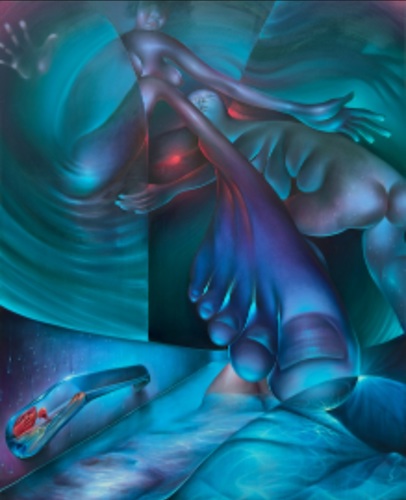
Vanessa Liem, A Crowded Place, 2026 Oil on canvas. Courtesy Cuturi Gallery
MA: Your interest in observation extends beyond vision to the ways people become conscious of themselves under another person’s gaze. Looking becomes an act shaped by social relationships and unequal positions of power.
How has John Berger’s Ways of Seeing informed your understanding of observation? When does the act of looking become an exercise of power? How do you negotiate the positions of observer and observed in your work?
VL: The biggest takeaway for me from Berger’s Ways of Seeing was self-surveillance, the idea that we perform for a stranger who lives inside us. He describes a woman as split into two parts, the surveyor and the surveyed. She carries an imagined observer around with her and adjusts herself for them, so she is both the one being looked at and the one doing the looking. That changed how I think about observation. It’s not only about what the eye sees, but it’s also about how being seen shapes who we are, and how that watching gets internalised until it feels like our own. It was strange to see something I’d lived through every day written down so plainly. I recognised myself in it, and the women around me.
I think looking becomes an exercise of power when it expects something from the person being looked at, when they feel they have to arrange, soften or perform themselves to be acceptable or likeable. But looking isn’t that straightforward, and it doesn’t always carry a negative connotation. The person being looked at isn’t always passive. Looking can also become a form of autonomy, a way of looking back and how you meet someone’s gaze.
In my work, it’s important to show the greys of looking and being looked at, a variety of responses rather than the single role that tradition gave women. It’s important to me not to pigeonhole them, because that autonomy can look very different from one figure to the next. Some love being looked at and embrace it, and that holds its own freedom and power. Some shy away, some are paralysed, some secretly love the attention, and some stare back defiantly. They are all valid. A stare can be an invitation, or it can be a judgement, a “why are you here?” That puts the viewer in a position too: are they welcome, or are they intruding? Berger’s viewer is assumed to be the owner of the image, but I don’t agree with that entirely, and I’m interested in what happens when viewers start to question their role. I’d rather leave this tension open, so they notice they’re also being positioned as an outsider looking in.
MA: Your figures often depart from conventional anatomy, suggesting that the body can express experiences that remain difficult to articulate. Personal experience informs this exploration without necessarily determining a single interpretation.
How do you translate psychological experiences into bodily forms? What guides your decision to distort or fragment a figure? How do you approach the relationship between personal vulnerability and artistic representation?
VL: I try to draw how I feel in my body rather than how it looks. I do use some references, mostly to make sure I get things like the angle of a hand right or the colours of the skin in certain lighting. I am trying to work towards using no references at all. I tend to exaggerate whatever insecurities I have about my own body, the parts I hate about my body, the parts I love; they are all mapped out in very, very psychologically loaded bodies. Materialising them is a way of telling myself I’m valid. The process itself is pretty intuitive. It starts with rough sketches, then I refine them bit by bit. Distorting or fragmenting a figure comes out of that same process; it isn’t a way to make them feel intentionally alien or otherworldly, it’s just a way of processing my own body.
The relationship between vulnerability and artistic representation is tricky. What I’ve realised is that vulnerability can be a performance too. There are almost meta moments where I can see myself trying to be vulnerable because that’s what’s expected in art, and I start to question the honesty of what I’m expressing. Sometimes it’s hard for me to tell if I am actually feeling this, or am I just showing this feeling? I think that’s the nuance of expressing pain - that even the most guttural feelings can be shaped by the knowledge that someone else will see them.
I lean into that tension quite a bit. I use a lot of humour in my work, and I make it grandiose and flamboyant, turning it into a big spectacle. I’m really drawn to the idea of performance and the stage, because it lets the work admit that it’s performing while still carrying something real. Playing with the struggle to reveal something is more fun and layered than laying my feelings out bare, black and white. I also think there’s a difference between work that’s straight-up dishonest and work that is honest about its dishonesty, and the latter is really interesting to unpack. Maybe when I’m old and wrinkled, I’ll reach the purest form of vulnerability, but for now, at my humble age of 24, this is where I’m at.
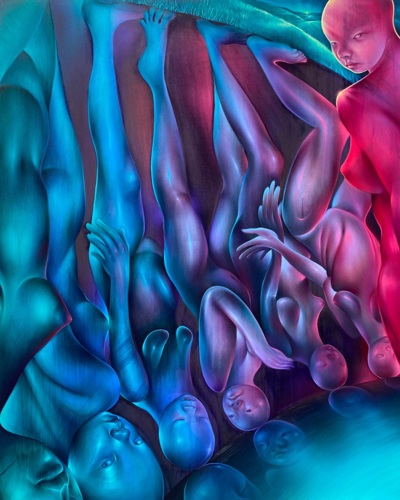
Vanessa Liem, Insula, 2025 Oil on Canvas. Courtesy Cuturi Gallery
MA: Your paintings combine airbrushed surfaces, carefully arranged forms and distinctive compositional choices. Their apparent fluidity emerges from a deliberate process of making.
How do you begin a new painting? How does the airbrush influence your handling of form and surface? What determines the relationship between spontaneity and control in your process?
VL: I think of the setting, then imagine a camera, pointing and moving around the scene in all directions. And then I select the image from there. I also try to see how I can make more unconventional points of the image the focal point.
I actually don’t use an airbrush. I use a normal painting brush(comb brushes), so they layer paint quite smoothly.
The relationship between spontaneity and control is something I struggle with, not just in painting but in life in general, and that’s exactly what I’m exploring in my next show. The question hits deep because I wrestle with it every time I put my brush on the canvas. My paintings are a byproduct of how I am at my core, and they highlight how I move through life too. That struggle between spontaneity and control is my way of being, and it bleeds into my work, it literally creates my work. It comes down to how I grew up and challenges I’ve faced, which mirrors itself in the way I work, in the pull between wanting to control everything and needing to let go, between perfection and imperfection. I could say the smoothness of my paintings comes from an uptightness at my core, and leaning into that has become a kind of “style”. But I want to keep exploring things that make me uncomfortable while also embracing how I work, instead of trying to change myself. I expect to struggle with this for as long as I paint, probably as long as I live, and I think the paintings will always be a place where I work through it.
MA: Colour and light establish the emotional register of your scenes, shaping how their environments are experienced. These elements contribute to the distinctive atmosphere of your painted universe.
How do you develop a colour palette for a new work? What role does light play in establishing the mood of a scene? How do you decide when an atmosphere has reached the intensity you are looking for?
VL: I like mixing warm and cool colours, and I really like bright, almost neon colours, especially used for skin tones. My palette usually carries over from the previous painting. Sometimes I want to continue where I left off, and other times I want to do something completely different, depending on whether I’m bored or not. So the palette develops more through a chain of paintings than from a fresh start each time.
Light is such a powerful tool. It can make a scene sad, happy or melancholic, etcetera. In my previous solo show, The Third Person in the Room, light was a conceptual choice as well as a visual one, adding to both how the scene is read and how it looks. Different colours of light carry different feelings. Think about the actual light in your room: sexy red light in a bedroom, the calm yellow lamp at 8pm, neon pink in a club or even an ominous green exit sign in a dark room. Our bodies already know how to react. I borrow that shorthand, because it lets me set the emotional register of a scene instantly, and then I can bend it. A warm, cosy light can sit in a space that feels uneasy, or a cold, eerie glow can land on something tender. That mismatch is where a lot of the atmosphere in my work comes from.
I leave the faces for last. It adds new life, and it’s always a surprise. I make sure the body can hold that expression, but in some cases, I let them disagree, and that gap creates its own weird tension. Knowing when the atmosphere has reached the right intensity is a gradual thing for me. The work grows how it wants to. Usually, the colour white is when I stop. It’s always the last colour I add, so everything else has to build up to it
MA: Once a painting leaves the studio, it enters a space of interpretation that the artist cannot entirely control. Viewers bring their own histories and associations to the work, sometimes discovering meanings beyond its original context.
How do you respond to interpretations that differ from your intentions? Has the audience’s response ever changed your understanding of one of your paintings? Which questions are currently guiding the next stage of your practice?
VL: I love it. Once a painting leaves the studio, it belongs to the world and not just to me. Hearing other people’s interpretations gets me out of my head. It really humbles me and completely expands my view all at the same time.
It doesn’t necessarily change my own understanding of a painting, but it shows me how the same image can be read in very different ways, which comes back to that tension between control and spontaneity. I can steer the painting, but I can’t steer what people bring to it.
As for what’s guiding the next stage of my practice, I’m trying to isolate my own voice. There’s a lot of noise, from the art world, from social media, from other people’s expectations, and I want to work out what excites me underneath it. To do that, I also need to keep looking. I need to see work that excites me. And I keep coming back to the same question: how do I navigate control and release, in the way I apply paint and in the stories I tell?
I carry a mountain of insecurities as an artist. Are my works too personal? Too selfish? Too self-indulgent? Am I too privileged to make art? I don’t think these questions will ever fully go away, so I just have to sit with them. I also think it’s important to check my ego every now and then. If I’m always protecting how the work looks, I’m also protecting myself from it. I need to make time for bad paintings and see what’s in them before I decide what they’re worth.
Main Image: Vanessa Liem, Sunburnt, 2026 Oil on canvas. Courtesy Cuturi Gallery