
BEFORE THE IMAGE Conversations on Painting in the Making - Sylvia Ong
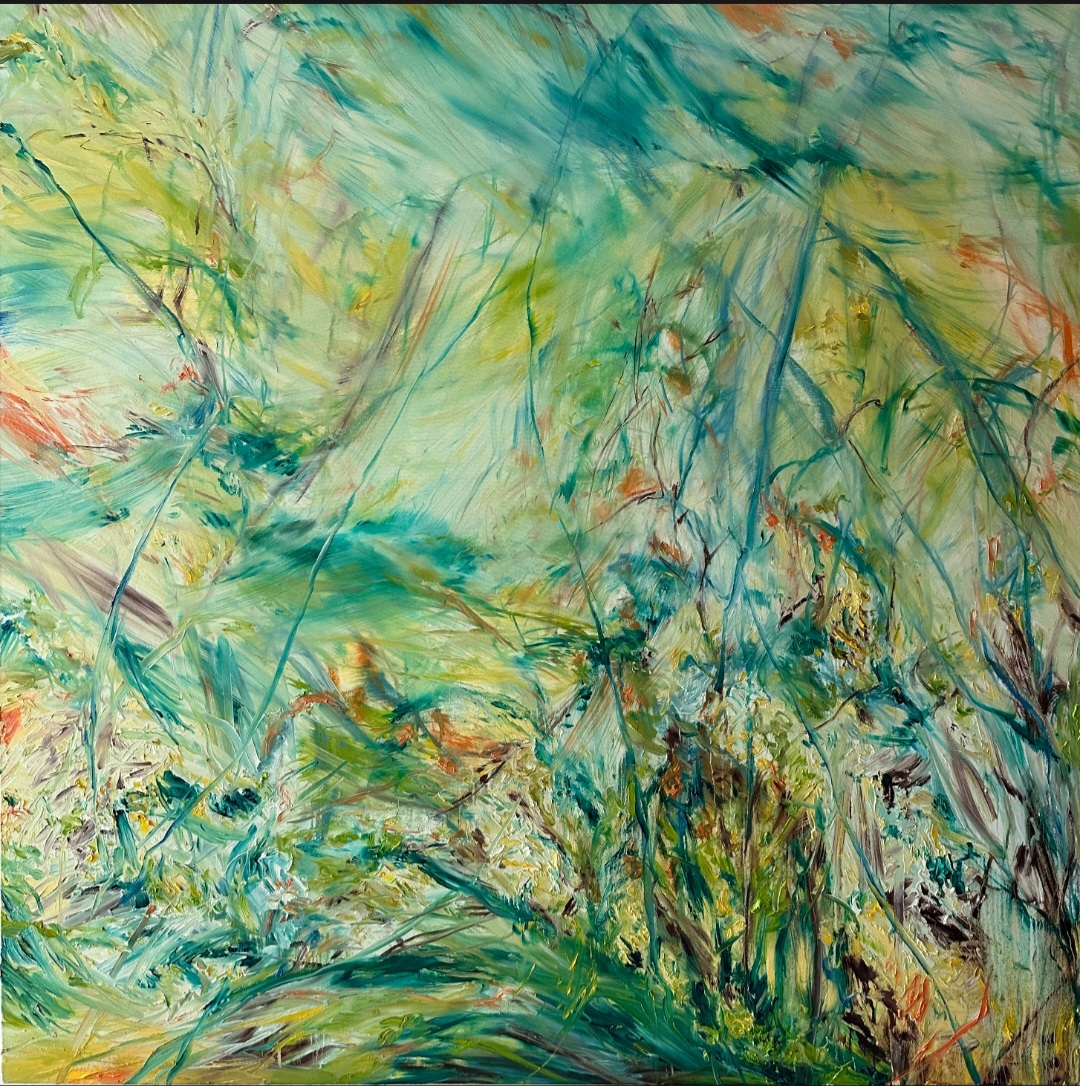
Sylvia Ong (Kuala Lumpur, 1980) is a contemporary artist based in Dubai whose practice explores the relationship between painting, music, and sensory perception through a language of lyrical abstraction.
Initially trained in cinematography, she has worked across different creative fields, including film, television, radio and photography. These experiences have shaped an artistic approach attentive to rhythm, atmosphere and the expressive possibilities of images.
Influenced by the environments and cultures in which she has lived, Sylvia Ong brings together sound, music, and colour to explore the emotional and restorative dimensions of nature. Through collaborations with musicians and composers from around the world, her paintings investigate the connections between visual and auditory languages, translating rhythms and sensations into fluid abstract compositions.
In her 2026 exhibition Inscape, presented at The Arts Club Dubai as part of its inaugural Artist Residency Programme, Ong further explored the relationship between sound, memory, and emotion. Her work After Returning received The Arts Club Residency Prize and entered the institution's permanent collection.
For BEFORE THE IMAGE, Margherita Artoni explores Ong's creative process: from her cinematic background to the relationship between painting and music, the emotional language of colour, and abstraction as a space for introspection.
Margherita Artoni (MA): Experiences, memories, and encounters with different environments often become the starting points for artistic creation. In your paintings, these impressions seem to evolve into abstract compositions in which colour and gesture translate inner and external landscapes. Which places or experiences have most influenced your visual imagination, and how have the different cultural environments in which you have lived shaped your artistic language?
Sylvia Ong (SO): I’ve observed that nature has its own rhythm, and that rhythm often inspires and feeds my creativity. There isn't one particular place that has influenced me more than others, but I have developed a fondness for snowy mountains, especially after spending long periods indoors during Dubai's extremely hot summers.
There is something deeply grounding and healing about the cold that I find myself drawn to. Looking at a vast white landscape gives me a sense of clarity. It feels almost like looking at a blank canvas, a space for renewal and new beginnings.
At the same time, the tropical environment I grew up in Malaysia is something I will always feel rooted in and long for. I miss the earthy smell after a heavy downpour, the humidity of the forest floor, and the sensory richness of tropical nature. These are impressions that stay with me, even when I am far away from home.
Living in culturally diverse environments has also broadened my perspective. Being exposed to different cultures, ways of life, and ways of thinking has helped me grow as a person, and I believe this openness has naturally found its way into my artistic journey as well.
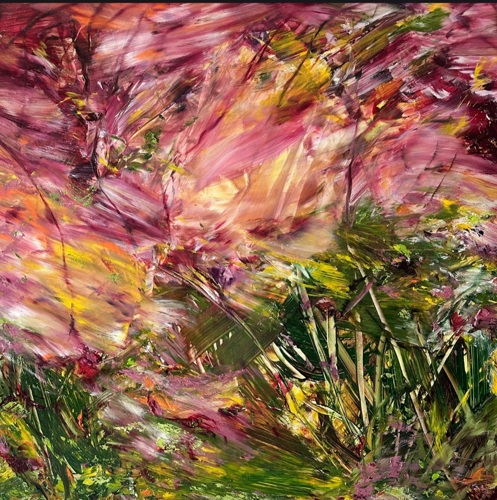
Sylvia Ong, Blush of First Light, 2025
MA: When you begin a painting, what guides your first decisions? How do memory, intuition, and unexpected discoveries shape the development of an image?
SO: I usually begin with an idea or a feeling. It doesn't necessarily have to be a clear direction or a fixed image. As long as there is something that gives me the motivation and curiosity to begin, I'm happy to start.
For me, painting is very much a process of memory and intuition, and I've come to see it as an interesting and almost healing practice. If I had to describe what guides me, I would say it's trust.
People often ask me how I can begin painting without having a clear image in mind. I think the blank canvas is precisely what gives me that freedom. It is an open space where I can explore, make discoveries, and allow the painting to find its own direction along the way.
I have learned to let go of the need to control everything, to turn inward, listen, and trust the process. Sometimes, the most interesting discoveries happen when I stop trying to decide what the painting should become.
"The blank canvas is precisely what gives me freedom. It is an open space where I can explore, make discoveries, and allow the painting to find its own direction."
MA: How do personal experiences and external impressions become abstract forms, colours, and gestures within your work?
SO: It has taken me years to really understand this process and find my way into it. When I first started my art practice, I was exploring in all directions. I wanted to discover different mediums, styles, and techniques. I was curious about everything, and I spent a lot of time looking outward, searching for inspiration and trying to understand what kind of artist I wanted to become.
Over the years, one of the most important things I've learned is to stop searching so much externally and start looking inward—to really understand who I am, what I feel, and what comes naturally to me. That kind of understanding doesn't happen in a year or two. It takes time, experience, and a certain amount of self-acceptance.
I'm grateful that I've gradually found my own artistic voice and developed a way of painting that feels genuinely true to who I am.
MA: Your background in cinematography, photography, and other creative fields has exposed you to different ways of constructing images. How has your cinematic background influenced your approach to painting, and what possibilities did the transition from moving images to the painted surface open up for you?
SO: My background is in cinematography, with a minor in music and theatre. These different disciplines have shaped the way I see and approach images. Cinematography gave me an understanding of composition, framing, lighting, and atmosphere, while music and theatre developed my sensitivity to rhythm, movement, and emotional expression.
Painting, however, gave me a different kind of freedom. Unlike filmmaking, where you work with a team, a script, a production process, and many external considerations, painting allows me to work more intuitively and independently. I can spend time with a single canvas, follow an impulse, and allow it to evolve without having to explain or resolve everything.
Although painting is a static medium, movement is something that appears in most of my work. Over time, these elements have become part of my own artistic language.
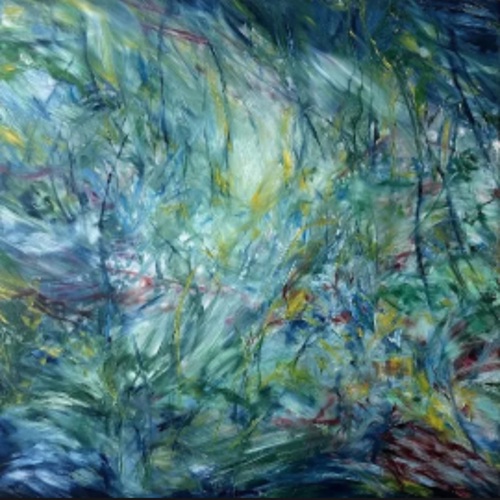
Sylvia Ong, Echoes No. 4, 2025
MA: Do ideas of framing, movement, and time continue to play a role in your creative process?
SO: Absolutely. My background in cinematography has continued to influence my painting, and I think the knowledge and experiences I've gained from different creative disciplines have never gone to waste. Everything I've learned has contributed to my artistic development in one way or another.
Cinematography has given me a strong understanding of visual composition and the many elements that contribute to an image. Art direction, props, costumes, lighting, sound, and framing all work together to create a particular atmosphere and convey a mood.
Even though I no longer work with moving images, I'm still very conscious of how different elements interact within a picture. They often come together intuitively in the process of painting.
MA: What have you discovered through painting that you could not fully express through film or photography?
SO: Sound to colours!
I think one of the things I've discovered through painting is the freedom to respond spontaneously to sound and music. I can translate what I hear into colours, gestures, and movement almost immediately. It's a very direct and personal experience, without having to follow a structured process.
Filmmaking involves a larger team, technical considerations, budget, and many stages of planning. While I value everything I've learned from that experience, painting gives me the freedom to work independently, allowing my response to music to flow directly onto the canvas.
MA: Music is an important element of your practice. How does music influence the way you paint? Do you associate particular colours or gestures with sounds, rhythms, or emotions?
SO: I do, very much. I understand that there have been attempts to associate sounds and musical scales with particular colours, such as Scriabin's sound-to-colour theories. But I believe that each sound, tune, or musical scale can create a different sensation for each individual.
For me, certain sounds can transport me somewhere else—almost into another realm:
-
The Cello: Brings a sense of melancholy; I find myself drawn towards darker shades of green and blue.
-
F Major (Piano/Violin): Conveys warmth and optimism. It feels almost like running freely in a green field with the wind passing through me.
I also have an interesting relationship with sound and visual imagery. When I listen to music, and especially when I engage in conversations, words and sounds can spontaneously trigger visual impressions in my mind. They can appear as still images—almost like photographs of words, numbers, faces, or entire scenes—or move like a sequence of images. It can be quite fascinating, though sometimes overwhelming and mentally exhausting.
"When I listen to music, words and sounds spontaneously trigger visual impressions in my mind. The sound of a cello brings melancholy and darker blues; F Major feels like running freely in a green field."
MA: When collaborating with musicians and composers, how does the creative exchange unfold? Does the music precede the painting, or do the two languages develop together?
SO: It develops together, although the process is almost the reverse of filmmaking.
When collaborating, I usually start with one or two paintings inspired by their music. I share these recent works with the composer, who responds to what they feel or see in the paintings and develops the music further.
From there, the exchange continues. Their compositions become part of my painting process, and I will listen to the music repeatedly, allowing myself to become immersed in its mood and sensations. I particularly love Neo-classical music; it gives me a wonderful space for imagination and expression.
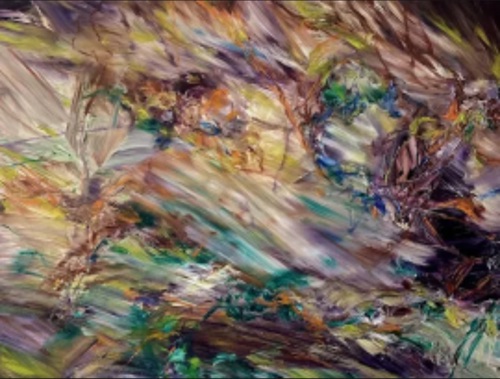
Sylvia Ong, Shifting Light, 2025
MA: Colour plays a central role in your paintings. How do you approach its expressive potential, and do colours carry personal associations or emotional memories for you?
SO: Yes, definitely. I find myself particularly drawn to green and yellow, which has something to do with how I respond to music.
I don't have a fixed approach or formula for using colour. Being truthful to what I feel during the process of creation is more important than consciously trying to enhance a painting. I prefer to allow colours to come naturally according to the mood and sensations I experience at that moment.
MA: What does the healing power of nature mean to you, both personally and artistically?
SO: Nature has so much more to tell—it is not just about a blue sky or pretty roses. I am fascinated by the greens of a forest, a herb garden, rocky mountains, lakes, or the ocean.
For me, nature grounds me and brings me back to myself. Artistically, I don't think of nature as something I need to represent literally. I'm more drawn to its rhythms, textures, and shifts in light.
I've also been interested in the Schumann resonance theory—the idea of the Earth having its own natural frequencies. While I see this more as a personal interest than a proven explanation for healing, it has deepened my curiosity about our connection with nature and the energies around us. The healing power of nature lies in its ability to make me feel connected to something beyond myself while giving me the space to look inward.
MA: How do you translate the energy and transformations of the natural world into colour and abstraction?
SO: I've been practising energy healing for a long time, so meditation and grounding are important parts of my daily life. They help me become more aware of my surroundings and my state of being.
I also enjoy creating during daylight. Natural light and the energy of the day bring a sense of positivity. When I feel low or emotionally unsettled, I prefer to step back and rest rather than force myself to create.
In today's increasingly chaotic world—where we are constantly surrounded by information, technology, and the rapid development of AI—it is important not to lose touch with our senses, intuition, and connection with nature. These are the things that make us human. I hope my paintings offer a moment for people to pause, feel, and reconnect with themselves.
MA: Can painting itself become a restorative experience, both for the artist and for the viewer? What kind of emotional connection would you like to establish through your work?
SO: Yes, I believe painting can offer a restorative experience for both. For me, painting is a way of exploring emotions and expressing what I sometimes cannot put into words.
As an artist, I naturally hope to bring positive energy into each piece of work. Art is powerful, and with that comes a responsibility. I hope my work can offer people a moment to pause, feel something meaningful, and leave them with a little more positivity.
MA: Your paintings do not impose a fixed narrative. How important is ambiguity in your approach to abstraction, and how do you balance your intentions with the viewer's freedom of interpretation?
SO: Ambiguity is important because my paintings begin with an internal experience—a feeling, a rhythm, or a sensory response—rather than a specific image.
As the work develops, it takes on a life of its own. There is a conversation between me and each mark I make. Once a work leaves my studio, it belongs partly to the viewer. Everyone brings their own memories and emotions to what they see. I would rather leave room for that personal connection than provide all the answers.
MA: Beyond the visual experience, do you hope your paintings create a particular emotional atmosphere?
SO: My mentor during my artist residency at The Arts Club Dubai suggested I try creating when feeling sad or frustrated to see if it led to a different outcome.
Of course, I could create something driven by anger or sadness, but I consciously choose not to. For me, it is more important to bring positivity into my work. Don't we all need a little more positivity in our lives, especially within our homes? I would love for my paintings to bring that sense of positivity into living spaces.
MA: Which questions are currently at the centre of your practice, and how has your experience with Inscape influenced your direction?
SO: One question I keep asking myself is how I can continue to evolve without becoming too comfortable with the way I work. I want to challenge my familiar habits, allow my process to become less rigid, and leave more room for unexpected discoveries.
MA: Are there new materials, collaborations, or visual territories you would like to explore in your upcoming work?
SO: I feel there are still many possibilities to explore. My cultural roots are diverse—I speak and write Malay, Cantonese, Hokkien, and some Mandarin, and I have previously worked on projects inspired by Bharathanatyam dance.
I would love to explore different materials, take my painting outdoors to work directly in nature, and bring traditional and contemporary musical forms together—perhaps through collaborations involving gamelan, tabla, erhu, or dance.
I believe art and cultural exchange are important forms of education that help us appreciate different perspectives and build greater understanding. Whether I am ready to realise all of these ideas now is another question! For now, I am happy to remain curious, keep exploring, and allow my practice to develop naturally.
Main Image: Sylvia Ong, A Song for Solara No. 2, 2024