
BEFORE THE IMAGE Conversations on Painting in the Making - Savannah Marie Harris
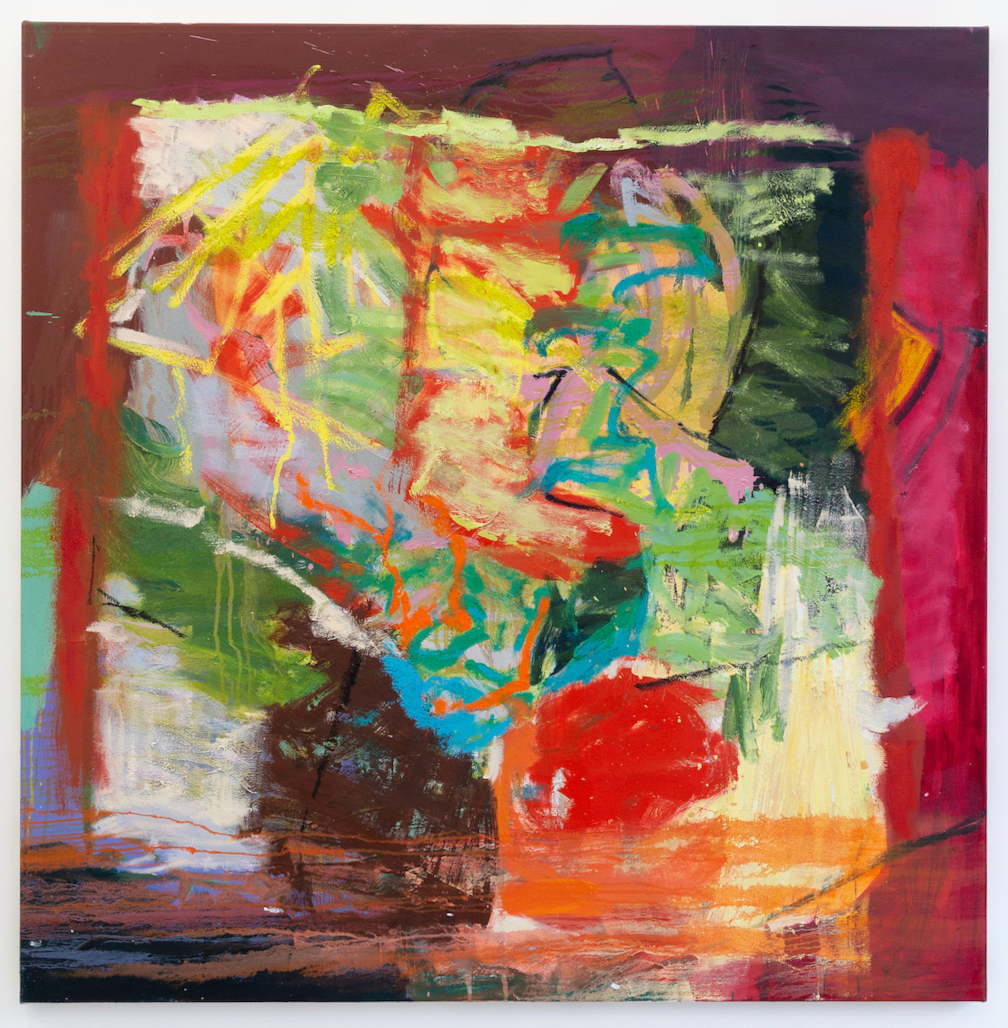
Savannah Marie Harris explores the inner world of memory, fantasy, and spirituality through abstract paintings that bring together nuanced colors, light, and textures. Her layered canvases transform personal experiences into shifting compositions where gestures, material, and fragments of color evoke worlds between the tangible and the imagined. Through processes of accumulation and dissolution, she creates surfaces that hold traces of experience while remaining open to change.
Currently studying at the Royal College of Art in London, Harris develops her work through an intuitive approach to painting. Sand plays a significant role in her practice, connecting its physical qualities with the cultural and geographical dimensions of her Caribbean and Cuban heritage. In 2026, her exhibition Undo at Gathering in Ibiza further explored processes of sedimentation and erosion, extending her investigation into material, memory, and cultural inheritance.
For BEFORE THE IMAGE, this conversation considers the transformation of lived experience into abstraction, the construction of pictorial space, the relationship between material and cultural identity, and the role of spirituality in Harris’s artistic practice.
Margherita Artoni (MA): Your paintings often begin with personal experiences that gradually lose their original form as they enter the abstract language of your practice. What first draws your attention to a subject? How do you translate an experience into an image? At what point does the painting begin to develop independently of its original source?
Savannah Marie Harris (SMH): My practice isn’t strictly autobiographical. The works are driven by active research spanning art history, geology, science fiction, and my experiences tracing natural landscapes. It's a process of webbing and wandering, constructing a new horizon I belong to.
Those observations and insights create the scaffolding of an idea, but there is an immediate tension because the work isn't a straight translation of a past event into an image; the work itself is the event.
By the time the painting matures, it has absorbed all references, writing, and field research to the point where the initial spark fades into the background. What remains is the physical and technical labour of how it was made—a reflex of repetition. That shift illuminates the moment where hyper-vigilance crumbles, the original reference point dissolves, and the painting finally shapes its own independence.
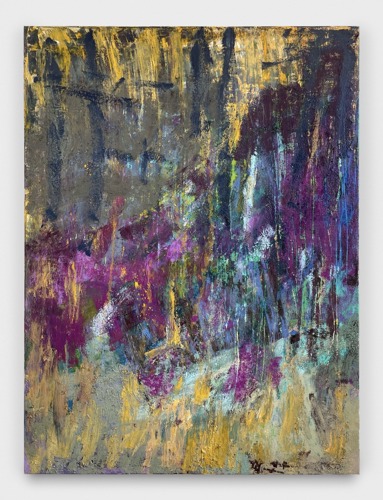
Savannah Marie Harris, Iteration, 2026, Oil paint, sand on canvas
MA: Your work explores memory and fantasy as shifting territories in which recollections and imagined experiences intersect. How does memory influence your creative process? What role does fantasy play in the development of an image? Are you interested in preserving the past or reimagining it?
SMH: Memory in my work does not follow a flat or linear chronology. Memory is layered, built on gaps, sharp edges, ruptures, and full of discontinuities. It is no different from geological erosion. In my studio, I allow memory to decay so the gesture can take over. The voids and unreliability of memory aren't limitations; they are the active spaces where the painting evolves.
Decay and transformation are central to my practice; that is the antithesis of preservation. I am interested in what survives the ruin—what is forged from the rubble once loss has been accepted.
Reimagining isn't quite the right word for it either. We live through history, not after it; so I'm not necessarily reimagining anything. The present is an active constellation of the past. My process is closer to world-building. I am connecting the dots and constructing an ecosystem one canvas at a time.
"Decay and transformation are central to my practice; that is the antithesis of preservation. I am interested in what survives the ruin—what is forged from the rubble once loss has been accepted."
ArtDependence: Your layered canvases establish complex spatial relationships through variations in light, texture, and colour. Their surfaces suggest environments that remain elusive rather than fully defined. How do you construct a sense of depth in an abstract painting? What role does light play in revealing or concealing different layers? How do you determine the spatial balance of a composition?
SMH: Depth is an illusionary act in painting; I think it's more a question of psychological states. The Renaissance considered this through mathematics, seeking clarity and efficiency in depicting reality. The Surrealists thought of depth as layers into the mind, the unconscious. Abstract Expressionism collapses depth into the experience with the absolute.
All of them demonstrate a distinct system of thinking.
How I construct depth is a way of thinking which is vividly argumentative, contradictory, and theatrical. That also feeds into how I determine the spatial balance of the composition: its skeleton form. The physicality of sand and paint manipulated with various tools is combative and full of friction—bruises emerging, strata intervening—it's a full-on brawl on the surface. Light either catches that surface, illuminating the density and mass within the gesture, or it's completely concealed in the lower layers. What holds this together is the frame—something I have been mulling over recently: whether the frame is the effect or the agent.
MA: Sand occupies a central place in your practice, connecting the material presence of your paintings with your Caribbean and Cuban heritage. How did you begin working with sand? What cultural or geographical associations does this material hold for you? How does your heritage inform your choice of materials and artistic language?
SMH: When I first started working with sand, it was a material inquiry into how to build a heaviness in the works. Oil paints have a buttery slippage that I was constantly modifying. I debated with the medium itself, making me wonder why I had such an aggressive frustration with it. Stumbling across sand started to make things click: its raw, unpolished grit, harshness on the surface, and unapologetic edge. The work started to possess a muscular attitude in the studio, an active push and pull against the fluidity of paint. That grit is what I was seeking; it made painting cool again.
Over time, as I experimented with the medium, my curiosity deepened: What is sand? Where does it come from and why? Sand began to occupy multiple registers in my practice: the geological, anthropological, economical, and cultural. It opened up another complex web that felt personal and reflective of my multicultural upbringing in London. What began as a studio experiment forced me to confront how geography is never neutral, how belonging can travel across timelines, and how identity remains as fluid as the land itself.
I observed the overlapping cultures of my environment alongside a subtle erosion of my heritage at home. This sense of being fragmented—suturing pieces into a sort of Frankenstein monster—reminded me that I function much like sand: a physical accumulation born from millions of years of continental friction. It is the closest material equivalent to my deep connection to the Caribbean and studio practice, altering the chemistry of my internal landscape.
"What began as a studio experiment forced me to confront how geography is never neutral, how belonging can travel across timelines, and how identity remains as fluid as the land itself."
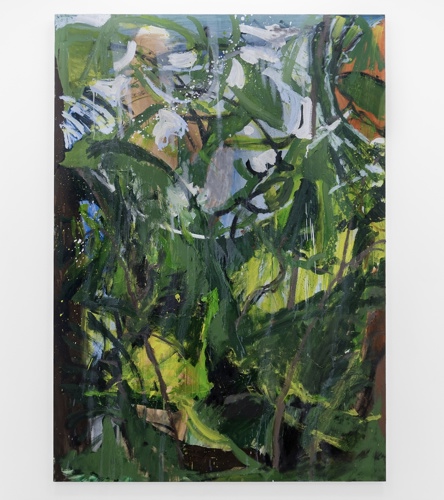
Savannah Marie Harris, Humidity, 2024, Oil paint, sand on canvas
MA: Vibrant colours and intuitive brushstrokes give your paintings an expressive energy, while their abstract forms suggest a dimension that extends beyond the visible. How do you approach colour in your work? How important is spontaneity to your use of gesture?
SMH: My use of gesture operates on a spectrum of duality, bridging geological processes with the raw expression of my internal landscape. The paintings hold structural and architectural characteristics drawn from sedimented rocks, mineral strata, and fossils; the spontaneity comes in actively subverting and distorting that scaffolding. It is my way of building an earthy literacy on the surface, where gesture and material collide directly through pigment.
Colour carries its own weight and history, which I use to interrogate the structural relationships that form naturally on the canvas. The colours I choose set a specific psychological temperature, driving an immediate, sensory experience.
MA: Your paintings emerge through processes of accumulation, disruption, and dissolution, in which the surface becomes a record of successive transformations. What prompts you to dismantle or alter a painting as it develops? How do you recognise when a work is complete? In what ways does spirituality inform your artistic practice, and which new questions or directions would you like to pursue in your future practice?
SMH: Working towards my recent solo show, Undo, led me to ask better questions in the studio. I am entirely resistant to asking whether a work is "good" or "finished." Instead, I ask: Has it weathered well?
Reading Dr. Ruth Allen on how landscapes are sculpted by violent geological forces had a profound effect on my practice and on me personally. To have weathered well means to have lived. The relentless dismantling, erosion, and imperfection on the canvas are evidence of a surface that endured labour, undergoing a journey and transformation, absorbing all its history while retaining its own wisdom of resilience. A painting is complete when it holds its own.
Spiritually, this inquiry into weathering has naturally opened up questions around the ruin, rituals, and physical re-enchantment. In a hyper-aware, often disenchanted world, I see an urgent need for re-enchantment—a search for meaning, the sublime, and a visceral, aggressive pursuit of pleasure through animated surfaces and teasing colour.
Moving forward, the broader question driving my practice is: How have we, as individuals and as a society, weathered? Building on my material vocabulary of oil paints, sand, and cultural shifts, I am expanding the work from studies of geographical forces into immersive, transformational environments.
Main Image: Savannah Marie Harris: Hot bubbles, 2023, Oil paint, sand on canvas