
BEFORE THE IMAGE Conversations on Painting in the Making - Sarah Martin-Nuss
Sarah Martin-Nuss is a New York-based artist whose practice spans painting, drawing,
performance and sound. Her layered compositions combine gestural marks and shifting
fields of colour, creating atmospheric images that evoke the rhythms and complexity of the
natural world.
Her work draws on ecology, biological systems and posthumanist philosophy, exploring
how bodies, environments and interconnected structures shape experience. Alongside her
visual practice, Martin-Nuss works extensively with the voice, approaching sound as an
independent compositional and performative medium.
In 2025–2026, she participated in land marks at Pace Gallery in Los Angeles and
presented five new paintings in a dedicated showcase at the gallery in spring 2026. She
will have an upcoming exhibition opening at Victoria Miro Gallery in November 2026 and is preparing for the Victoria Miro Venice residency this spring. For BEFORE THE IMAGE,
this conversation considers her creative process, ecological thinking, embodied perception and movement between visual and sonic forms.
Margherita Artoni (MA): Every painting begins with a decision, an impulse or an encounter. In your work, gestures and forms seem to develop through an open-ended process.
What initially draws you into a new painting? How do you determine the relationship between its different elements? What tells you that a work is complete?
Sarah Martin-Nuss (SMN): I always have multiple paintings in progress, so when I enter the studio, I am continuing an ongoing conversation. It is important to me that the studio functions as an ecosystem, where works come into being through processes of coevolution. I move between paintings, allowing each to inform and influence the others. Introducing a blank canvas into this environment feels like a necessary act of continuation. I typically begin with a thin wash of oil paint, mapping out the composition by sensing where light will reside.
I don't predetermine the relationships between elements within a painting. Rather, through
a process of addition and subtraction, I discover what emerges from their interactions.
Everything is permeable, responsive, and constituted through relationships.
I know a painting is complete when it seems to seal itself off from me. I can no longer enter its space as an agent of manipulation, but instead become an observer, witnessing the relationships that have formed within it. At that point, the painting has established an
internal life of its own.
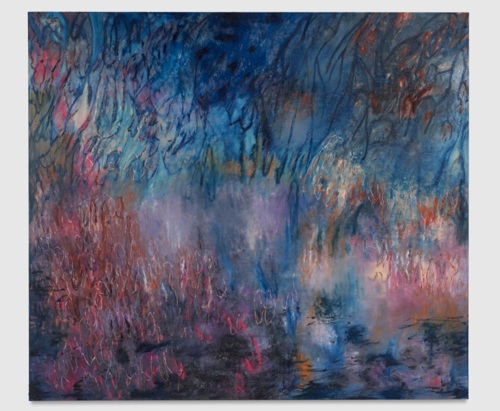
Sarah Martin-Nuss, Echoing the Sun, Oil and pastel on canvas, 2026
MA: Ecology and biological systems inform your approach to abstraction, shifting attention from isolated forms towards networks of relationships.
Which aspects of ecological thinking have most profoundly influenced your practice? How
do you engage with natural systems without directly illustrating them? Can abstraction
challenge conventional distinctions between human and nonhuman life?
SMN: What interests me most about ecological thinking is the understanding that nothing exists in isolation. Life emerges through relationships, exchanges, and interdependencies.
Rather than illustrating natural systems, I’m interested in how painting can embody their
processes of emergence, adaptation, and transformation. Each gesture influences the
whole, while simultaneously being shaped by the relationships around it.
I see abstraction as a way of questioning the boundaries we construct between ourselves
and the natural world. Through rhythm, movement, and the dissolution of form, I explore
the permeability of these boundaries and the ways in which life is continually becoming.
MA: Your compositions bring together layers and marks that retain traces of their making. Time therefore becomes part of the work’s material history.
How do you incorporate duration into your painting process? How does personal memory
enter your work, if at all? What interests you about the persistence or disappearance of
visual traces?
SMN: Duration enters my work through the physical act of painting. Embodiment cannot escape duration; both my body and the painting are subject to the passage of time. If personal memory enters the work, it does so through my movements and interactions with the material. I often paint directly with my gloved hands, leaving traces of physical gestures that become embedded in the surface. During early pregnancy, I painted lying on the floor because of nausea, and later in my pregnancy, I returned to the floor because of fatigue. Those paintings hold the memory of my body in space, recording not only the gestures of their making but the physical conditions under which they came into being. In this sense, duration is not simply the passage of time, but an accumulation of causes and conditions through which the painting takes form.
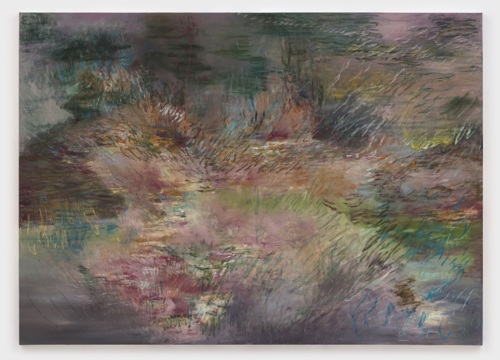
Sarah Martin-Nuss, Future Currents, Oil and pastel on canvas, 2025
MA: The changing appearance of your paintings invites viewers to reconsider how an image is experienced from different positions.
How do you anticipate the effects of light when developing a composition? Does the scale
of a work influence how viewers physically approach it? How do you want the encounter
with a painting to unfold in the exhibition space?
SMN: The shifting appearance of my paintings is central to my practice. When I began to
understand color not as a fixed property, but as an event that occurs when particular
conditions come together, I became interested in working with paint as a material capable
of producing an unfolding series of perceptual experiences. Light, surface, and the
surrounding environment continually influence how the work is encountered.
I don't often think about how a viewer approaches a painting. Instead, I think about how
the painting approaches and interacts with its surroundings. Through its relationship with
light, the painting extends beyond its physical boundaries, reaching into the space around it. This intention remains the same regardless of scale. Whether large or small, I am interested in how a painting can establish a presence beyond its material dimensions and enter into an exchange with the surrounding environment.
MA: Your training with the Meredith Monk Ensemble forms part of a broader engagement with voice and performance. These practices introduce breath, rhythm and the presence of the performer into your artistic vocabulary.
What first led you to explore the voice? How does collaboration with other voices and
musicians shape your approach to composition? What does performing demand from you
that working in the studio does not?
SMN: Singing has been part of my life since childhood, and I've always been drawn to the voice as an instrument inseparable from the body. My training with the Meredith Monk
Ensemble, along with my ongoing work with a vocal coach, has deepened my interest in
the possibilities of the voice beyond conventional language and song, particularly its
capacity to communicate through breath, gesture, and rhythm.
In composition, I'm interested in creating structures that allow music to emerge through the relationships between performers. I often work with open-form scores that establish a set of conditions rather than a predetermined musical outcome. Each musician brings their own sensibility to the work, and the composition develops through collective listening, intervention, and response.
Performing asks me to embrace a different kind of vulnerability. There is an exposure in
allowing others to witness a process as it unfolds, without knowing exactly where it will
lead. I'm increasingly interested in this vulnerability as a generative force, where openness and trust make possible something that none of us could create alone.
MA: Painting, drawing and sound offer different ways of organising material and experience. Rather than treating them as interchangeable, your practice allows each medium its own possibilities.
How do you decide which medium to pursue for a particular project? What becomes
possible in sound that cannot be achieved through visual work? Which artistic questions
are you most interested in pursuing next?
SMN: Often, an investigation in one medium opens a question that I want to pursue through another. I find myself asking similar questions in painting and musical composition about emergence, transformation, and the ways in which relationships shape what comes into being.
Recently, I've been studying diptychs, tracing the etymology of the word and exploring how the format has been used historically. This research has informed a new series of
paintings and musical scores conceived as duets. I'm interested in how two distinct voices, whether vocal or instrumental, can retain their individuality while creating a shared form. Sound allows these relationships to unfold in real time, with each performance offering new possibilities.
In these compositions, I'm experimenting with creating a system and then stepping back to witness its unfolding, allowing the performers to discover relationships I could not have
anticipated.
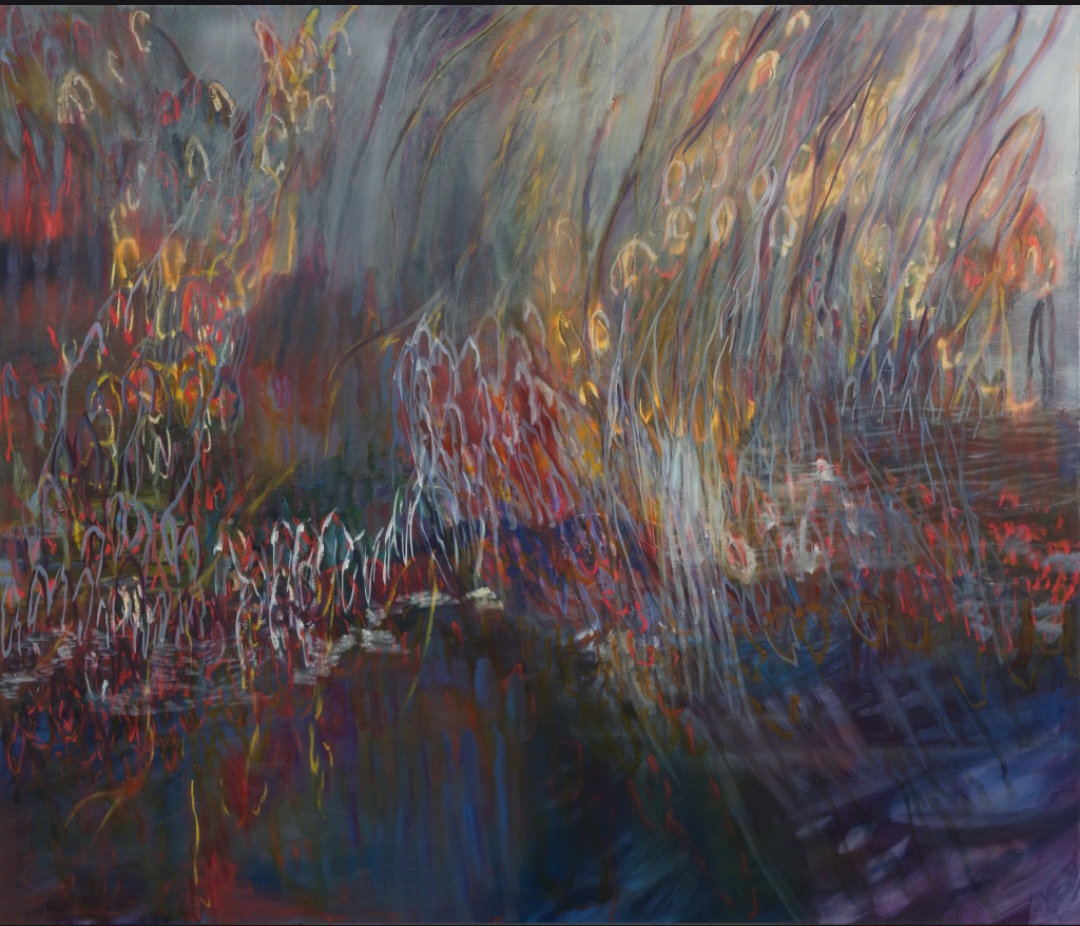
Main Image: Sarah Martin-Nuss, Mist of Forms, Oil and pastel on canvas, 2026