
BEFORE THE IMAGE Conversations on Painting in the Making - Jacob Littlejohn
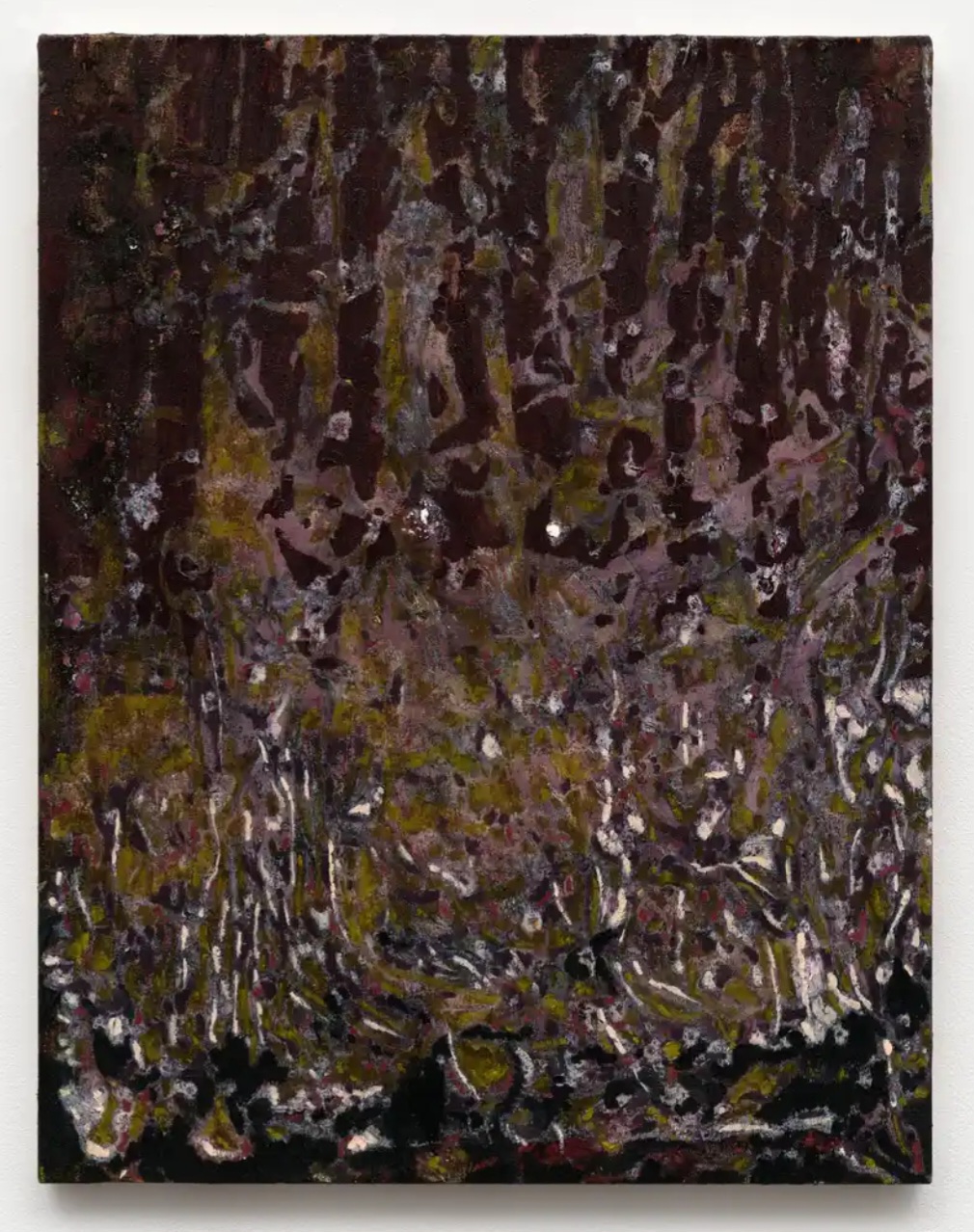
Jacob Littlejohn (Edinburgh, 1995) explores the relationship between personal experience and the natural world through an abstract expressionist language.
Oceans, geological formations and cosmic phenomena inform images in which colour, gesture and shifts in scale evoke dimensions that exceed everyday perception. His paintings engage with the sublime, exploring the capacity of images to suggest phenomena and presences that resist definitive form.
In What the Thunder Said, his 2025 solo exhibition at KARMA in New York, Littlejohn brings together observations of nature, visionary poetry and Scottish and Celtic folklore. His painted surfaces emerge through layers, erasures and chromatic shifts that evoke processes of transformation and erosion. The collection of natural materials, practices of documentation, and an interest in myths and folk narratives further expand his inquiry, connecting individual memory, collective imaginaries and deep time. Melancholy and poetic sensibility accompany a reflection on how we perceive and interpret the world.
For BEFORE THE IMAGE, this conversation explores Littlejohn’s creative process: from the experiences that shape his visual imagination to his studio practice, from the material properties of paint to the relationship between folklore, time and perception, and finally to the emotional experience of the sublime.
Margherita Artoni (MA): Which experiences or natural phenomena feed your imagination?
Jacob Littlejohn (JL): I think there are a multitude of experiences that haunt the work. I tend to avoid reaching for one particular experience too early, preferring instead to explore several possibilities. By keeping these experiences fluid, fragments of different things often stitch together later. I like to remain as open as possible when beginning a painting, as though the experience of being in the studio, in itself, could be enough. More specific lived experiences, containing recognisable signifiers, are introduced further down the line to ground the work in something a little less abstract.
Natural phenomena interest me because they provide an origin point from which a painting can depart through deeper exploration. The concept of phenomena is useful to me when considering lived experiences, as it allows for a more inquisitive understanding of how we perceive the world. Natural events are particularly mesmerising because they expose the limits of our own perception. They offer representations of things as they are experienced through our understood perspective, while simultaneously suggesting that there is often much beyond what we are able to comprehend.
If phenomena describe things as they are perceived and experienced through both the senses and the mind, then abstraction perhaps allows us to experience something of the imperceptible. It allows for space to document pure movement, influence internal states, capturing time as a form and making something so fluid appear immobile.
Coming from a particularly rainy part of the world, things like petrichor have caught my interest. Watching displays of starling murmurations is another example. Crown shyness in tree canopies, wave interference and cloud formations have all provided generous sustenance for the paintings I've made. These understandings offer a framework of knowledge to learn from, something I can use as a starting point from which to experiment and explore the unknown. The mechanics of bridging opposing ideas or objects together can force a painting to find a new, hopefully undiscovered, poetic meaning. The search for new phenomena in the world is also an opportunity for me to learn and remain curious, which I believe is important. It also reflects the way I work, the strive to constantly search for new areas of painting that I can incorporate into my vocabulary.
MA: When you begin a painting, what guides your initial decisions? How do your inner world and the canvas come together as you work in the studio, and what space do you leave for the unexpected?
JL: My initial decisions come from a variety of places. I voraciously take notes, and these notations can be anything from a passage in a book I've been reading before arriving at the studio, a verse from a poem, or a line or scene in a film that catches my attention for whatever reason.
In terms of the initial painting decisions, I approach the process as openly and unconsciously as I can, trying to remain completely unburdened. This often begins with applying and pushing previously mixed or leftover paint around the canvas, eventually responding to what emerges and making decisions about where to take the work, or identifying avenues that appear to offer worthwhile endeavours. The process becomes a conversation with what's in front of me: a discussion, an argument, an apology or a complimentary correspondence between intention, application, imagination, result and discovery. Hopefully, this eventually reaches a point where it feels as though there is nothing else to ask.
I think my inner world and the canvas come together somewhere in between these exchanges, fairly organically, although often only after I've left the studio. I always work on a multitude of surfaces at any given time, allowing works and thoughts to cross-contaminate. Hopefully, they are conversing with one another behind my back until I find a familiar image, place or space through which everything begins to connect.
I'd say that a lot of space is left for the unexpected, and I try to remain consistent in this way of working, although it can often be difficult. From previous experience, having something set in stone too early can lead to a tight and restrictive way of working, eventually concluding in disappointment. I do believe it is useful to have some direction, as it encourages the drive to make that discovery. Finding something unexpected is, after all, one of the reasons I paint in the first place. I think this is what abstraction offers in abundance and why it continues to interest me.
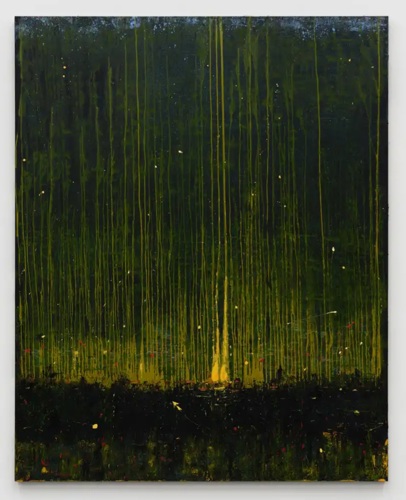
Jacob Littlejohn Hinkypunk, 2025 Oil on canvas © Jacob Littlejohn. Courtesy the artist and Karma
MA: What forms of documentation accompany your practice?
JL: Typical forms of documentation for me include found imagery, magazines, bundles of photographs bought on eBay, and personal photographs, usually taken on a walk. This allows me to maintain a balance between chance encounters and more intentionally collected imagery, creating movement between personal associations and the possibility of a more detached, objective reading. I also keep written notes, usually taken spontaneously in response to an experience of a place, alongside fictional writing, both found and self-written, that often relates to a particular location.
One example that comes to mind is a trip to Death Valley, California, where I made extensive sketches, took notes and read about the history of the location. These different forms of documentation eventually informed a large painting when I returned to the studio. This distance is also important. I find the delay between taking photographs myself and processing, as I typically use film, allows the original subject to be seen more clinically, while allowing room for imperfections, which relates to memory. Surprise, chance and the material qualities of the photographic process also influence this decision.
MA: What role does gathering natural materials play in your relationship with places?
JL: I think it is an enjoyable process, most importantly. It also acts as a memento of a place, helping to form and solidify a memory. Stones, plants, leaves and other forms of detritus can sometimes describe a place much better than words, as its environment has shaped their very nature. They speak to the specificity of individual locations and how, even a few miles apart, the characteristics of what is produced can change drastically. I find this extremely invigorating.
Site-specific materials help provide a deeper and more tangible understanding of a place. Rather than relying solely on the description of an observation, they offer a literal fragment of the environment itself. Collecting materials also creates a connection to the individual's particular journey: the place travelled to, the decision to collect something, the process of extracting it and the limitations surrounding what can be taken. All of these considerations are equally important.
Working with these materials reduces the distance that can emerge when relying solely on memory. It speaks to habitual behaviours and routines, as well as the ethics of extraction versus fallen materials, like collecting fallen leaves and flowers, which I often do on my commute. They become literal source materials and cyclical markers of the passing of time. Things like rocks from ochre deposits are genuinely site-specific and carry their own geological histories. Often, these things are overlooked or disregarded within the extractive pace of contemporary life.
MA: How do you transform these traces into painting, and how much of their original context remains recognisable in the finished Image?
JL: Sometimes I use the materials I've collected directly in the work, while at other times they are more loosely introduced, removed and often reintroduced as organically as possible. It's important to me not to be too precious with the work in its early stages, as forcefully preserving something can prevent the risk-taking and experimentation that I value.
Sensibilities are inherently tied to the work, whether through an established mood, the chosen palette or even a particular gesture. I want the works to develop their own characteristics and challenge the original perspectives that their source material might initially suggest, which highlights that I'm happy for recognisability to disappear completely. Sometimes the original material might disappear, but its qualities remain through markers of colour, texture or gesture. Titling the work can provide useful context for the viewer to enter the work, preserving an origin point or a thread of thought that helps shape the work into what it has become.
It's impossible to recreate an experience like for like, so we rely on a multitude of components to create something unique that might generate a sense of resonance. Every experience is singular to the individual and will differ significantly for anyone else. No matter how many times we return to a particular place, or how familiar we feel with it, the experience will always be different, for everyone. As a familiar philosophical saying goes, "No man ever steps in the same river twice; for it's not the same river and he's not the same man."
MA: Which stories or traditions have had the greatest influence on your imagination?
JL: My favourite examples are usually those involving water and the beliefs surrounding particular bodies of water. I am fascinated by how the supernatural often coexists with the natural. I think about the holy wells of Scotland and Ireland, which were believed to possess physical and mental healing properties, or the belief that certain fairy pools and lochs could act as portals into another world, sometimes associated with Tír na nÓg.
I find it interesting to consider how people once explained things they couldn't understand through supernatural beliefs. Some of those holy wells, for example, are associated with mineral-rich groundwater, where water passes through geological formations and dissolves naturally occurring minerals. These physical properties may have contributed to the beliefs surrounding their healing capabilities, as these waters were rich in minerals like magnesium, calcium, lithium, and sulfate, which are now commonly known for their health benefits. It's interesting to consider the point at which the natural and supernatural become difficult to distinguish, and how one might give rise to the other.
Other stories surrounding flood myths have always fascinated me, particularly The Epic of Gilgamesh. I am also interested in stories of supernatural guardians and water spirits, such as nymphs and sirens, alongside tales of will-o'-the-wisps, whose appearances have historically been associated with dangerous or mysterious landscapes. A degree of fear is very common in many of these oral traditions, and I think it can be particularly beneficial. Stories are constantly reinterpreted and retold for new audiences; language is malleable, and over time can change, which is another quality that draws me to them.
I like how these stories often humble our understanding of the human experience, challenging our belief that we reside at the centre of the natural world. By personifying nature and narrating the things around us as otherworldly, they create deep shadows of uncertainty that encourage us to question the things we think we know.
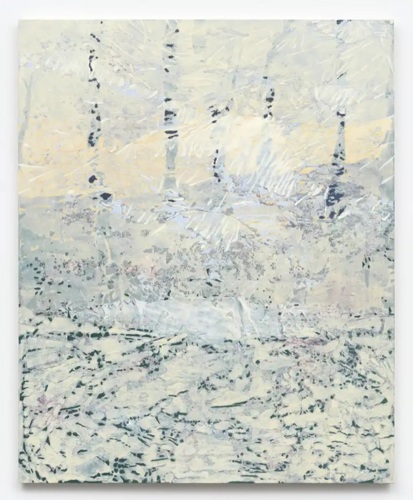
Jacob Littlejohn The Air's Invisible Corners, 2026 Oil on canvas © Jacob Littlejohn. Courtesy the artist and Karma
MA: How do folklore and personal experience intersect in the making of your work?
JL: Looking back at my work, I can see how folk stories and personal experiences have intersected in a number of ways. Typically, an idea for a painting emerges from one or the other, acting as a starting point. They often embed the underlying structure or philosophy of the painting, influencing everything from the subject matter to the decisions on how to paint, made during its development.
This might condition my initial research into reference imagery or broaden my interests in what I'm choosing to read. It can also inform the materials I use, the imagery I begin to collect or the substrate I choose to paint on. A story surrounding the Catskills Witch, retold by S. E. Schlosser, is a more specific example. One story describes how the bones of a giant monster created a new mountain after a great spirit froze it into the earth. This encouraged me to consider using bone black paint, with its carbon qualities, alongside thinking more carefully about where I might collect other pigments. These material decisions connect the work to the narrative and geological history of the earth.
Rhythmic brushwork can also be used to mimic the repetitive structures and timing of oral traditions, connecting an experience or story to the painting. This can help establish a particular mood, while informing the relationship between composition, light and the selection of different palettes. Repetition in painting relates to the act of storytelling, particularly the way a story can change ever so slightly through each retelling. Folklore is not simply subject matter for the paintings, but a method of thinking about how images might be constructed and communicated.
MA: How does abstraction allow you to evoke a narrative dimension while leaving room for multiple interpretations?
JL: The word evoke is key to me. You can only do what feels right at the time, with the hope that others might be able to experience something through it. Abstraction allows me to drift between different forms and degrees of representation. Simultaneously, it allows for multiple readings and interpretations, much like the different understandings and retellings of folktales. Paintings also become stories, witness marks inspired by events driven by emotion and susceptible to change depending on who encounters them.
I believe it provides a structure and direction to work towards something without requiring a defined image or narrative to be seen as complete. Rather than presenting the viewer with a fixed set of conditions, I want them to respond to what is in front of them and bring their own associations to the work, in a collaborative way. Various interpretations will always exist, but this environment of uncertainty of what is being looked at feels particularly potent to me.
I also think abstraction offers a more open form of accessibility, despite the common perception that it can be inaccessible. It makes room for doubt and questioning, challenging and rewarding the viewer through the experience of something new, without requiring a single, static interpretation.
MA: How do you translate your interest in deep time into the construction of your paintings?
JL: Painting, in today's world, seems to be one of the few things capable of manipulating time, with its ability to physically slow people down. Deep time is also inherent in painting; it has a particularly unique ability to encapsulate and visualise time, both past and present, while continuing to change as time progresses. Paint as a physical material has the ability to present a visible and tactile substance and timeline that is usually imperceivable. Deep time allows the comprehension of the vast scale of geological and interstellar history in relation to a single moment, painting also allows a finite material to hold an almost infinite range of conceptual possibilities.
Deep time is articulated through the subjects I choose to paint, such as the Sailing Stones at Death Valley or the Artist's Palette, and through the materials I choose to work with, including natural pigments sourced from different locations. I also like to incorporate found surfaces whenever possible, as they arrive with their own histories and patinas. These materials continue to change under the conditions surrounding them, carrying their own temporal qualities.
In a sense, my paintings have the ability to transcend my own time, which is something I can't quite decide whether to consider a good or bad thing. On the one hand, there is something quite vulnerable and exposing by creating something with the capability to transcend time, like a work of art, especially as it is a representation of you, on the other hand that is what makes it so unique.
MA: What roles do colour, gravity and the rhythm of gesture play in this process?
JL: Colour is primal. I think all artists have a unique connection to and appreciation of colour that is essential to their practice. It is a language that helps shape and articulate ideas within the work. It allows light to illuminate certain areas while dropping others into shadow, rather than just being descriptive, colour helps formulate the psychological possibilities that a painting can assert.
Painting light is an important subject for me, and I feel it is best communicated through a dynamic relationship with gravity and rhythm. I like to use gravity as a tool for generating different gestures and showing the process is always in flux, by constantly rotating the orientation of the painting as I work.
Rhythm and gesture allow a painting to become lyrical, almost vibrating. This connects painting to the repetition of natural processes that comes down to cadence and timing, which can manipulate our perception of the work and operate as a form of communication between the maker, the painting and the viewer.
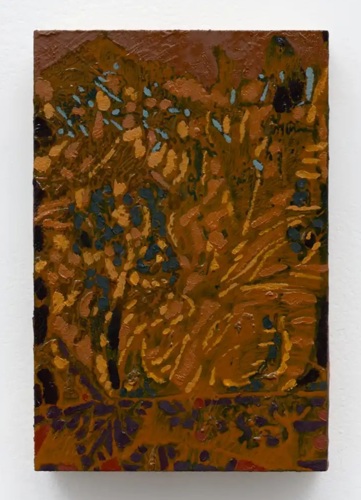
Jacob Littlejohn More than Mountain, 2026 Oil on panel © Jacob Littlejohn. Courtesy the artist and Karma
MA: How do layering and the removal of paint evoke processes of erosion, transformation and cyclicality?
JL: Quite literally, we excavate the earth to transport ourselves across time, learning from the past in order to move forward more consciously. I think considering the process of painting in a similar way can offer a means of progression. What initially appears to be a destructive course of action can often create new possibilities and directions.
This back-and-forth movement mimics the erosion of the ocean as it continually transforms the surrounding landscape. By digging into a painting, we diminish and alter its accumulated history, changing the contained landscape. The paint is malleable, fusing with the surface on a comparatively compressed scale to geological strata.
Layering and removing paint with spirits, or physically cutting into its surface, simultaneously creates and reduces a painting's topography, guiding the eye and mimicking the cyclicality of weathering patterns. It can also reveal hidden structures, much like the underlying geological processes that shape the natural world. These movements become part of a continuous, repetitive cycle of accumulation and erosion.
MA: How do you approach the sublime through abstraction?
JL: It’s often a challenge because the sublime is such a loaded term, and can describe both objective and subjective experiences. It can operate at the intersection of external physical realities and the internal human psyche. Abstraction is therefore a useful way to influence the viewer in a similar fashion, through a variety of different means.
Considering that emotion is central to the sublime, there are several ways I try to translate this into the work. Formally, this might involve strong distinctions between light and shadow, the use of local against non-local colour, or the creation of a false sense of security, interrupted by dramatic shifts in scale that produce a sense of the uncanny. I also find that introducing multiple vantage points, allowing familiar landscapes to slowly dissipate, can make it difficult for the viewer to situate themselves within the painting, creating a possibility of disorientation.
Sublime objects and experiences can often appear formless or chaotic, challenging human comprehension. Abstraction allows me to explore this by incorporating ideas of infinity into the work, stripping away aspects of the physical world and using formlessness to reject the compositional anchors that might otherwise comfort the viewer. The ability to drift between different forms of representation allows me to exist somewhere in between, the sublime could ultimately be the inquiry into the limits of representation, an attempt to capture the immeasurable or measure the imperceptible.
MA: What do you personally experience when confronted with a natural phenomenon that feels sublime to you?
JL: I’ve only been fortunate enough to encounter a handful of events that I would consider sublime, although I think the sublime can also be found in much simpler things. Of the experiences I've had, the emotions have varied. It can manifest as fear or as an unapologetic state of awe, often leaving me temporarily without words but scarred with a lasting impression.
Experiencing the extreme, inhospitable heat in the basin of Death Valley was incomparable to anywhere else I had visited before, and left a particularly lasting impression. Another experience that comes to mind was camping in Lone Pine, California, where I was able to witness the Sierra Nevada mountain range and observe the desert sky at night, entirely free from light pollution.
Usually, this is followed by a desire to make work about the experience and to learn more about whatever I've witnessed, whether first-hand or through someone else's account. The distance I allow between the initial encounter and my eventual return to it often determines the magnitude of the experience and whether it is something I feel compelled enough to pursue.
MA: How do emotions such as wonder, melancholy or unease enter your painting process and influence your formal decisions?
JL: These emotions are introduced into the work semi-consciously through a variety of ways. I often consider extreme shifts in scale, particularly in relation to distance, to generate feelings of insignificance and influence the emotional resonance of a painting. The physical size of a work can also play an important role, determining how impactful it might be before it is even completed.
Colour and light are other conscious ways of approaching these emotions, whether through solid, blocked-in areas or softer pools of transparent pigment. Other formal decisions also come into play, including the textures created, the shapes within the composition and the use of soft and hard edges to articulate the architecture of a painting. These contours help define how the work is interpreted and the mood it establishes.
Combined and manipulated, these methods can create a variety of associations for the viewer, often beyond my control. I like to think about how a painting can push and pull the viewer, playing with memories and associations that might provoke a particular response. I also consider the volume a painting produces, the visual intensity it carries that directs its spatial sound and how this can confront the viewer, redirect areas of focus and influence the pacing of an exhibition. The relationship between individual paintings and the space they occupy can fundamentally change how they are experienced.
MA: Which questions are currently at the centre of your practice?
JL: Time is always a question that drives my practice, and I think it is something I will continue to explore. I'm interested in what it means to me, how it shapes the things I look at, the way I choose to paint and how these relationships might evolve alongside my practice. One question that emerges from this is how a painting might hold several different temporal experiences simultaneously.
I'm still interested in exploring how the pacing of works can compel viewers to enter a mindset of dreamlike, suspended scenarios. Future work might consider how we instinctively search for archetypal symbols within landscapes in order to understand reality, and how this process might ultimately teach us something about ourselves and our existence. These symbols might be personal, culturally inherited or geographically specific, each offering a different way of understanding the world.
I'm also interested in further investigating the distinctive character of a place, probing its particular energy and presence, alongside the world of illusions and how these can be constructed while still acknowledging the acoustic and natural distortions through which we experience the world. This could take its shape through natural reverberation or the translation of sound into visual rhythm and how this can elicit a new toolbox of gestures.
MA: What aspects of your method or visual language would you like to explore further?
JL: I’m always interested in finding new ways to change my method, as this inevitably creates the possibility of developing a new visual language. Whether this is the palette I choose, the materials I incorporate or the method that I apply them with. Recently, I just discovered a number of undeveloped rolls of film so I've felt an urge to return to working with my own photography, potentially making more conscious decisions and seeking specificity earlier in the process.
This might be paired with more impersonal, found imagery in order to establish a balance between the two, without relying too heavily on either. From there, I think it would be fruitful to begin experimenting with different methods of working and allowing these approaches to influence one another.
It's difficult to predict exactly what might evolve, but I think something will, provided I remain open to the process, allow mistakes happen and learn from them. I expect to continue making work inspired by the natural world, as the more I open myself up to discovery, the more it continues to offer an inexhaustible source of material.
MA: What visual territories would you like to move towards in your upcoming work?
JL: I’m not entirely sure yet, but I am interested in how music might begin to play a role in the work, despite not necessarily seeming like an obvious visual influence. Initially, I'd like to explore the traditions and storytelling that accompany music, then how ideas of time are integral to musical scores and how intuition, repetition, spacing and contrast might translate between disciplines.
More recently I've been reading about a Celtic folk tradition that appears to have died out, which is lamenting, known as Keening in Scotland. A tradition revolving around call and response singing or chanting, performed to comfort grieving families and guide souls into the afterlife. I'd like to see if I could conjure new visual territories by working closely with these ideas inspired by something to do with the message behind the music or its archetype.
It could be interesting to expand on the relationship between repetition, lamentation and the passage of time, and how something as intangible as sound might be translated into a visual correspondence. Lamentation and the idea of a painting are both entities that can carry or preserve an absence. Perhaps the paintings could operate through a similar call and response, with gestures, layers and the removal of paint becoming a form of a visual exchange. I'm considering whether recordings could become source material, or whether musical structures might be translated more directly into physical painting processes. I'd like to see where these ideas might lead without necessarily deciding on an outcome too early.
Main Image: Jacob Littlejohn The Plot, 2026 Oil on canvas © Jacob Littlejohn. Courtesy the artist and Karma