
BEFORE THE IMAGE Conversations on Painting in the Making - Emma Masut
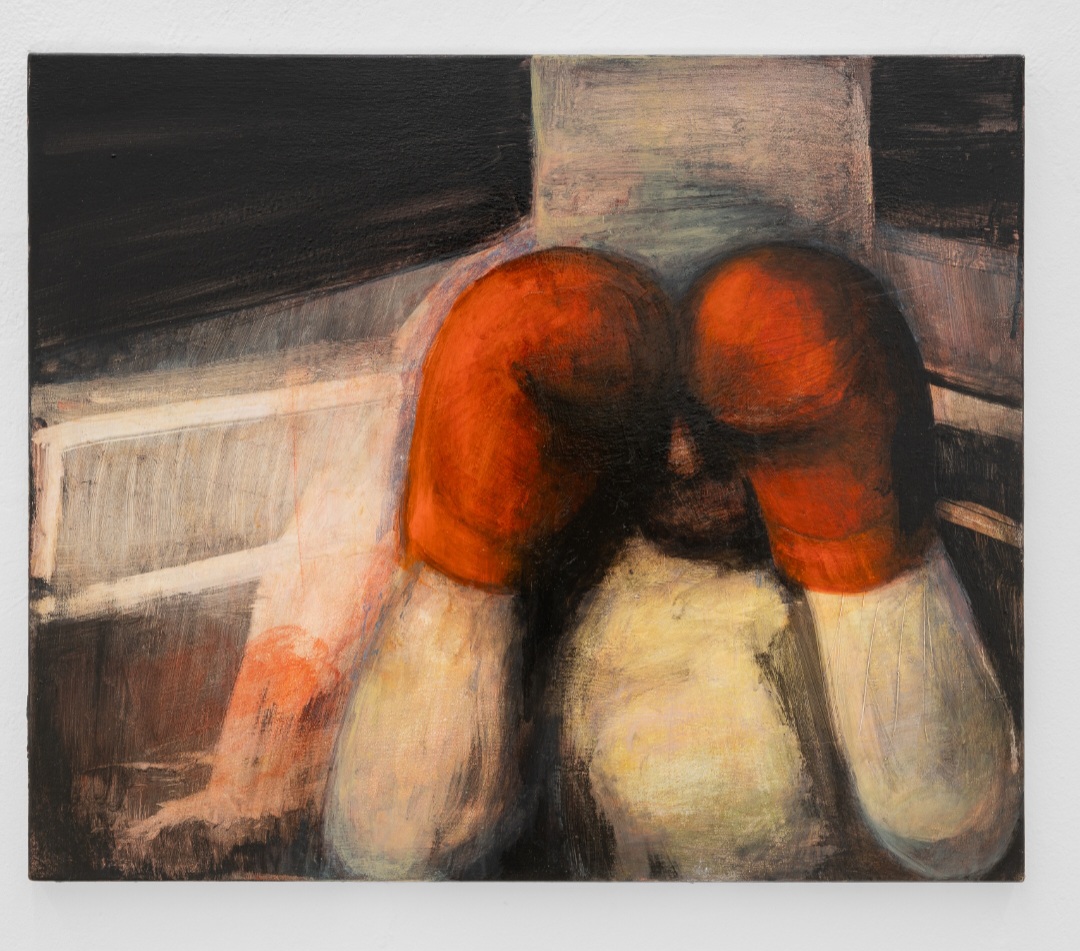
Emma Masut's practice unfolds between drawing and painting, through images that take shape from impressions, associations and enduring interests.
Mystery, premonitions, obsessions and crime are among the territories explored in her work, offering starting points for investigating the narrative and perceptual possibilities of the image. Objects, figures and gestures become elements through which open-ended situations are constructed, capable of raising questions and activating the imagination.
In Duel, her solo exhibition at Clima Gallery in Milan, images occupy a zone of tension
between action and anticipation, presence and absence. The elements depicted suggest
relationships and possible developments, while painting intervenes in their definition,
calibrating the relationship between recognisability and indeterminacy. Each work thus
becomes a space where the visual and narrative dimensions converge, allowing multiple
interpretations to emerge.
For BEFORE THE IMAGE, this conversation explores the process through which Masut
develops her visual language: from the sources that feed her imagination to her technical
and formal choices, and the questions that accompany the evolution of her practice.
Margherita Artoni (MA): Images can emerge from personal experiences, memories,
cultural references or chance encounters with visual elements. Throughout the creative
process, these impressions are selected and reworked, taking on a form that reflects the
way the artist observes and interprets them.
What are the sources that nourish your imagination? Where do you begin when starting a
new work, and through what stages does an initial impression become an image you feel
compelled to develop?
Emma Masut (EM): I don’t have any preferred sources to draw from. There is a period of
gathering, during which I collect images, frames, intuitions, clues—anything I can get my
hands on—without worrying about the artistic value of what I’m looking at. The image then
emerges from the deductions and associations that develop between the things I have
accumulated, in a process that can be more deliberate or more intuitive, depending on the
case.
As for developing images within a painting, I believe they need to be somehow digested or internalised before they can be represented. I have often compared this process to
chewing: you have to chew images, hold them between your teeth, mumble them to
yourself. Once you have done that, an image is ready to be painted.
MA: An image can contain a situation without making all its elements explicit. A gesture,
an object, figure may suggest possible events, leaving viewers to imagine relationships
and developments. Narrative takes shape through what appears on the surface and the
connections it evokes.
How does the relationship between image and narrative develop in your practice? Do you
begin with an already defined story, or do you allow the images to gradually suggest a
sequence of events? What space do you wish to leave for the personal interpretations of
those who encounter your work?
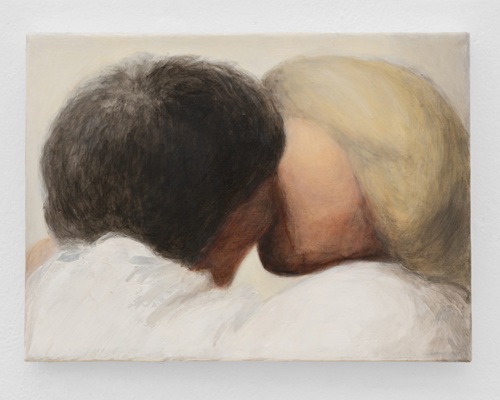
Emma Masut, Untitled 2026
EM: I never begin with the specific intention of telling or narrating something. Sometimes
associations or references emerge between images, but I would like them to remain mere
suggestions, open possibilities. Some paintings are certainly connected to others of their
kind, linked by a common thread, but I am not interested in connecting them in order to
construct a narrative.
Rather, I would like them to share an underlying sensation—something almost physical,
felt in the gut—or to suggest a particular investigative attitude to the viewer, without
necessarily having to conform to a logical chain of causality. In this sense, I hope my work
can be read intuitively: the interpretative space remains open, yet inevitably shaped by my intentions.
MA: Over time, certain subjects can come to occupy a significant place in an artist’s
practice. Their recurrence makes it possible to explore enduring interests and observe how they change through new associations, techniques and contexts.
Which elements recur most frequently in your work, and how does your relationship with
them evolve? Do you tend to recognise recurring motifs only in retrospect, or do you
consciously identify themes you wish to explore further? How do these recurrences
contribute to the development of your visual language?
EM: There are certainly recurring interests in my work, relating both to the painting
process and to the construction of the image. The development of a theme can be either
consequential or causal: sometimes I consciously choose to explore it, but just as often I
only become aware of it in retrospect.
When it comes to translating these themes into painted images, however, the process is
almost entirely active. In representation, visual elements become tools in my personal
arsenal, allowing me to test the action of a force upon a body, or the body’s resistance to
it. I can turn things inside out and upside down, play, inflict violence. Through this
mechanism, oppositions can be suspended, blurring the boundaries between mischief and cruelty, victim and perpetrator, sleep and wakefulness.
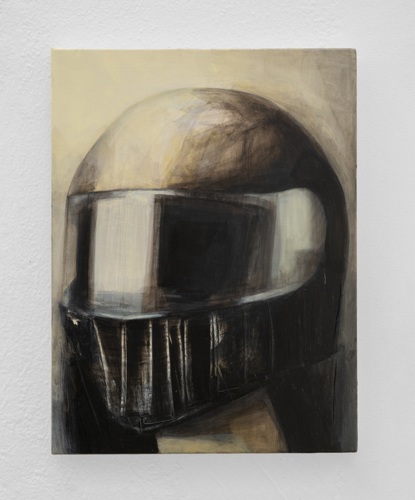
Emma Masut, Helmet 1 2026
MA: Drawing and painting offer different tools for organising forms, establishing
relationships and developing an image. Mark-making, colour and surface influence the
rhythm of the work and its expressive possibilities, making the choice of technique an
integral part of the artistic investigation.
How do drawing and painting influence one another in your practice? What possibilities do
you find in each medium, and how do you decide which one to use? How can the material
properties of a technique transform an initial idea or suggest developments you had not
anticipated?
EM: For me, drawing and painting are two radically different practices. I also believe that
some images need to be painted, while others need to be drawn. Drawing, for me, is a
quick, decisive and sometimes subtractive practice, precisely because of its concision. It
can feel almost shameless in its immediacy: a form of synthesis that leaves no room for
second thoughts, absolute and sometimes unreasonable.
Painting, on the other hand, sometimes gives me the same heavy, muddled feeling as
sleep, that same sense of numbness. In my case, I think painting is less direct, more
restrained in a way; rather than defining or asserting things, it blurs them.
Where drawing offers an immediate correspondence between thought and gesture, the
intrinsic qualities of painting make room for doubt and reconsideration. The painting
process is therefore more layered, giving rise to developments that may be more or less
unpredictable in relation to the original starting point.
MA: The relationship between depicted forms and objects can generate conflicting
meanings. Some gestures may express closeness while simultaneously suggesting confrontation; an object may evoke protection while concealing a presence. Tension thus
emerges from visual relationships and from the way painting determines the degree to
which its elements remain recognisable.
How do you work with the relationships between elements within an image? Are you
interested in constructing situations in which opposing sensations or meanings coexist?
What role do colour, composition and the definition of forms play in suggesting these
tensions, and how do you decide how much to leave open to the viewer’s perception?
EM: What I seek to investigate in my work is a tense relationship between the visual
elements of an image, organised around two opposing poles. In this context, I would like
my practice to be understood as a mechanism through which this duality can be
suspended: a way of corrupting the oppositional nature of things, reversing roles and
subverting them.
I don’t think painting needs to be suggestive. In my case, inversion, violence and play are
intrinsic characteristics of the painting process. For the same reason, I cannot calculate in
advance how much interpretative freedom to leave the viewer. What I would like, however,
is for viewers to perceive how the mechanism I have described operates, so that they can
then activate it individually in their own way.
MA: An artistic practice evolves through experimentation, shifts in perspective and
questions that emerge in the course of working. Each new work can transform an artist’s
relationship with an established visual language, opening up possibilities that have yet to
be explored.
Which questions feel most urgent in your practice today? Are there aspects of your
method or visual language that you would like to put to the test, or new visual territories
towards which you feel drawn? What possibilities would you like to explore in the next
phase of your artistic journey?
EM: What matters most to me at the moment is developing a painterly language that is
open yet solid. I believe this is a slow process, one that must remain receptive to doubt
and reconsideration. What I appreciate most about this work is that you often come up
against a series of small revelations, each of which can open up a myriad of new
possibilities.
For this reason, I would like to broaden the range of my interests, making more room both
for the development of a broader theoretical framework to support my practice and for
external reassessment. I would like to engage more often with contexts that allow for
dialogue and exchange, including those involving practices very different from my own. I
don’t believe this journey can unfold in a linear way, nor do I think one should be overly
selective about the influences one allows in. For me, it is precisely the continuous process
of questioning and reconsideration that makes it possible to move forward.
Main Image: Emma Masut, Pugile 2026