
BEFORE THE IMAGE Conversations on Painting in the Making - Caroline Jackson
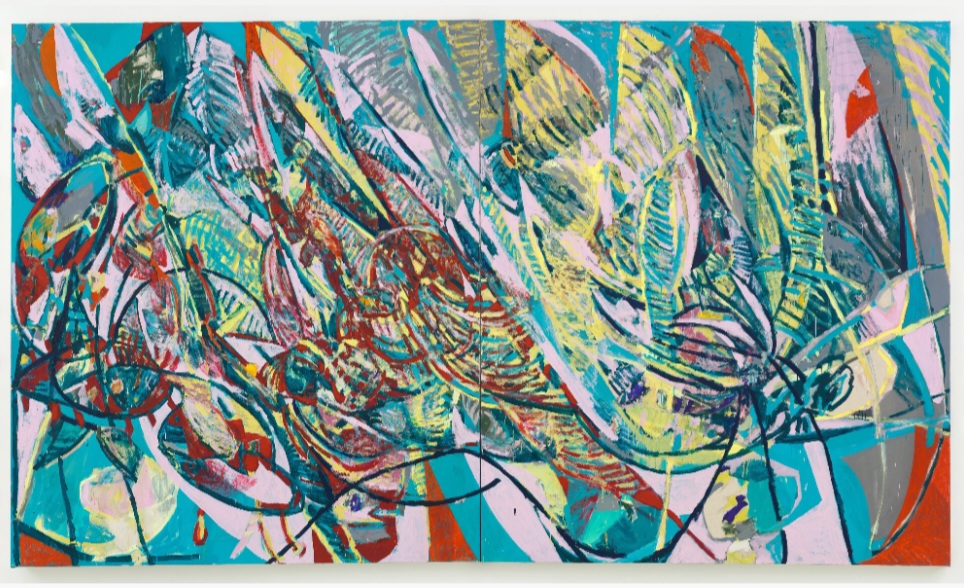
Caroline Jackson explores the possibilities of abstract painting through compositions in which colour, texture, and gesture shape the perception of space. Her layered surfaces evoke geological formations, atmospheric conditions, and fragments of landscape without settling into recognisable representations. Moving between material density and perceptual openness, her paintings invite viewers to experience space as something both physical and imagined
Working through an intuitive yet carefully considered process, Jackson builds, scrapes, and reworks painted surfaces, allowing the properties of her materials to guide the development of each composition. Her practice balances spontaneity with structural awareness, creating images in which gesture, rhythm, and texture establish a dialogue between form and atmosphere.
In 2026, Sim Smith presented Multum, Jackson's second solo exhibition with the gallery, bringing together works that further explored the textural and structural possibilities of paint. The exhibition offers a point of entry into a broader practice concerned with the relationship between material, perception, and the construction of space.
For BEFORE THE IMAGE, Margherita considers the origins of abstraction, the relationship between painting and landscape, the expressive potential of material, the organisation of colour and form, and the evolving nature of artistic practice.
Margherita Artoni (MA): Your paintings develop without necessarily following a predetermined plan, allowing compositions to emerge through successive decisions. What usually prompts you to begin a painting? Do you start with a gesture, a colour, or an initial idea? How does the first mark influence what follows?
Caroline Jackson (CJ): I usually start by looking and thinking, "Where do I want the energy of the piece to be or stem from?" I then start drawing, almost always in oil with my favorite brush. The brush is small, incredibly dense, and short, so it doesn't really allow paint to move very much, allowing me to be very intentional with where my material is placed.
I know what's being placed down initially will likely not be seen in the finished piece—it's more about allowing the process to start organically, without preconceived notions of an ending. I focus on creating interesting shapes, overlapping gestures, tendrils, and forms that can then be built upon.
MA: Your work evokes natural environments without depicting identifiable places. Landscape emerges through forms, textures, and spatial relationships rather than direct representation. What draws you to landscape as a source for your work? How do observation and imagination inform your compositions? What transforms an abstract arrangement into something that evokes a sense of place?
CJ: I grew up in East Sussex and lived amongst nature, on farms and near the seaside, until I moved to London in 2019. Even though my work does not depict any real place, I want to create some sense of the "real"—imagined spaces that evoke our senses, creating abstraction that does not feel indigestible.
There's a dynamism to nature that's expansive and captivating to me. There's a definite spirit of the British landscape within my work that reminds me of places from my childhood.
When I'm painting, I'm eager for a sense of place to feel "right" in some way. The active gesture of painting feels how I imagine painting a real landscape does, or how it may feel to draw a real face and try to capture someone accurately. For me, an abstract arrangement must feel balanced in some way, its movement anchored somewhere as if space, air, and gravity can exist around it, enabling us to place ourselves within it.
"For me, an abstract arrangement must feel balanced in some way... as if space, air, and gravity can exist around it and enable us to place ourselves within it."
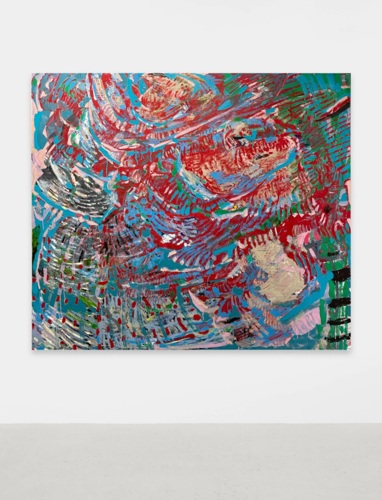
Caroline Jackson, Winnow, 2025 oil on canvas. Courtesy of Sim Smith. Copyright © Caroline Jackson
MA: Through layering, scraping, and reworking, you explore the physical properties of paint. The surface retains traces of these actions, making the material process an integral part of the finished work. How do you choose the materials for a painting? What do you discover through scraping or removing layers? Are there physical properties of paint that continue to surprise you?
CJ: I think the magic of paint comes from using it unconventionally: layering when things are still wet, layering acrylic over oil so it separates, or diluting pigment until it's so thin it only stains the small grooves of an already dry mark.
Seeing all your materials as equal—rather than dictating what should logically go down first—makes for a much more exciting process and painting.
MA: Your paintings bring together areas of density and openness, establishing relationships between colour, form, and structure. How do you establish a compositional balance? What guides your chromatic choices? How do you decide where a painting needs greater complexity or restraint?
CJ: Compositions are created intuitively, guided by a gut feeling of what's "right" and "balanced." The emergence of a composition is wrestled with, often slipping from my grasp and returning until finally settling.
Usually, compositions present themselves via two different routes:
-
Texture First, Composition Second: Where the frenzy of mark-making is at the forefront. Creating interesting and intriguing texture is the primary focus, and the composition must then be drawn out from this.
-
Composition First, Texture Second: Where a composition reveals itself very early on, and the density is built up after—like adding flesh to bones.
Colour also plays an important part in creating variation between density and openness. Most of my work has a larger pool of one colour—maybe a pastel pink, a blue, or even a harsh black or vivid orange—that juxtaposes the more cerebral mark-making. This choice establishes breathing room for form and texture to be suspended without being overwhelmed.
MA: Your practice combines spontaneous gestures with deliberate choices. How do you recognise when a painting needs to change direction? What helps you distinguish a productive uncertainty from an unresolved problem? How do you know when to stop working on an image?
CJ: I don't know if there's necessarily a singular point in a work where I go, "Okay, this needs to go a different route." I know it can change in any direction at any time.
To me, an unresolved problem is a productive uncertainty. I do find the uncertainty of problem-solving frustrating, and I haven't mastered the whole "not overthinking thing" just yet. It takes dedication and time to recognize that the struggles and uncertainty in any capacity are part of the process, and no two painting processes are the same.
"To me, an unresolved problem is a productive uncertainty."
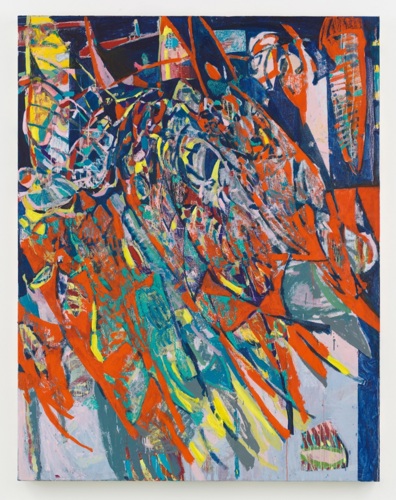
Caroline Jackson, Palimpsest, 2025 oil, acrylic and oil pastel on canvas. Courtesy of Sim Smith. Copyright © Caroline Jackson
MA: How has your approach to painting changed over the years? What have you learned from spending extended periods working on a single canvas? Which new possibilities would you like to explore in your future work?
CJ: I’ve learned to go along for the ride when it comes to painting and to know that everything has value and potential. Marks can't be wrong or discarded—everything is used in some way.
I try not to get too overwhelmed by hating a piece. I have hated most of my works at some stage, but this feeling is important: resolving the unresolved is the whole point. Without the push and pull involved, there would be nothing but a blank canvas.
I'm also less precious about trying to preserve certain areas, as doing so is inevitably detrimental and jarring to one's involvement. There's nothing that can't be fixed by just putting something away and revisiting it. The excitement of new, unknown possibilities is precisely because they are unknown.
Main Image: Caroline Jackson, Mast, 2025 oil, acrylic and oil pastel on canvas. Courtesy of Sim Smith. Copyright © Caroline Jackson