
BEFORE THE IMAGE Conversations on Painting in the Making - Ana Paula Garcia Benavides
Ana Paula García Benavides (b. 1996) is a London-based artist originally from Monterrey, Mexico. Her practice brings together abstraction, organic forms, and an expressive exploration of colour and texture.
Drawing on nature, personal experience, and sensory perception, she develops compositions that investigate identity, memory, and the ways in which we experience the world. Her paintings combine chromatic richness with a carefully considered material language, creating surfaces that convey movement, depth, and intensity.
In 2025, her solo exhibition Breakthrough at Hope 93 Gallery in London marked an important moment in the development of her practice. Its title reflects a recurring impulse in her work: the pursuit of emotional freedom and the courage to embrace experience without restraint.
For BEFORE THE IMAGE, Margherita Artoni explores the foundations of Benavides's artistic language: the influence of memory and place, the dialogue between music and colour, the physical dimensions of painting, and abstraction as a space for meaningful human encounters.
Margherita Artoni (MA): Which experiences, memories, or encounters with the natural world have most deeply influenced your artistic imagination? How have Monterrey and London shaped your perception of identity and belonging? What usually marks the beginning of a painting: a remembered image, a particular sensation, or an idea that gradually takes shape through the act of painting?
Ana Benavides (AB): Growing up in Monterrey, a city often described as the "City of Mountains," nature was an inseparable part of my childhood and the foundation of my artistic imagination. My relationship with nature was shaped not only by the landscape surrounding the city but also by the environment at home. My father has always had a particular affection for plants and flowers; I grew up surrounded by the fruits he nurtured—grapes, mandarins, pomegranates, and limes. This constant presence of nature, colour, and organic forms quietly shaped the way I see the world.
I have always been fascinated by transformations in nature: the moment a flower blooms, its gradual fading, texture changes, and how colours deepen or disappear. There is something profoundly beautiful about the entire cycle—not only in the moment of flourishing but also in decay. I find beauty in impermanence and in the idea that transformation is, in itself, a form of life.
Moving to London five years ago opened an entirely new chapter. Coming from a relatively traditional Catholic upbringing, moving to a city so culturally diverse challenged many of the beliefs I grew up with. It encouraged me to question things I had taken for granted, to become more open, and to expand my understanding of myself. Belonging does not necessarily mean being rooted in one particular place; it can be built through the accumulation of everything we have lived through.
Nature, too, revealed itself differently here—the landscapes, changing seasons, light, and colours offered a new visual language from the one I knew in Monterrey.
Inspiration is everywhere if we allow ourselves to be attentive. It lives in conversations, fleeting encounters, unexpected emotions, a colour on the street, or a vague memory. Reading and writing are equally important to my practice; they build an inner world that eventually finds its way onto the canvas.
I rarely begin a painting with a fully formed idea. Sometimes I start with two or three colours that have stayed with me. I might make preliminary sketches to explore composition, but once I begin painting, I put them aside so I don't become attached to a predetermined outcome. Quite often, it is only after completing a painting that I understand what I was feeling when I made it.
"I find beauty in these transitions, in the impermanence of things and in the idea that transformation is, in itself, a form of life."
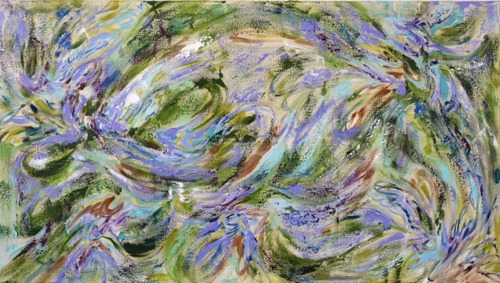
Ana Paula Garcia Benavides, A place I had forgotten.90x160 cm. Oil, marble powder, oil pastels and wax on canvas, 2026 Courtesy Hope 93 Gallery
MA: How does the music you listen to influence your choices of colour, rhythm, and composition? Do particular sounds or musical frequencies correspond to specific colours, textures, or visual arrangements in your imagination? If your paintings were musical compositions, what kind of listening experience would you want them to offer?
AB: My relationship with music has evolved considerably over the years. When I first arrived in London, I listened to a lot of energetic Latin music with strong rhythms. Nowadays, I find myself drawn much more towards nature sounds, handpan music, and classical compositions—especially instrumental music without lyrics, which allows me to enter a deep state of concentration.
Music creates an atmosphere in which I can disconnect from external distractions. While I don't associate specific sounds directly with specific colours, music has a very physical effect on the way I paint. It influences the speed of my gestures, the intensity with which I apply colour, the movement across the canvas, and how much space I allow a composition to breathe.
If my paintings were musical compositions, I would want them to hold two seemingly contrasting energies: something deeply powerful and energetic, yet simultaneously calming. I would love for someone to stand in front of a painting and experience both movement and stillness—like being invited into an emotional landscape that is constantly shifting while offering a sense of refuge.
Ludovico Einaudi is an artist I deeply admire. His compositions carry an extraordinary emotional sensitivity, vulnerability, and depth. That is what I hope to achieve through my paintings: a visual experience that moves someone emotionally, even before they try to understand it.
"If my paintings were musical compositions, I would want them to hold two seemingly contrasting energies: something deeply powerful and energetic, yet simultaneously calming."
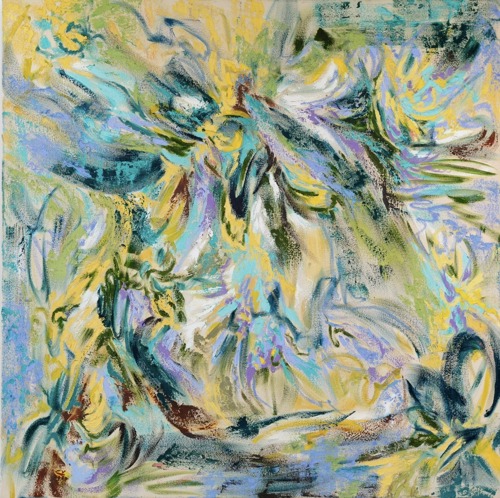
Ana Paula Garcia Benavides, Beneath the old skin. 140x140 cm. Oil, marble powder, oil pastels and wax on canvas, 2026 Courtesy Hope 93 Gallery
MA: What led you to adopt the floor as your primary working space, and how has this choice transformed your relationship with painting? How do your movements respond to music during the creative process, and what role does physical intuition play?
AB: For a long time, the floor was my primary working space. At that stage, I had an enormous amount of physical and emotional energy, and working on the floor allowed me to release it without limitations. Moving around the canvas and participating with my entire body was deeply liberating.
Over time, my approach has become more measured and attentive. I now primarily work with canvases on the wall. My movements have become more conscious; physical intuition guides me in a quieter, more considered way.
Painting becomes a way of overcoming emotional restraint when I stop thinking about the outcome and allow myself to become completely immersed. The moment I begin to question whether something is right or wrong, beautiful or ugly, finished or unfinished, I move away from that instinctive place.
Losing control is not about abandoning intention, but about allowing space for something unexpected to emerge. Magic happens in that space between intention and surrender. When body response precedes mental interference, something much more honest emerges. The painting becomes a place where unspoken emotions take physical form.
MA: What guides your exploration of texture and the physical properties of paint? How do you decide when a composition has reached its desired balance, and how much room do you leave for unexpected developments?
AB: Texture introduces a dimension that goes beyond the visual. It creates a physical presence felt before it is consciously understood. I am interested in the tension between different qualities: what is dense and delicate, concealed and exposed, built up through layers or left untouched. We are made up of different emotional layers; the physical properties of paint offer a beautiful way to explore these ideas without literal representation.
Knowing when to stop is difficult because I can always imagine another gesture or layer. However, I have learned to step away when the colours begin to harmonize and the energy of the painting feels resolved.
I am also increasingly interested in the relationship between what is painted and what is left untouched. Leaving areas of raw canvas creates a tension that would disappear if I continued working. Absence can communicate just as much as presence.
My process begins with an instinctive first session without overthinking. Once the initial visual language is established, I step away. Returning later allows me to be more analytical regarding texture, balance, and composition, while preserving the initial spontaneity.
I always leave room for unexpected developments. Some paintings simply don't work, and I accept that as an essential part of the process. Unsuccessful paintings teach you the most—they reveal what to reconsider and explore further. It is a continuous conversation between intuition and reflection.
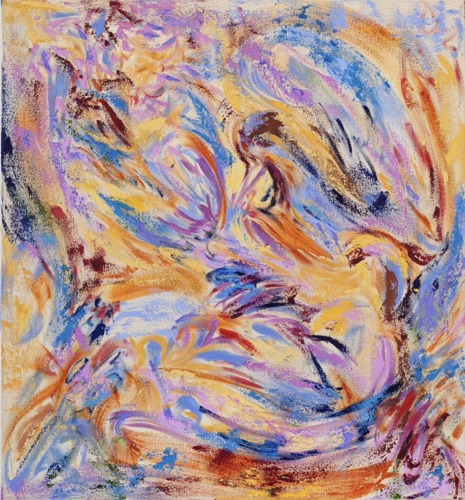
Ana Paula Garcia Benavides, The return to wonder. 109x101 cm. Oil, marble powder, oil pastels and wax on canvas, 2026 Courtesy Hope 93 Gallery
MA: What aspects of nature most strongly attract your attention, and how do you translate these observations into abstract forms? How important is it that viewers understand your personal experience versus approaching the work through their own interpretations?
AB: What fascinates me most about nature is its energy and constant state of transformation—from seed to bloom to withering. It reminds me that nothing is static and that there is beauty in every stage of becoming. Visually, I am drawn to the relationship between chaos and harmony found in natural forms.
When people recognize plant or floral motifs in my brushstrokes, it is because those forms exist in my visual memory through a lifetime of observation. In abstraction, I am not trying to depict nature, but rather translate the energy, movement, and life I feel when observing it.
When it comes to the viewer, the most important thing is that they feel something. I am deeply influenced by philosopher Maurice Merleau-Ponty and his writing on the phenomenology of perception—specifically the idea that our bodies experience the world before our conscious minds begin to analyze it.
I don't expect viewers to experience exactly what I felt while making a work. It is much more interesting when they bring their own memories and emotions. I want the work to awaken something within them that they haven't yet articulated.
Ultimately, a painting does not need to provide answers or a single fixed meaning. If someone can stand in front of a work and experience a pause, reflection, or connection to an unacknowledged part of themselves, then the painting has created something meaningful.
"Our bodies experience the world before our conscious minds begin to analyze it. There is an immediate, almost instinctive response to what surrounds us."
MA: Which questions are currently driving your artistic research? Are there other sensory dimensions or artistic disciplines you would like to bring into dialogue with painting?
AB: One driving question in my practice is how to give physical form to invisible experiences. How can an intangible memory, emotion, or sensation become something encountered through colour, texture, and gesture?
I am curious about how we encounter a painting beyond simply looking at it. Dimensions like sound, touch, and movement could create deeper connections between the artwork and the audience.
This curiosity naturally leads me towards sculpture and textiles—not as a departure from painting, but as an extension. I wonder what happens when the physical language of painting moves beyond the flat surface, when gesture occupies space, and when the viewer can experience a work from multiple perspectives.
At this stage, what excites me most is entering unfamiliar territory without knowing exactly what I am looking for. I want to allow room to experiment, make mistakes, and embrace uncertainty. I hope my practice continues to evolve without losing the core curiosity that first brought me to painting.
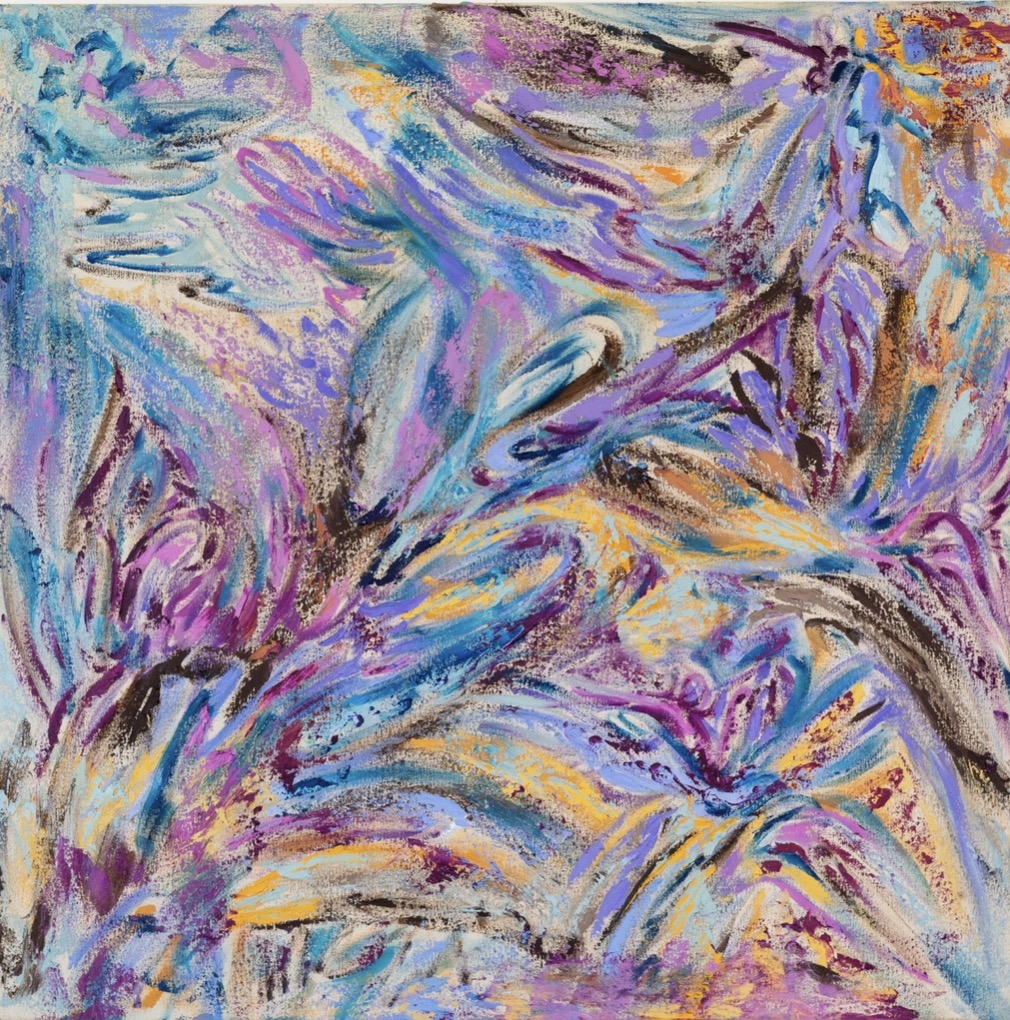
Main Image: Ana Paula Garcia Benavides, The lightness of being. 95x95 cm. Oil, marble powder, oil pastels and wax on canvas, 2026 Courtesy Hope 93 Gallery