
Badru Temitayo: Art, Truth and Resilience
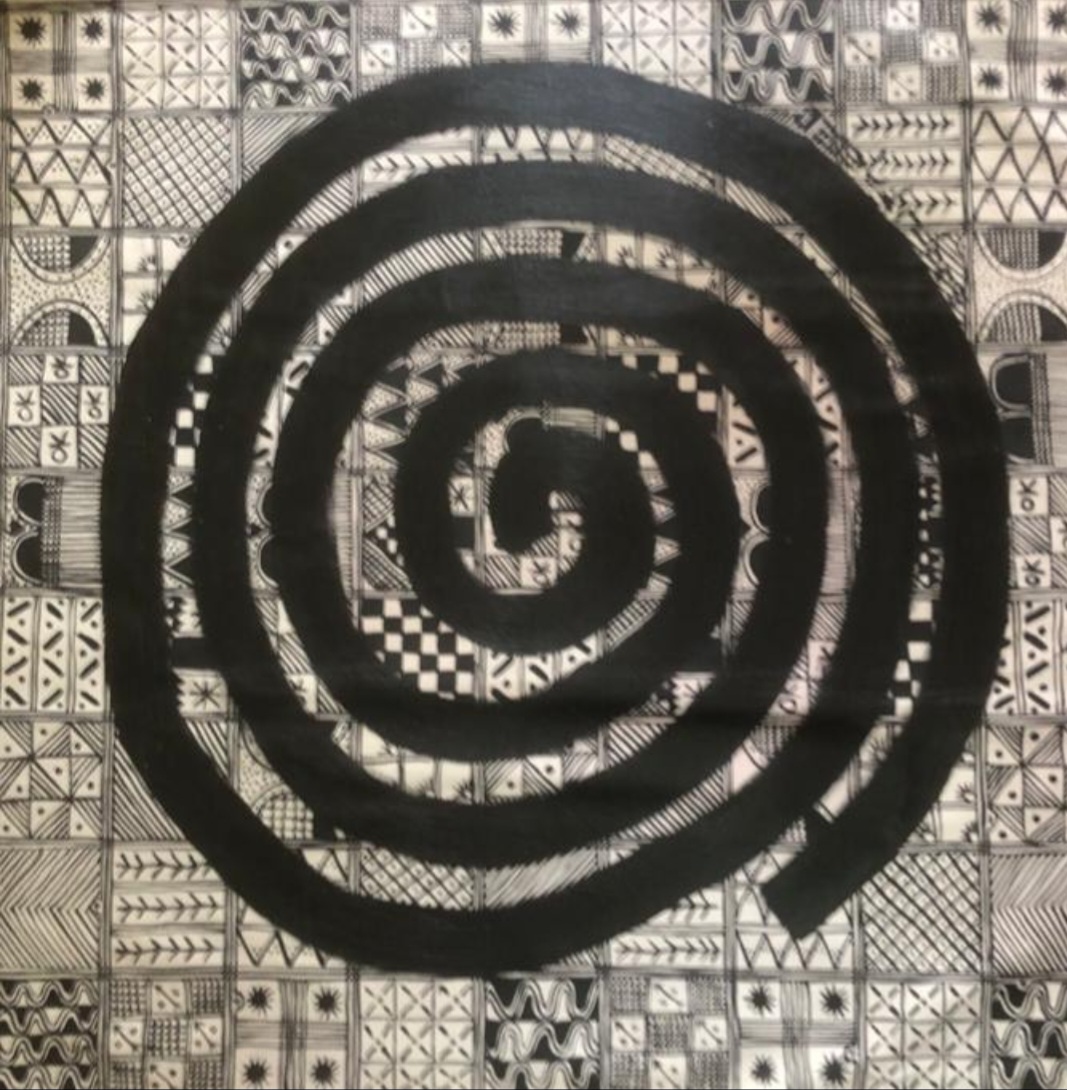
Badru Temitayo’s works sits generally in the abstract-figurative. Sometimes he blurs the line in being outrightly figurative, yet still discernible.
This contributes immensely to the alluring nature of his artworks. Thematically, he is focused on the exploration of and critical engagement with language, myth, folklore, proverb, spirituality and daily life in the Nigerian and importantly the Yoruba context. Influenced by his roots in Abeokuta, a city known for traditional dyeing techniques, my work, aims to amplify the etymological and semantic meaning of the traditional Adire Eleko patterns through interpreting their visual semiotics and using symbolic abstract images motivated by myths folklores, proverbs and deep observations of naturality and spirituality.
He is also focused on the female form and the ways they are depicted in contemporary society which draws from a close relationship with his mother. Badru is a self-taught artist with a Bachelor of Arts and Master of Arts (both in Textile) from Obafemi Awolowo University, Ile-ife, Osun State, Nigeria. A signature element of his works is his use of imagery and symbols from African wall murals and fabrics, most especially Adire Eleko fabrics. Badru has participated in several successful joint exhibitions, art fairs and a solo exhibition. He is a recipient of several awards and was part of “LIMCAF 2017 top 4 artists” sponsored to 13th Dark’art Biennial in Senegal by renowned artist, Professor El Anatsui. In 2024 Badru had a solo exhibition in Museum Rijswijk, Netherlands.
ArtDependence (AD): How does your work reflect your view of the world right now?
Badru Temitayo (BT): My work reflects how I see the world right now, complex, wounded, yet full of resilience. I respond to the chaos, corruption, and contradictions that shape our society, especially within the Nigerian political space. Through textiles, embroidery, and linear drawings, I translate these realities into visual metaphors, not just to criticize, but to question and to heal.
I see art as a mirror and a memory keeper. The world today feels like a cycle of struggle and survival, where power often comes with violence and sacrifice. My recent works, including Political Bugs, speak to this unease the ways leadership and politics affect ordinary lives, and how collective silence enables decay.
Still, even in that tension, I try to preserve a sense of hope and cultural rootedness. By drawing from Yoruba traditions, proverbs, and symbols, I remind myself and my viewers that our history holds wisdom and strength. So, my work reflects both the pain and the possibility of the present, the thorns and the crown that define our shared human story.
AD: What role do you think art plays in connecting people today?
BT: I believe art plays a powerful role in connecting people today. In a world that feels increasingly divided by politics, culture, and technology, art remains one of the few languages that speaks to everyone beyond words, borders, or beliefs. It allows us to share emotions, stories, and truths that might otherwise go unheard.
For me, art is a bridge, it connects generations, traditions, and personal experiences. When people encounter my work, I want them to feel seen, to reflect on their own realities, and to engage in dialogue. Whether it’s through the textures of fabric, the rhythm of lines, or the symbolism drawn from Yoruba culture, I see art as a way to remind us of our shared humanity.
At its core, art connects us because it helps us understand one another, not through explanations, but through empathy. It gives form to silence and makes invisible struggles visible. That, to me, is its greatest power today.
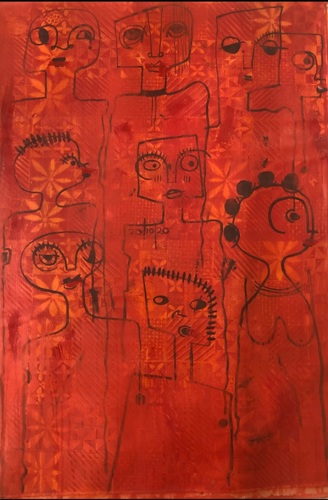
Badru Temitayo, Political Bugs, Acrylic on canvas, 2020
AD: Can you tell us the story behind the artwork 'Political Bugs'?
BT: In Political Bugs, I visualizes the corrosive influence of political thuggery and violence in Nigeria’s democratic landscape. Rendered in my signature linear style over a richly patterned red background, the work vibrates with tension, each figure etched like a restless spirit within a heated atmosphere of chaos and manipulation.
The red hue becomes both a metaphor for power and a warning of bloodshed, while the distorted human forms evoke the facelessness of the oppressed and the moral disfigurement of corrupt systems. Beneath the rhythmic Yoruba-inspired motifs lies a coded resistance, an insistence on cultural memory amid social decay.
Rooted in Yoruba symbolism and contemporary realities, Political Bugs exposes how political thugs, like insects gnawing at fragile fabric undermine free and fair elections. Yet, within the intensity of the composition, my recurring themes of resilience and identity quietly persist, suggesting that even in turmoil, the human spirit continues to seek justice, order, and restoration.
When people see my pieces, I hope they feel something, maybe discomfort, curiosity, or even hope. I want them to sense the tension between power and pain, tradition and change. Many of my works speak about leadership, sacrifice, and the struggles within society, but they also carry a quiet message of resilience.
At the heart of it, I hope viewers see that despite the chaos, there’s still strength, identity, and meaning in who we are. If my art can make someone pause, question, or reconnect with a part of their own story, then I’ve done my job.