
Ana Mendieta at Tate Modern: The Art of Disappearance
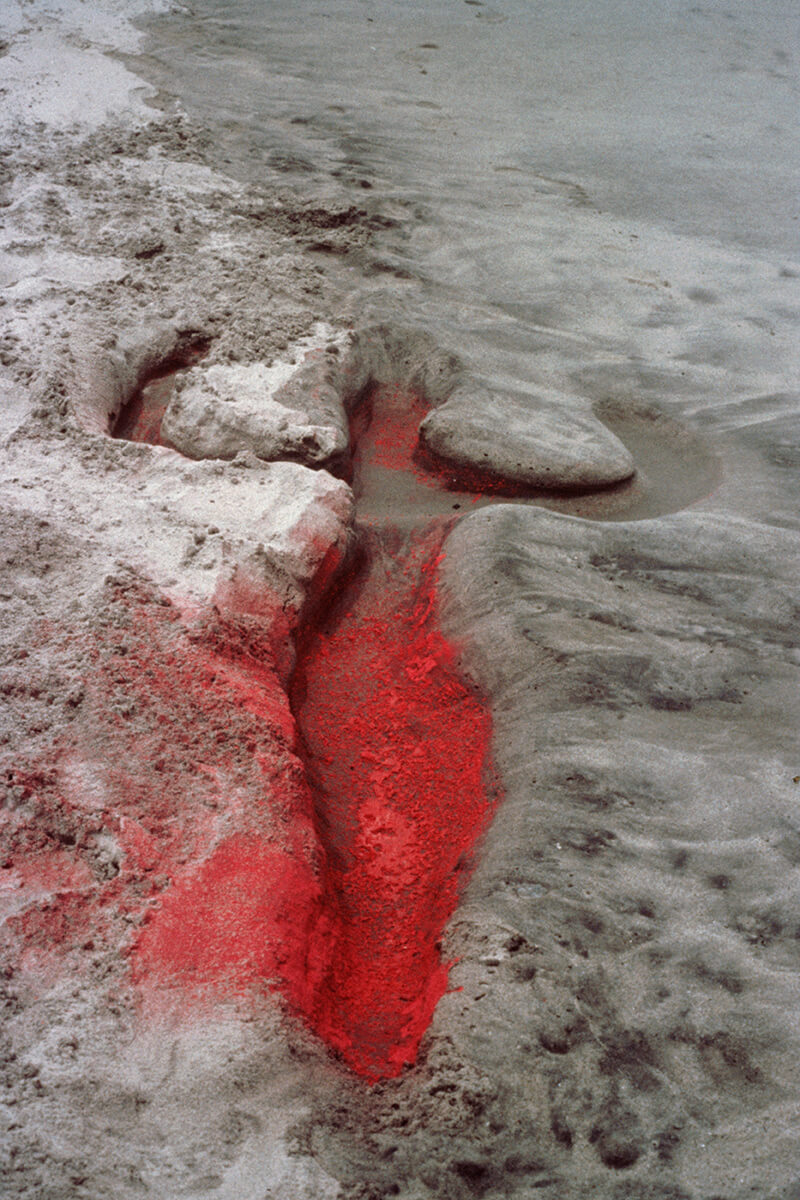
Ana Mendieta is usually introduced through a chain of familiar terms: exile, body, landscape, ritual, belonging.
The account is persuasive, but it can make the work sound more stable than it is. Mendieta’s Siluetas do not simply place the body in nature to recover a lost sense of home. They make the body provisional. The figure appears as an imprint, an interruption, a form already moving toward disappearance. The trace is where presence becomes visible because the body itself is no longer secure.
That tension gives Tate Modern’s exhibition its particular force. Bringing together more than 120 works across performance, photography, film, painting and sculpture, the show follows a practice that moved between media while returning to the same question: what happens to identity when the body becomes a material relation rather than a fixed image? Body becomes outline, outline becomes photograph, photograph becomes memory.
Born in Havana in 1948, Mendieta was sent to the United States with her sister Raquel Mendieta in 1961, at the age of twelve. Exile became inseparable from her practice, but Mendieta translated displacement into a formal problem rather than leaving it at the level of autobiography. In a 1981 statement she described her art as a way of re-establishing “the bonds that unite me to the universe” and as “a return to the maternal source.” Connection became something material: something that could be entered, marked, buried, burned, washed away.
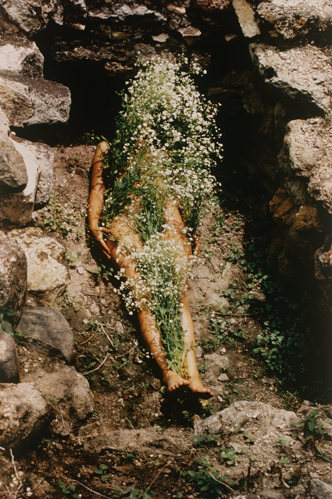
Ana Mendieta, Imágen de Yágul 1973 Copyright The Estate of Ana Mendieta Collection, LLC. Licensed by Artist Right Society (ARS), New York / DACS, 2026 / Courtesy Marian Goodman Gallery and Alison Jacques, London
Imágen de Yágul (1973) is generally regarded as the first work of the Silueta Series. In Labyrinth Blood Imprint (1974), Mendieta made the transition from the body itself to its traced outline particularly explicit. The figure no longer needed to occupy the work for the work to register it.
This also separates Mendieta from the monumental tradition of Land Art. Nancy Spero observed that Mendieta “did not rampage the earth to control or dominate” it or to produce “grandiose monuments of power and authority.” Mendieta relinquishes part of the work to the site itself. Mud collapses, water carries material away, vegetation grows through the figure, fire consumes it. Change belongs to the work.
Richard Long offers a useful comparison. In A Line Made by Walking (1967), a bodily action produces a temporary mark in the landscape, preserved through photography. Mendieta begins from a comparable relationship between gesture, place and documentation, then turns the emphasis inward. Long records where the body has been; Mendieta makes the body’s disappearance the event being recorded.
Bird Run (1974) pushes this instability into performance. Covered in feathers, Mendieta runs along a beach, producing a figure that slips between human and animal. The action is brief; what persists is the film. The camera therefore does more than document an event. It becomes the form through which an action designed to vanish continues to exist.
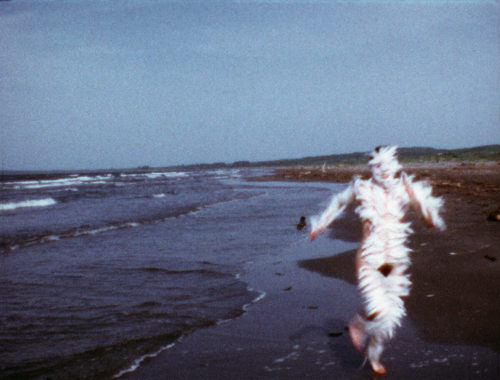
Ana Mendieta, Birdrun 1974 Copyright The Estate of Ana Mendieta Collection, LLC. Licensed by Artist Right Society (ARS), New York / DACS, 2026 / Courtesy Marian Goodman Gallery and Alison Jacques, London
The newly remastered films at Tate make this temporal structure especially apparent.
Documentation gives Mendieta’s ephemeral works duration without giving them permanence. The image survives while the original intervention changes beyond recovery. Tate is consequently exhibiting both the work and the evidence of its disappearance.
By the 1980s, Mendieta increasingly transferred this vocabulary into sculpture. La Jungla (Totem Grove) (1985) carries the human figure into a more durable structure, with dark forms burned into upright tree trunks. The body has become a mark within wood. A form that once disappeared into earth now remains embedded in another material, carrying the memory of the body as physical alteration.
The progression from Imágen de Yágul to Bird Run to La Jungla is therefore less a history of media than a history of where Mendieta allows the body to reside. In the tomb it enters
archaeological time. In performance it becomes metamorphosis. In sculpture it becomes a scar. Identity moves outward, into its surroundings.
This is where the exhibition’s institutional setting becomes significant. Tate Modern is built
around preservation; Mendieta repeatedly made disappearance part of the work’s condition. The museum can conserve the photograph, restore the film and preserve the sculpture, yet it cannot conserve the exact event from which those traces originated. Preservation becomes part of the problem the work poses.
The same tension complicates exile as a search for return. Mendieta’s encounters with earth are often read as attempts to recover an origin lost with Cuba. Yet the Siluetas never reconstruct a homeland. They establish temporary relations with places that remain other than the place from which she was separated. The earth becomes a medium through which belonging can be enacted without becoming possessed.
This is what gives the work its continuing force. Migration, ecological vulnerability and unstable identities are often treated as separate subjects. Mendieta makes them materially inseparable. A displaced body enters a landscape; the landscape alters it; the resulting trace records a relationship that cannot be fixed.
The Silueta captures identity in the process of becoming an imprint, where the body is registered through the trace it leaves behind. Tate can preserve that trace, but the moment of contact between body and place has already passed, and it is precisely this gap between the event and its afterlife that gives Mendieta’s work its particular tension. As the body recedes, what remains is an increasingly vivid sense of its connection to the landscape, as though disappearance itself were what allows that relationship to come fully into view.
Main Image: Ana Mendieta, Untitled: Silueta Series 1976 Copyright The Estate of Ana Mendieta Collection, LLC. Licensed by Artist Right Society (ARS), New York / DACS, 2026 / Courtesy Marian Goodman Gallery and Alison Jacques, London