
Ali Banisadr: The Symphony of Metamorphosis
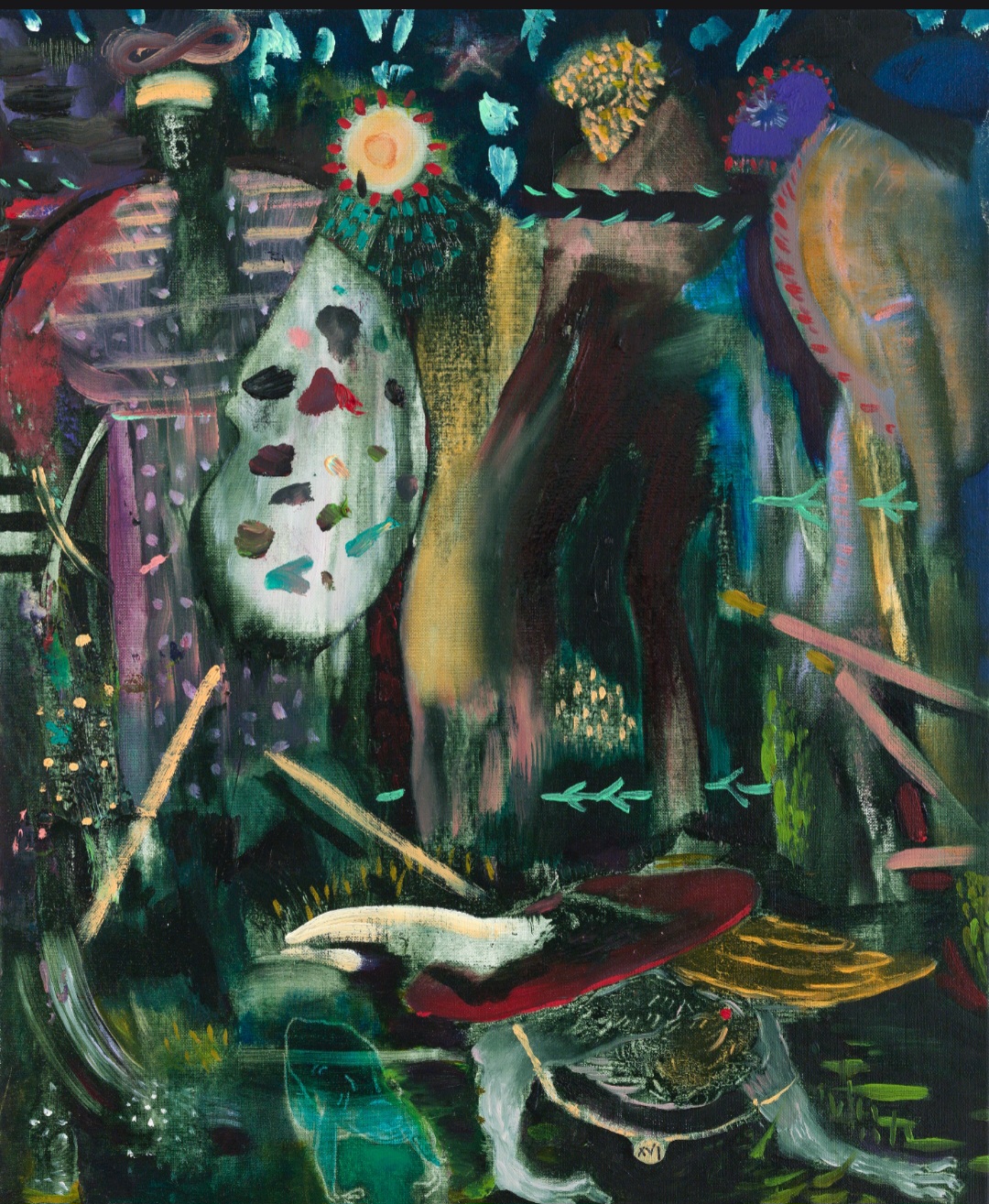
In an age saturated by images, Ali Banisadr’s paintings reaffirm the transformative potential of painting as a space of memory, imagination, and continuous becoming.
Through a complex balance between figuration and abstraction, his practice explores the unstable relationships between personal experience, collective history, and the construction of images.
Born from the intersection of memory and invention, Banisadr’s paintings unfold as intricate visual ecosystems in which forms, colours, and gestures remain in constant movement. His childhood experiences in Tehran during the Iran-Iraq War — which he has often described through fragmented impressions of sounds, images, and sensations — continue to inform a practice in which reality is not reproduced, but reimagined through the processes of perception and transformation.
A central element of Banisadr’s work is his experience of synaesthetic perception, through which sound and colour are perceived as interconnected. This condition becomes a visual language: colour acquires rhythm, brushstrokes suggest movement, and the painted surface becomes a field of simultaneous energies. His compositions emerge through a dialogue between precision and spontaneity, accumulation and erasure, creating images that appear to evolve before the viewer’s eyes.
Banisadr’s visual universe is deeply connected to the history of painting. Drawing from Renaissance masters such as Hieronymus Bosch and Pieter Bruegel, as well as from Surrealism and Abstract Expressionism, he absorbs different artistic traditions into a personal mythology. Historical references, imagined creatures, and contemporary anxieties coexist within compositions that reflect on the instability of identity, memory, and human experience.
Metamorphosis is at the core of his practice. Hybrid figures and shifting forms appear between emergence and disappearance, suggesting a world in which identities, narratives, and realities are constantly transforming. As the artist has described, he seeks the feeling of “things becoming something else” — a condition in which imagination and memory reveal their essential fluidity.
The tension between chaos and harmony defines the architecture of Banisadr’s paintings. Multiple narratives, conflicting energies, and fragmented systems are brought together within compositions where disorder becomes a generative force and painting becomes a space for connection and renewal.
His exhibition "Temple of the Mind" at the Buffalo AKG Art Museum places his work in dialogue with Surrealist and Abstract Expressionist masters, highlighting the broader artistic lineage within which his practice unfolds. The exhibition continues his investigation of painting as a meeting point between inner vision, historical consciousness, and material transformation.
Across his works, Banisadr creates images that resist a single interpretation. They function as visual symphonies where memory, history, and imagination remain in perpetual motion — not simply representing transformation, but becoming a place where transformation itself occurs.
Margherita Artoni (MA): Your paintings often emerge from the intersection of personal memory and collective history. Your childhood experiences in Tehran during the Iran-Iraq War have been described through fragmented impressions of sounds, images, and sensations — memories suspended between abstraction and recognition. How has this relationship between memory and experience shaped your understanding of painting? How does a past event become transformed into an image belonging to the present?
Ali Banisadr (AB):Since I was a child, I have used images to build an internal world in order to understand the external one. My experience of the Iran-Iraq War was fragmented—sound, vibration, flashes of images, things half-seen or half-understood. I think this taught me very early that experience does not enter memory as a complete narrative. It becomes fragments, sensations, images, and sometimes abstractions.
That is still how I think about painting. I am not interested in illustrating a memory or reconstructing an event. I am interested in what happens to an experience once it has passed through memory, time, history, and imagination. By the time it arrives in a painting, it has already become something else. This also connects to my interest in the history and power of images. Images have their own memory. They travel through civilizations, disappear, return, and change meaning.
The past, for me, is never really past. It keeps circulating through the present. I sometimes think of time less as a straight arrow than as something circular or spiral-like. Things return, but they return transformed.
This is very present in my exhibitions Talisman at Thaddaeus Ropac and at the Musée Gustave Moreau. A talisman is itself an image or object carrying memory, belief, protection, and psychic energy across time. The paintings are not trying to revive the past nostalgically. They are asking how certain images continue to live inside us now.
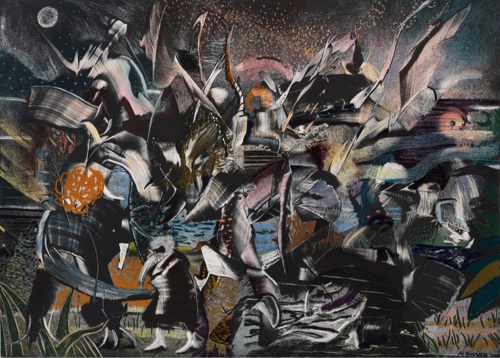
Ali Banisadr, The Moonwatchers 2026, Pastel, Charcoal and ink on paper
MA: Your practice is deeply connected to synaesthetic perception, through which sound and colour are experienced as interconnected. In your paintings, colour, gesture, and form create rhythms and harmonies across the surface. How does this relationship between sound and vision influence your approach to painting? Do you experience the act of painting as a translation of internal sensations into visual structures?
AB: Sound is integral to how I experience the world. Because of my synaesthesia, I do not really experience sound and image as separate things that then need to be translated into one another. Sound already contains colour, temperature, movement, density, distance, vibration.
When I listen to music, I often see an infinite number of parallel worlds of images. Painting works in the other direction as well. As I am painting, I hear the painting. A colour can have a pitch, a brushstroke can have a rhythm, one area can become too loud, another too quiet.
I think of the painting almost as a musical composition. Different areas have different tempos and frequencies. Something may need to repeat, something may need to disappear, something may interrupt the rhythm completely. I am constantly listening for whether all of these different energies belong to the same world.
The ultimate ambition would be to make something like an orchestra: many independent voices operating simultaneously but somehow becoming one composition. This is also one reason I rarely plan a painting in advance. I need to respond to what is happening in real time. Improvisation is essential. I dive into the abyss and begin listening and looking for what comes back.
MA: Your paintings are animated by a powerful sense of movement. Figures, colours, and abstract forms appear to merge and transform, creating complex visual worlds in constant flux. You've spoken about your desire for paintings to create the feeling of 'things becoming something else.' How do you construct this state of metamorphosis? What role do chaos and harmony play in the development of your compositions?
AB: Metamorphosis is probably one of the central conditions of my work. I rarely want a form to become completely fixed. I prefer the moment when you think you recognize something and then it begins becoming something else.
The paintings usually begin through improvisation, without a predetermined image. I establish different energies, movements, temperatures, and rhythms, and slowly forms begin to emerge from this field. A figure may come from a brushstroke, architecture may turn into a body, a cloud may become a creature. I try not to close these transformations too quickly.
Chaos is important because it creates possibilities. But chaos alone is not enough. The painting eventually has to find its own order. I think of that order more like an ecosystem or a musical composition than a conventional composition. Many things can be happening simultaneously—even contradictory things—but there has to be some underlying coherence connecting them.
This idea of transformation is at the center of Talisman. The paintings and sculptures move between human, animal, architectural, natural, mythological, and imaginary states. The natural world is especially important to me because nature is constantly transforming and carrying memory without needing to explain itself.
In “Temple of the Mind” at Buffalo AKG Art Museum, transformation also happens through perception. The exhibition places my work into a larger historical field, where different artists, times, and ways of seeing begin speaking to one another. For me, the mind itself is a kind of metamorphic space.
MA: Your paintings inhabit a space where abstraction and figuration continuously transform into one another. Forms seem to emerge from colour and gesture, revealing images that remain connected to the energy of the surface. Your work also exists in dialogue with the history of painting, from Renaissance masters such as Hieronymus Bosch and Pieter Bruegel to Surrealism and Abstract Expressionism. How does abstraction serve figuration within your practice? Which artists, traditions, or images have shaped your visual language? Are there painters from whom you have “stolen” — in the sense of absorbing their discoveries, internalising them, and transforming them into something entirely your own?
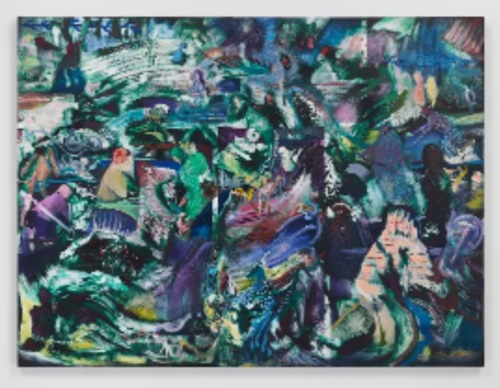
Ali Banisadr, Smoke and Mirrors 2026, Oil on Linen
AB: I have never experienced abstraction and figuration as opposites. Abstraction is actually what allows figuration to appear. I usually begin with movements, colours, rhythms, stains, pressures—things that do not necessarily represent anything. Then I begin recognizing possibilities within them. A figure emerges, but I try to allow it to remain connected to the abstract energy that produced it. If I define it too completely, it dies. Art history works in a similar way for me. I am not interested in quoting particular paintings so much as absorbing different systems of seeing.
Bosch and Bruegel showed me how an image can contain many simultaneous worlds. Persian miniature painting taught me about multiple perspectives and different times existing within one field. Tintoretto and Titian taught me about movement and the instability of the painted image. Goya showed me what painting can do with history, violence, and the irrational. Blake demonstrated that an artist can construct an entire visionary cosmology.
Later there are artists like de Kooning, Ryder, Burchfield, Giacometti, and many others who opened entirely different doors. And then there is Gustave Moreau. The dialogue with his work in the Musée Gustave Moreau for Talisman feels very natural to me because his images are never simply illustrations of mythology, they become psychic spaces—dense
with memory, symbols, ornament, imagination and mystery. So yes, I steal constantly—but hopefully in the older sense of artistic inheritance. I steal discoveries rather than appearances. You absorb something deeply enough that eventually you forget where it came from, and it becomes part of your own vocabulary.
MA: Your paintings often appear as worlds that emerge through a personal process of discovery, yet eventually acquire an existence beyond the artist’s intentions. How do you experience your relationship with your works once they leave the studio? Do you continue to perceive them as part of an ongoing dialogue? How do you relate to their independent journey through collections, museums, and encounters with new audiences?
AB: When I am working on a painting, the relationship is extremely intimate. I spend so much time inside that world that I know its smallest shifts and tensions. But eventually there is a moment when it no longer belongs entirely to me. I actually think that separation is necessary.
Once a painting leaves the studio, other people bring their own memories, histories, fears, desires, and associations to it. Because my paintings are intentionally open and contain many possible points of entry, I am interested in interpretations that I could never have anticipated.
A painting also changes according to where it goes. Seeing a work inside a museum collection can reveal relationships that did not exist in the studio. This has been particularly meaningful with Temple of the Mind at Buffalo AKG Art Museum, where my paintings can enter into conversation with works and histories already living inside the museum.
I sometimes think of paintings as having their own biographies. They travel, they encounter different generations, and their meanings shift with time. That is one of the mysterious things about art. You make an object at one particular moment, but if it survives, it can continue producing experiences long after the conditions that created it have disappeared.
MA: At a moment when images are produced and circulated with unprecedented speed, painting continues to insist on duration, attention, and material presence. What can painting still offer that cannot be reduced to the circulation of images? What possibilities do you believe remain unexplored within the medium?
AB: We are living through an extraordinary proliferation of images. Images appear instantly, circulate instantly, disappear instantly, and are replaced by thousands more. With AI this acceleration has become even more extreme. For me, this does not make painting less relevant. It may actually make painting more necessary.
A painting is not only an image. It is an accumulation of time. You stand in front of an object that contains decisions, mistakes, revisions, hesitation, touch, memory, and duration. Its material existence matters. Walter Benjamin’s idea of aura becomes interesting again in this context—the presence of something that exists here, physically, with its own history.
I am not particularly interested in competing with technology over who can produce the most spectacular image. Machines will become infinitely better at producing images. That is not the question. The more interesting question is: what can an image contain? Can it contain lived experience? Can it carry memory? Can it create a space for contemplation rather than consumption? Can it connect someone living now to an image made five hundred or five thousand years ago? Can it open a channel toward something we do not entirely understand?
This is where Talisman and Temple of the Mind come together for me. A talisman is more than its appearance—it carries accumulated meaning and energy. And a temple of the mind suggests an interior space where images, sounds, memories, history, nature, and imagination can coexist.
I do not believe painting is exhausted because I do not believe perception is exhausted. As long as consciousness continues changing, painting will continue changing with it.
Perhaps “after the image” does not mean that the image has ended. It might mean that, surrounded by endless images, we begin asking again what makes certain images necessary.
Main Image: Ali Banisadr, The Tower, 2026 Oil on Linen