
Why This Photographer Removed His Father From His Family Photos
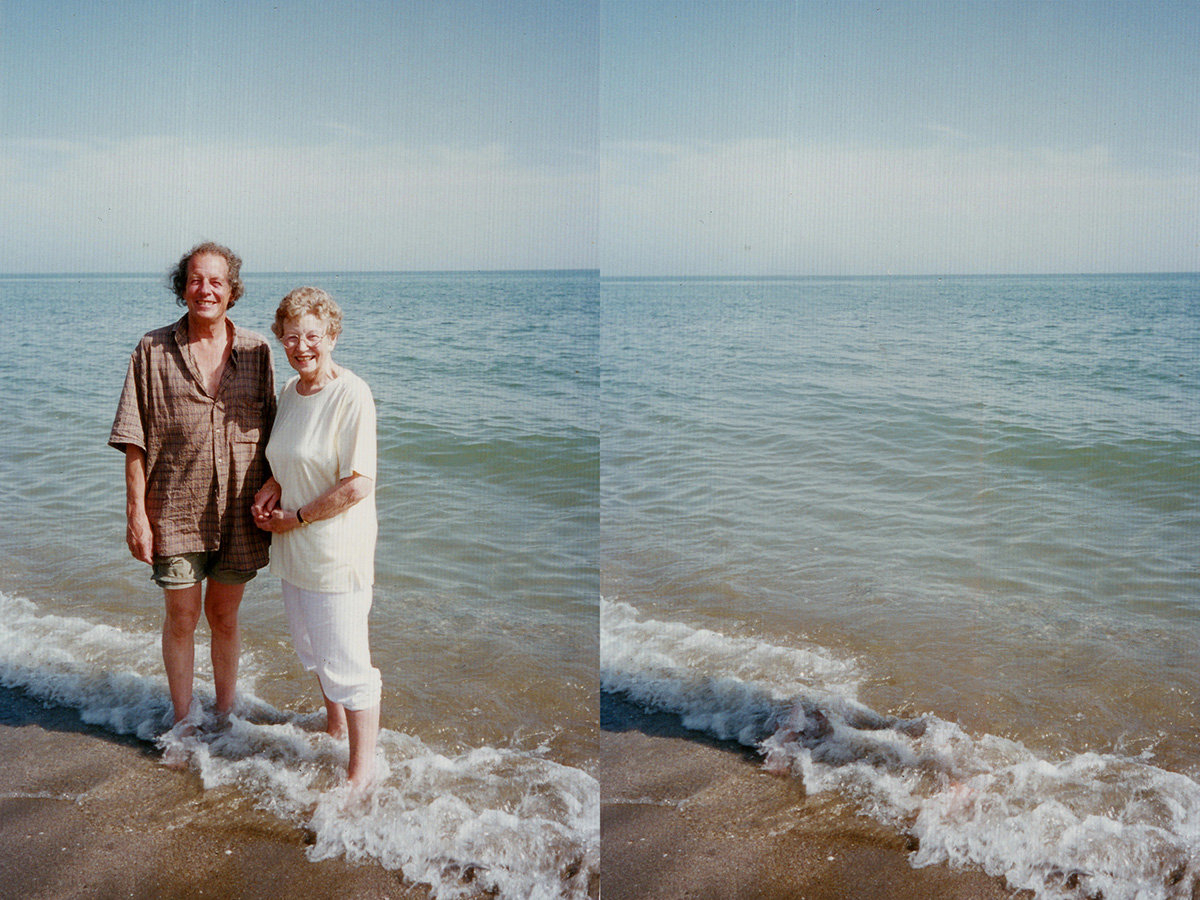
There is a long history of doctoring photographs, routinely altered for political, ideological and personal reasons. Soviet-era retouching famously erased inconvenient figures from history, while countless family albums quietly omitted estranged relatives through scissors, cropping and careful selection.
Erasure, as a photographic gesture, has nearly always been an exercise of power — a rewriting of who gets to be remembered. What makes William Josephs Radford’s Transparent so compelling is that it adopts this same visual language and redirects it towards memory, loss and the fragile evidence of a life.
Transparent is the fifth and final chapter in Radford’s ongoing artistic response to his father’s death, released deliberately on the second anniversary of it. While earlier works explored grief through ritual, colour and abstraction, this concluding series returns to the family archive itself. Radford digitally removes his father from a collection of old photographs, reconstructing each room, beach and doorway as they might have appeared had he never been there. The resulting images do more than depict absence; they invite viewers to consider how photographs continue to carry traces of people who are no longer visible within them.
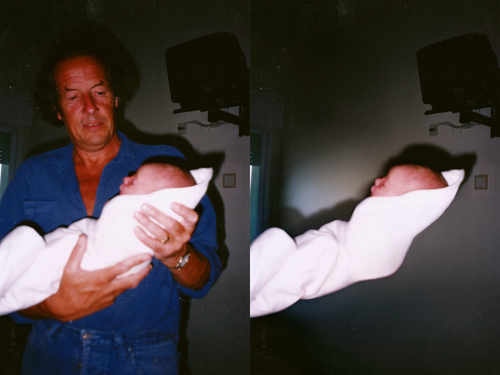
The project inevitably recalls the history of conceptual erasure in twentieth-century art, most notably Robert Rauschenberg’s Erased de Kooning Drawing, where subtraction became the central creative gesture. Radford’s approach carries a different emotional weight — grief rather than experimentation — but shares the underlying proposition that removal can become a productive way of looking, revealing structures of memory that might otherwise remain unnoticed.
This shift is particularly significant given Radford’s previous artistic practice. Known for his commitment to analogue techniques, including flash gels, long exposures and in-camera light painting, he has traditionally favoured the physical processes of image-making over digital manipulation. His decision to spend six months working with Photoshop and generative software therefore feels less like a rejection of those methods than an acknowledgement that this particular project demanded different tools.
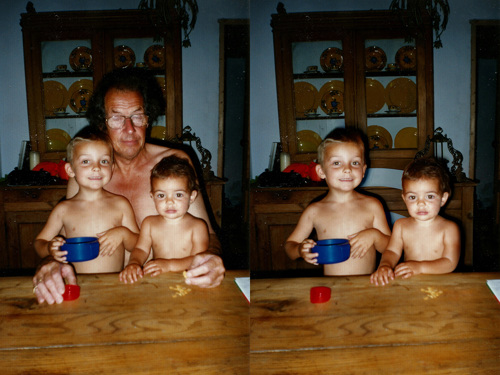
The decision to realise the series as lenticular prints proves central to the work's argument. The format — more often associated with novelty postcards than fine art — creates a physical encounter with appearance and disappearance. Move past one of these prints and the father appears; move again and he is gone. It recalls, in spirit if not method, Idris Khan's layered explorations of accumulation and dissolution, with the viewer's own movement becoming the mechanism through which visibility continually shifts. The effect reinforces the work's interest in memory as something unstable rather than fixed.
The work also enters into conversation with artists who have explored family archives and photographic absence. Diana Markosian’s Father examines the physical void left by a parent removed from family photographs, while Jon Uriarte’s Album similarly manipulates domestic images to question the reliability of photographic memory. There are also connections to artists such as Christian Boltanski, whose installations transform personal archives into reflections on mortality and remembrance, and Sophie Calle, whose work frequently investigates disappearance and emotional traces.
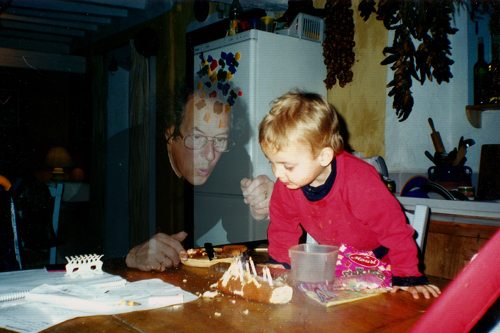
The project also arrives at a moment when photographic truth is undergoing renewed scrutiny. As generative AI increasingly complicates confidence in photographic evidence, Transparent uses similar technologies not to fabricate events but to examine the interpretative nature of family archives. The alterations remain deliberately understated, drawing attention less to digital intervention than to the emotional consequences of removal. Rather than presenting manipulation as deception, the work suggests that photographs have always been partial constructions shaped as much by omission as by what they record.
Ultimately, Transparent proposes that absence itself can become a subject rather than simply a condition. By reconstructing familiar scenes without their central figure, Radford encourages viewers to think not only about loss, but about the ways photographs preserve relationships through spaces, objects and environments as much as through the people they depict. The series asks how memory survives when its most obvious reference point has disappeared, offering an understated meditation on photography's ability to record both presence and its aftermath.