
‘Two Women (Women in the Green)’ by Karl Schmidt-Rottluff re-mains in the Von der Heydt Museum in Wuppertal
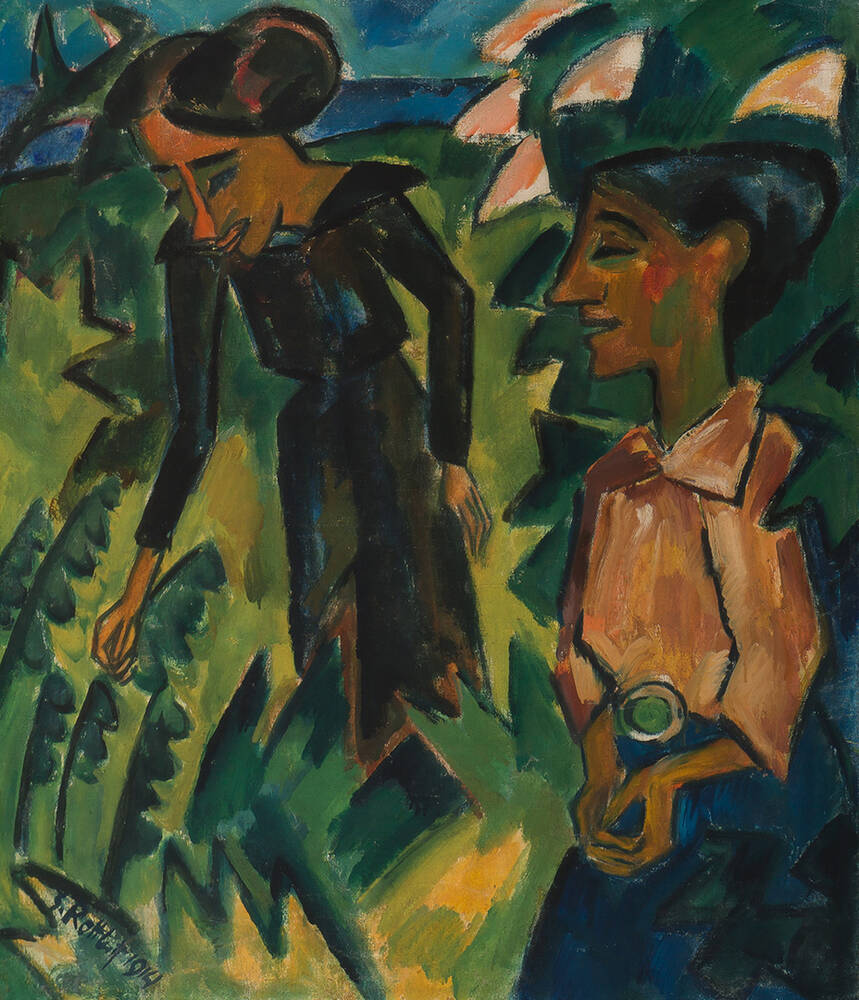
Thanks to an amicable agreement with the heiress of the Hess family, who were persecuted by the National Socialists, a major work from the Von der Heydt Museum can remain in the collection: the painting ‘Two Women (Women in the Green)’ from 1914 by Karl Schmidt-Rottluff.
Schmidt-Rottluff. It was returned and subsequently repurchased with funds from the Freiherr von der Heydt-Stiftung and generous support from the Kulturstiftung der Länder, the Ernst von Siemens Kunststiftung, from the State of North Rhine-Westphalia and the Kunststiftung NRW.
The restitution of the painting was decided by the Wuppertal City Council in a closed session on 16 September 2024. The City of Wuppertal thus commits itself to the ‘Washington Principles’ and acts in accordance with the principles of the Joint Declaration of the Federal Government, the states and the local authority associations on the tracing and return of cultural property confiscated as a result of Nazi persecution, in particular from Jewish owners. The decision was preceded by extensive provenance research conducted by the Von der Heydt Museum over several years and intensive dialogue with the heiress of the Hess family and her legal representatives.
The painting ‘Two Women (Women in the Green)’ by Karl Schmidt-Rottluff belonged to the collection of Erfurt shoe manufacturer and patron Alfred Hess (1879–1931) since at least 1924. Hess's collection was one of the most important private collections of modern art in Germany, comprising more than 4,000 works of art. After the collector's unexpected death in 1931, his son Hans Hess (1908– 1975) inherited the collection. In the years that followed, the collection was looked after by his mother Tekla Hess (1884–1968).
With the appointment of Adolf Hitler as Reich Chancellor and the National Socialists' seizure of power on 30 January 1933, Tekla and Hans Hess were subjected to racial persecution because of their Jewish heritage. Hans Hess lost his job at the Ullstein publishing house in Berlin on 1 June 1933 and emigrated first to France and later to Great Britain. A large part of the art collection – including the painting ‘Two Women (Women in the Green)’ – was transported to Switzerland in the summer of 1933 using free passes for exhibition purposes and subsequently stored there. On 18 March 1937, Tekla Hess arranged for some of the paintings in the deposit to be sent to the Cologne Kunstverein (Art Association), including the painting ‘Two Women (Women in Green)’. There is a gap in the record for the painting until April 1947; its location or movements during this period cannot be verified.
In 1936, the fundamental threat to Tekla Hess posed by the National Socialist regime became more concrete. On 19 February 1936, she reported in a letter to the Kunsthalle Basel that she had been interrogated by the Erfurt Foreign Ex- change Office about her assets stored abroad. In the restitution proceedings in 1958, she testified in an affidavit that the threat from the Gestapo in 1936 had forced her to immediately return the art collection to Germany. In March 1939, Tekla Hess emigrated to London. In the summer of 1947, the Cologne Kunstverein informed the Hess family, upon request, that the stored artworks were no longer available and had probably been destroyed during the Second World War.
At that time, the painting ‘Two Women (Women in the Green)’ was already in the Städtisches Museum Wuppertal, today Von der Heydt-Museum. The museum had acquired it in April 1947 from the Cologne art dealer Aloys Faust. In 1950, some of the paintings from the Hess collection that had been declared destroyed reappeared during a criminal trial against a former employee of the Cologne Kunstverein and a painter from Cologne, and it became known that works of art had been stolen from the Kunstverein's depot during or shortly after the Second World War and sold. Tekla Hess had already been informed about the preserved works of art at the end of 1949.
In 1958, Hans Hess exchanged letters with Harald Seiler, then director of the Wuppertal Museum, about the painting ‘Two Women (Women in Green)’: ‘How this painting ever left our possession has not yet been clarified, but will probably be clarified in due course.’ No further correspondence between the museum and the Hess family from this period has been preserved.
Thanks to the fair and equitable solution that was reached, the Von der Heydt-Museum retains a prominent major work in its collection: the purchase of the painting in April 1947 was programmatic in nature, as it was the first purchase of an Expressionist painting after the end of the Second World War. It thus marked the beginning of efforts to compensate for the losses suffered during the Nazi era as a result of the ‘degenerate art’ confiscation campaign. Immediately after its purchase, the work was exhibited in the first ‘Exhibition of Expression-ist Painting’ in what was then known as the Elberfeld Municipal Museum.
For many decades, ‘Two Women (Women in the Green)’ was the only painting by Karl Schmidt-Rottluff in the Wuppertal collection and thus plays a central role in the museum's high-calibre collection of works by the ‘Brücke’ group of artists. Shown in many monographic and thematic exhibitions worldwide, ‘Two Women (Women in the Green)’ has had a significant influence on both the public's perception of Expressionist art and art historical research.
Main Image: Zwei Frauen (Frauen im Grünen) Schmidt-Rottluff, Karl (1884-1976) | Maler:inÖl auf LeinwandVon der Heydt Museum