
Two Jan van Huysum Masterpieces Come to Auction
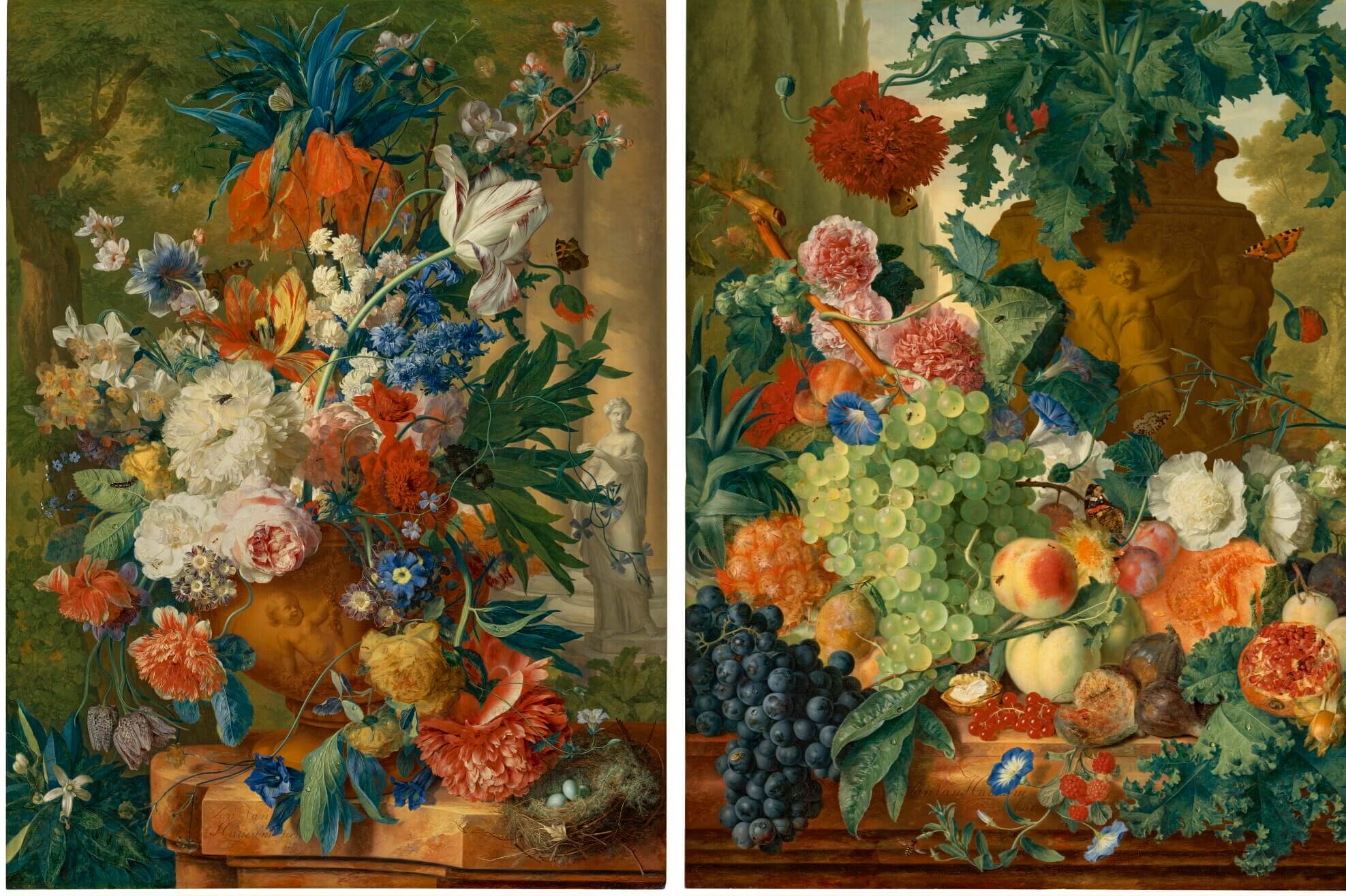
A Vase of Flowers and Fruit with Flowers are the only known large-scale fruit and flower pendants by the peerless still-life painter Jan van Huysum in private hands (estimate: £6,000,000-8,000,000).
These magnificent panels will lead Christie's Old Masters Evening Sale in London on 8 December, during Classic Week. Painted with dazzling skill at the height of the artist's career in the early 1730s, their exceptional quality is matched by distinguished provenance spanning three of the most notable European art collecting dynasties in history: the Landgraves of Hesse-Kassel, the Barings and the Rothschilds. Remarkably, they have remained together since their creation. Part of a private English collection for the last eighty years, the sale of these pictures presents the market with a unique opportunity. The paintings are on tour to New York (until 16 November), ahead of being on public view in London for the pre-sale exhibition (4-8 December).
Andrew Fletcher, Christie's Global Head of the Old Masters Department commented : “In terms of quality, condition and visual impact these are amongst the finest 18th century still lifes I have come across and they perfectly exemplify the refinement and ambition of Van Huysum's mature style. We are thrilled to be handling their sale, following the record prices achieved for the artist earlier this year at Christie's.”
As the genre of still life emerged in its own right, so too did collectors' taste for pendant fruit and flower pieces, uniting two complementary expressions of nature's bounty: the ephemeral splendour of flowers with the rich abundance of fruit. This tradition reached its zenith in such sumptuous pendants by van Huysum, whose meticulous technique, brilliant colouring and sophisticated compositions elevated the genre to new heights. He included an astonishing array of forms, colours and textures. In A Vase of Flowers, a splendid bouquet rises above an elegant terracotta vase, bringing together roses, hyacinths, gentians, peonies, blossom and other flowers in an arrangement that transcends the blooms of a single season; in Fruit with Flowers, peaches, grapes, figs, plums, redcurrants and a pomegranate spill across a marble ledge, before hollyhocks and a terracotta vase of poppies. Such variety provided the artist with an opportunity to display the range of his technical brilliance, from the smooth surfaces of plump grapes, to the velvety, soft skin of the peaches, and the challenging textures of seeds and pulp. Van Huysum's mastery of light animates these pictures, which are both illuminated by an unseen source from the left.
The brief flowering and inevitable decay of fruit and flowers is frequently read as a reflection on the transience of earthly life. Yet in these pendants, van Huysum appears equally intent on celebrating nature's bounty in all its richness, breadth and scale. This spirit is underlined by the animated reliefs that decorate the terracotta vases. In A Vase of Flowers, a putto suspends himself playfully from a garland of flowers, whilst in Fruit with Flowers, three dancing nymphs, perhaps an allusion to the Three Graces, evoke harmony and abundance.
The dates inscribed by the artist reveal a key feature of his famously secretive working method. Both paintings are dated twice: A Vase of Flowers is dated 1731 and 1732, while Fruit with Flowers is dated 1732 and 1733. This is not uncommon in van Huysum's work, and underlines his preference for painting specimens from life, even waiting months for the right flower to bloom so that he could paint it from nature. In order to capture varieties from life, these pictures may have been started in the summer months, when the right flowers were in bloom. Van Huysum likely continued work during the winter months before completing them in the spring or summer of the following year. This laborious process allowed him to observe each flower and fruit at its peak. The resulting compositions are therefore not exact records of a particular time, but carefully orchestrated inventions in which varieties from different seasons are observed from life and 'live' together on the canvas in a harmonious composition.
Whilst many of van Huysum's fruit and flower paintings were not necessarily conceived as pendants, and were only paired up by later collectors, these remarkable works appear to have always remained together in a succession of exceptional collections. They are first recorded in a 1783 inventory of the celebrated Hesse-Kassel collection during the reign of Landgrave Frederick II, possibly acquired by his predecessor and father, Landgrave Wilhelm VIII who formed one of the finest picture collections in pre-revolutionary Europe having spent his youth in the Netherlands, which ignited a lifelong passion for Dutch and Flemish painting. The pre-Kassel history continues to be the subject of debate, on account both of the generic descriptions in eighteenth-century inventories and sale catalogues as well as the artist's penchant for using standard-sized panels. They have traditionally been identified with the pictures acquired from the Counts Zinzendorf und Pottendorf of Vienna in 1762 by the renowned Swiss artist and collector Jean Étienne Liotard (1702-1789). At Kassel, they passed by descent from Frederick II to his eldest son, Wilhelm IX, and remained in the collection until they were seized by French forces in 1806 and gifted to Empress Josephine Bonaparte, who probably took them to Château de Malmaison. Not listed in either the 1811 or 1814 inventories of Malmaison, they were presumably selected as gifts, or sold in untraced sales before 1811.
By the time John Smith published his famous Catalogue of van Huysum's work in 1835, the paintings were recorded in the distinguished collection of banker, politician and connoisseur, Alexander Baring, later 1st Baron Ashburton. They then passed through several generations of the Baring family, before the collection was acquired en bloc in 1907 by Thomas Agnew & Co. and a consortium of other dealers. These pictures were bought by Alfred de Rothschild, scion of another eponymous banking family, who was a formidable connoisseur and collector. Alfred bequeathed Halton House to his nephew, Lionel Nathan de Rothschild (1882-1942), who later sold the property and moved much of the contents – including these paintings – to his own home, Exbury House. Lionel Nathan's passion for botany is well-known from the renowned rhododendron and azalea gardens at the world-famous horticultural estate at Exbury, where the pendants found an especially fitting new home. According to Lionel's probate valuation of April 1942 (Rothschild Archive, London, 000/920), the present paintings were sold to Partridge for £1,250 each, from whom Sir Edward Mountain, the founder of Eagle Star Insurance, purchased them in 1946. These superb pictures have passed by descent in the family ever since.
Main Image: Jan van Huysum (1682–1749) | Left to right: A vase of flowers, including roses, tulips, and a crown imperial, with a bird's nest on a marble ledge, a statue of Flora and columns behind, in a landscape, signed and dated 1731/32 | Fruits, including grapes, peaches, figs and a pineapple, with hollyhocks and poppies in a sculpted vase, in a landscape, signed and dated 1732 and 1733 | oil on panel | the first, 31½ x 23 in. (80 x 59.3 cm.) | the second, 31½ x 23¾ in. (79.9 x 60.3 cm.) | (estimate: £6,000,000-8,000,000)