
TURIST: The Artist Who Paints Our Collective Unease
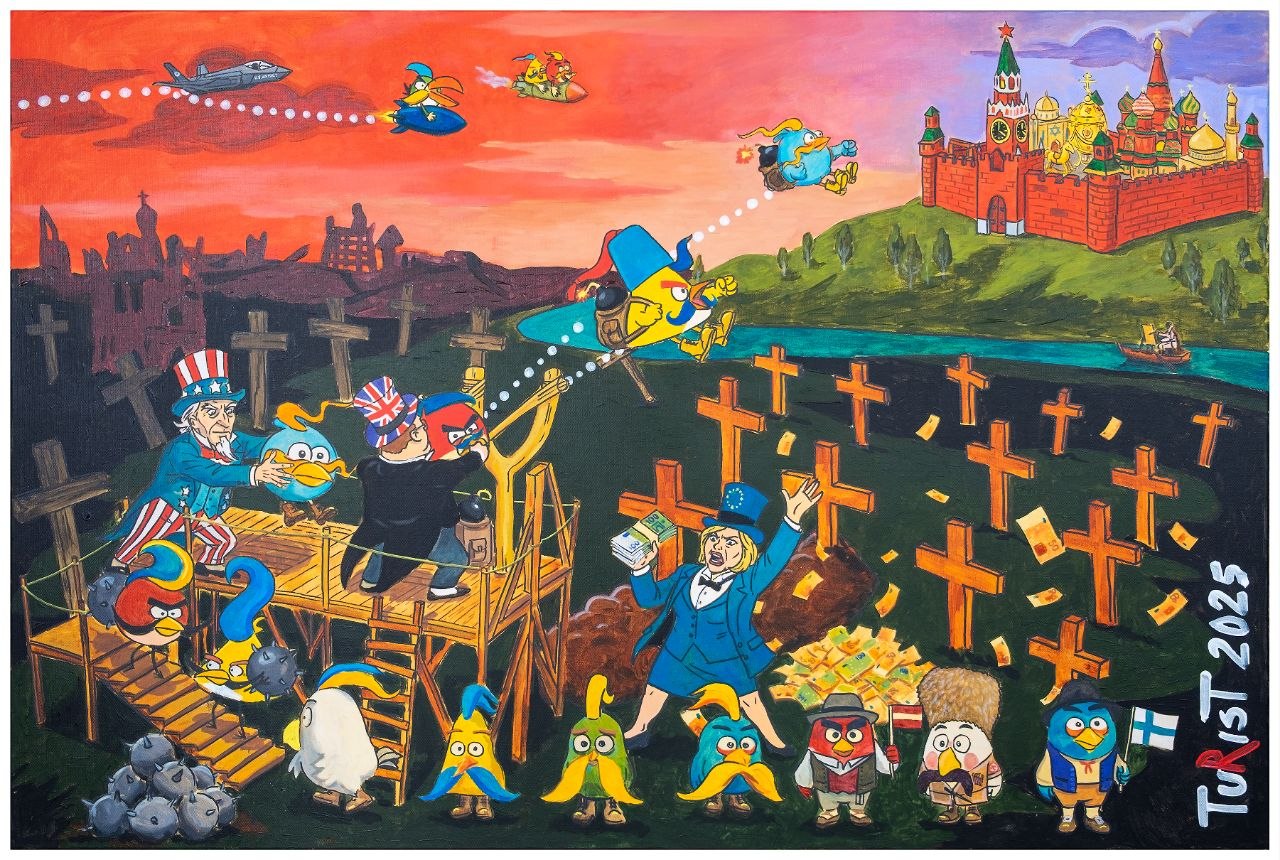
Turist is not your regular artist. One look at works from this artist and it immediately
becomes apparent that there is something urgent to say. There is no ambiguity about
where the message is directed either.
Sometimes the gaze turns towards governments and political institutions, at other times towards capitalism, religion, technological dependency, beauty culture or the collective anxieties that define contemporary life.
Political art is hardly new. Artists have long responded to moments of upheaval, from
the propaganda posters of the twentieth century to contemporary digital activism. Yet
this artist’s practice stands out because of its immediacy. The world is increasingly
characterised by instability. Ideological lines are constantly shifting and old certainties
appear to be dissolving. For these times, these works become visual alarms that force
audiences to confront uncomfortable realities.
Turist is an avid traveller and adopts the pseudonym "Turist" to reflect the role movement and observation play in their creative process. Travelling is a method of
understanding the world, and this is reflected in the artist’s visual expressions.
Informed by experiences across different countries, cultures and political landscapes,
these experiences serve as a knowledge bank of raw material from which the artist’s
visual language evolves.
Turist is also self-taught. This fact perhaps explains some of the unfiltered directness
that characterises the works. Although occasionally experimenting with other mediums
and styles, the core artistic foundation lies in the legacy of the Russian avant-garde
poster tradition, a movement known for bold graphics, political messaging and the
capacity to communicate complex ideas to a broad public. More recently, Turist has
ventured into conceptual art while maintaining the same sense of urgency.
The works are vivid and bursting with colour, often rendered with such realistic effect
that compels viewers to engage regardless of how uncomfortable the encounter may
feel. The discomfort, in fact, is intentional. They are designed to be provocative. This is
particularly evident in works such as Angry Bird. War in Ukraine (2025) and the
Economy of Emotion series (2026), where humour coexists uneasily with tragedy. The
absurdity of contemporary life frequently becomes the subject matter. Global conflicts,
economic precarity, social media dependency and technological obsession are
transformed into visual narratives that oscillate between satire and warning.
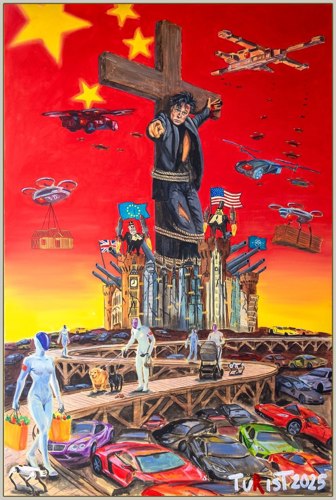
Turist, The Lament of Prophet Elon (2025)
Another striking work is The Lament of Prophet Elon (2025). Here, the internationally
renowned entrepreneur and innovator Elon Musk is depicted in a crucifixion-like pose.
One hand appears nailed to the cross while attention remains fixated on technological
creations. Around the figure, robots, machines and automated systems perform
recognisable human tasks, suggesting a future in which humanity has become
secondary to its own inventions.The work asks: Is Musk a saviour, martyr or architect of humanity's eventual downfall?
The question remains unanswered, leaving viewers to sit with the ambiguity. This tension between reverence and fear lies at the heart of Turist's artistic philosophy.
According to the artist’s manifesto, humanity is currently undergoing several
simultaneous crises: rapid technological acceleration, the erosion of political
institutions, moral uncertainty, escalating global conflicts and demographic change.
These are not isolated concerns but interconnected forces colliding in real time. The
paintings attempt to capture these collisions and render visible what many people
already feel but struggle to articulate.
Beneath the grand narratives of civilisation, war and social collapse is the voice of an
ordinary individual trying to navigate extraordinary times. In Turist's own words, there
is the experience of being a parent raising children, an investor safeguarding savings, a
migrant reconciling multiple identities and a citizen witnessing profound global
transformations unfold in real time. This vulnerability distinguishes the work from
mere propaganda. The paintings emerge not from ideological certainty but from anxiety
itself.
Ultimately, Turist is documenting a civilisation in transition. The canvases become
archives of collective unease, recording humanity at a moment when old systems are
faltering and new ones have yet to be fully formed.
Whether one agrees with this worldview or not is almost secondary. The power of the
work lies in the ability to provoke reflection. Perhaps that is Turist’s greatest
achievement— transforming contemporary fear and unease into something visible.
Main Image: Turist, Angry Birds, War in Ukraine