
The University of Wolverhampton School of Art Building saved from Demolition
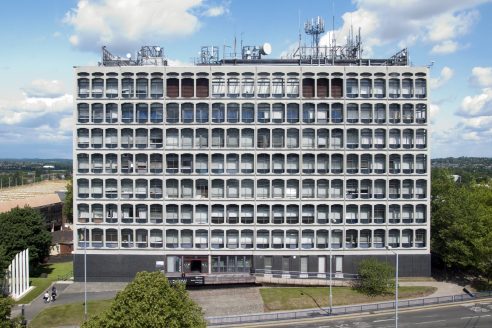
The University of Wolverhampton School of Art building has been granted Grade II listed status by the Department for Culture, Media and Sport (DCMS) on the advice of Historic England.
The School of Art at the University of Wolverhampton, also known as the MK Building, built in a Brutalist style, was designed by Diamond Redfern and Partners in collaboration with the borough architect, and is a striking emblem on the skyline of the city.
Construction began in 1966 and completed in 1969, coinciding with the College of Art merging with the College of Technology to form Wolverhampton Polytechnic.
The 8-storey building has an exo-skeleton of pre-cast modular panels hung from a concrete frame, creating a facade with a striking, sculptural pattern. The concrete panels and the repeated pattern demonstrate the influence that the Pop Art movement, made famous by artists such as Andy Warhol and Roy Lichtenstein, was having on architecture at the time.
Wolverhampton School of Art has a close association with the Blk Art Group. Formed in 1979 and originally named the Pan-Afrikan Connection, many of the founding members were students at the polytechnic, including: Keith Piper, Marlene Smith and 2024 Turner prize nominee Claudette Johnson.
The group sought to empower and raise the profile of Black artists during a period in which racial tensions were common, and Black art, and artists, were under-represented within mainstream art institutions.
Members of the group were largely children of Caribbean migrants, raised in the industrial West Midlands. Their first exhibition, ‘Black Art An’ Done’ was held at Wolverhampton Art Gallery in 1981.
The group organised the First National Black Art Convention in October 1982, held at the College of Art, which is recognised as key to the formation of the British Black arts movement.
Main Image: School of Art, George Wallis Building, University of Wolverhampton, Molineux Street, Wolverhampton. General view of south elevation © Historic England Archive